

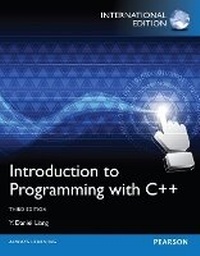
Introduction to Programming with C++
International Edition
3rd Edition
Published on 2. May 2013
Book
Paperback/Softback
720 pages
978-0-273-79324-3 (ISBN)
Description
For undergraduate students in Computer Science and Computer Programming courses A solid foundation in the basics of C++ programming will allow students to create efficient, elegant code ready for any production environment. Learning basic logic and fundamental programming techniques is essential for new programmers to succeed. A distinctive fundamentals-first approach and clear, concise writing style characterize Introduction to Programming with C++, 3/e. Basic programming concepts are introduced on control statements, loops, functions, and arrays before object-oriented programming is discussed. Abstract concepts are carefully and concretely explained using simple, short, and stimulating examples. Explanations are presented in brief segments, with many figures and tables. NEW! This edition is available with MyProgrammingLab, an innovative online homework and assessment tool. Through the power of practice and immediate personalized feedback, MyProgrammingLab helps students fully grasp the logic, semantics, and syntax of programming. Note: If you are purchasing the standalone text or electronic version, MyProgrammingLab does not come automatically packaged with the text.
To purchase MyProgrammingLab, please visit: myprogramminglab.com or you can purchase a package of the physical text + MyProgrammingLab by searching the Pearson Higher Education web site. MyProgrammingLab is not a self-paced technology and should only be purchased when required by an instructor. Teaching and Learning Experience To provide a better teaching and learning experience, for both instructors and students, this program offers: *Fundamentals-First: Basic programming concepts are introduced on control statements, loops, functions, and arrays before object-oriented programming is discussed. *Problem-Driven Motivation: The examples and exercises throughout the book emphasize problem solving and foster the concept of developing reusable components and using them to create practical projects. *Support for Instructors and Students: The author maintains a website at http://www.cs.armstrong.edu/liang/cpp3e that includes multiple interactive resources.
To purchase MyProgrammingLab, please visit: myprogramminglab.com or you can purchase a package of the physical text + MyProgrammingLab by searching the Pearson Higher Education web site. MyProgrammingLab is not a self-paced technology and should only be purchased when required by an instructor. Teaching and Learning Experience To provide a better teaching and learning experience, for both instructors and students, this program offers: *Fundamentals-First: Basic programming concepts are introduced on control statements, loops, functions, and arrays before object-oriented programming is discussed. *Problem-Driven Motivation: The examples and exercises throughout the book emphasize problem solving and foster the concept of developing reusable components and using them to create practical projects. *Support for Instructors and Students: The author maintains a website at http://www.cs.armstrong.edu/liang/cpp3e that includes multiple interactive resources.
More details
Edition
3rd edition
Language
English
Place of publication
Harlow
United Kingdom
Target group
College/higher education
Dimensions
Height: 250 mm
Width: 205 mm
Thickness: 30 mm
Weight
1284 gr
ISBN-13
978-0-273-79324-3 (9780273793243)
Copyright in bibliographic data and cover images is held by Nielsen Book Services Limited or by the publishers or by their respective licensors: all rights reserved.
Schweitzer Classification
Other editions
Additional editions
Y. Daniel Liang
eBook Instant Access - for Introduction to Programming with C++, International Edition
International Edition
E-Book
11/2013
3rd Edition
Pearson
from
€77.59
Available for download
Previous edition
Book
07/2009
2nd Edition
Pearson
€80.46
Article exhausted; check for reprint
Content
Part I Fundamentals of Programming
Chapter 1 Introduction to Computers, Programming, and C++
Chapter 2 Elementary Programming
Chapter 3 Selections
Chapter 4 Mathematical Functions, Characters, and Strings
Chapter 5 Loops
Chapter 6 Functions
Chapter 7 Single-Dimensional Arrays and C-Strings
Chapter 8 Multidimensional Arrays
Part II Object-Oriented Programming
Chapter 9 Objects and Classes
Chapter 10 Object-Oriented Thinking
Chapter 11 Pointers and Dynamic Memory Management
Chapter 12 Templates, Vectors, and Stacks
Chapter 13 File Input and Output
Chapter 14 Operator Overloading
Chapter 15 Inheritance and Polymorphism
Chapter 16 Exception Handling
Part III Data Structures and Advanced Topics
Chapter 17 Recursion
Bonus Chapters
Chapter 18 Developing Efficient Algorithms
Chapter 19 Sorting
Chapter 20 Linked Lists, Queues, and Priority Queues
Chapter 21 Binary Search Trees
Chapter 22 STL Containers
Chapter 23 STL Algorithms
Chapter 24 Graph Applications
Chapter 25 Weighted Graph Applications
Chapter 26 AVL Trees and Splay Trees
Appendixes
Chapters 18-26 are bonus chapters available from http://www.pearsonhighered.com/liang. Login or register under VideoNotes and Web Chapters.
Chapter 1 Introduction to Computers, Programming, and C++
Chapter 2 Elementary Programming
Chapter 3 Selections
Chapter 4 Mathematical Functions, Characters, and Strings
Chapter 5 Loops
Chapter 6 Functions
Chapter 7 Single-Dimensional Arrays and C-Strings
Chapter 8 Multidimensional Arrays
Part II Object-Oriented Programming
Chapter 9 Objects and Classes
Chapter 10 Object-Oriented Thinking
Chapter 11 Pointers and Dynamic Memory Management
Chapter 12 Templates, Vectors, and Stacks
Chapter 13 File Input and Output
Chapter 14 Operator Overloading
Chapter 15 Inheritance and Polymorphism
Chapter 16 Exception Handling
Part III Data Structures and Advanced Topics
Chapter 17 Recursion
Bonus Chapters
Chapter 18 Developing Efficient Algorithms
Chapter 19 Sorting
Chapter 20 Linked Lists, Queues, and Priority Queues
Chapter 21 Binary Search Trees
Chapter 22 STL Containers
Chapter 23 STL Algorithms
Chapter 24 Graph Applications
Chapter 25 Weighted Graph Applications
Chapter 26 AVL Trees and Splay Trees
Appendixes
Chapters 18-26 are bonus chapters available from http://www.pearsonhighered.com/liang. Login or register under VideoNotes and Web Chapters.