

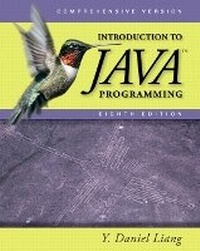
Introduction to Java Programming, Comprehensive
United States Edition
8th Edition
Published on 29. April 2010
Book
Paperback/Softback
1368 pages
978-0-13-213080-6 (ISBN)
Description
Introduction to Java Programming, Comprehensive, 8e, features comprehensive coverage ideal for a one-, two-, or three-semester CS1 course sequence.
Regardless of major, students will be able to grasp concepts of problem-solving and programming - thanks to Liang's fundamentals-first approach, students learn critical problem solving skills and core constructs before object-oriented programming. Liang's approach has been extended to application-rich programming examples, which go beyond the traditional math-based problems found in most texts. Students are introduced to topics like control statements, methods, and arrays before learning to create classes. Later chapters introduce advanced topics including graphical user interface, exception handling, I/O, and data structures. Small, simple examples demonstrate concepts and techniques while longer examples are presented in case studies with overall discussions and thorough line-by-line explanations. Increased data structures chapters make the Eighth Edition ideal for a full course on data structures.
Regardless of major, students will be able to grasp concepts of problem-solving and programming - thanks to Liang's fundamentals-first approach, students learn critical problem solving skills and core constructs before object-oriented programming. Liang's approach has been extended to application-rich programming examples, which go beyond the traditional math-based problems found in most texts. Students are introduced to topics like control statements, methods, and arrays before learning to create classes. Later chapters introduce advanced topics including graphical user interface, exception handling, I/O, and data structures. Small, simple examples demonstrate concepts and techniques while longer examples are presented in case studies with overall discussions and thorough line-by-line explanations. Increased data structures chapters make the Eighth Edition ideal for a full course on data structures.
Reviews / Votes
"All the topics and concepts are clearly explained with examples and tips to remember with side texts." - Syed Riaz Ahmed, North Georgia College and State University"The first, best feature of this text is the rich set of clear example code provided - which are located in concise textual explanations well-suited for the modern undergraduate. In addition, the wide coverage of material makes this book suitable for several courses. For an undergraduate student, it is a true "keeper"." - Frank Ducrest, University of Louisiana - Lafayette
"One book [Liang] for ALL Java courses." - Maureen Opkins, California State University - Long Beach
"The thorough nature of this text [Liang] should be stressed; it has utility as a reference far after the course is over." - Dale Parson, Kutztown University of Pennsylvania
"The interactive and animated online support for this text [Liang] will help students realize how Java syntax evolves into a Java program, which, in turn, executes." - Barbara Guillott, Louisiana State University
More details
Other editions
New editions
Y. Daniel Liang
Introduction to Java Programming, Comprehensive Version plus MyProgrammingLab with Pearson eText -- Access Card Package
Book
11/2012
9th Edition
Pearson
€129.85
Article is exhausted; no reprint
Y. Daniel Liang
Introduction to Java Programming, Comprehensive Version
Book
06/2012
9th Edition
Pearson
€127.50
Article exhausted; check for reprint
Previous edition
Book
09/2008
7th Edition
Pearson
€85.41
Article exhausted; check for reprint
Person
Dr. Liang earned his Ph.D. in Computer Science from the University of Okalahoma in 1991, and an MS and BS in Computer Science from Fudan University in Shanghai, China, in 1986 and 1983. Prior to joining Armstrong, he was an associate professor in computer science at Purdue University in Fort Wayne, where he twice received the Excellence in Research award.
Dr. Liang was trained in theoretical computer science. He was active in graph algorithms from 1990 to 1995 and published more than ten papers in several established journals such as SIAM Journal on Computing, Discrete Applied Mathematics, Acta Informatics, and Information Processing Letters. Since 1996, he has devoted to writing texts and published more than thirty books with Prentice Hall. His popular computer science texts are widely adopted in the world.
Dr. Liang was elected a Java Champion in 2005 by Sun Microsystems. He has given lectures on Java internationally.
Dr. Liang was trained in theoretical computer science. He was active in graph algorithms from 1990 to 1995 and published more than ten papers in several established journals such as SIAM Journal on Computing, Discrete Applied Mathematics, Acta Informatics, and Information Processing Letters. Since 1996, he has devoted to writing texts and published more than thirty books with Prentice Hall. His popular computer science texts are widely adopted in the world.
Dr. Liang was elected a Java Champion in 2005 by Sun Microsystems. He has given lectures on Java internationally.
Content
Chapter 1 Introduction to Computers, Programs, and Java
Chapter 2 Elementary Programming
Chapter 3 Selections
Chapter 4 Loops
Chapter 5 Methods
Chapter 6 Single-Dimensional Arrays
Chapter 7 Multidimensional Arrays
Chapter 8 Objects and Classes
Chapter 9 Strings and Text I/O
Chapter 10 Thinking in Objects
Chapter 11 Inheritance and Polymorphism
Chapter 12 GUI Basics
Chapter 13 Exception Handling
Chapter 14 Abstract Classes and Interfaces
Chapter 15 Graphics
Chapter 16 Event-Driven Programming
Chapter 17 Creating Graphical User Interfaces
Chapter 18 Applets and Multimedia
Chapter 19 Binary I/O
Chapter 20 Recursion
Chapter 21 Generics
Chapter 22 Java Collections Framework
Chapter 23 Algorithm Efficiency
Chapter 24 Sorting
Chapter 25 Lists, Stacks, and Queues, and Priority Queues
Chapter 26 Binary Search Trees
Chapter 27 Graphs and Applications
Chapter 28 Weighted Graphs and Applications
Chapter 29 Multithreading
Chapter 30 Networking
Chapter 31 Internationalization
Chapter 32 JavaBeans and Bean Events
Chapter 33 Containers, Layout Managers, and Borders
Chapter 34 Menus, Toolbars, and Dialogs
Chapter 35 MVC and Swing Models
Chapter 36 JTable and JTree
Chapter 37 Java Database Programming
Chapter 38-48 are bonus chapters on the Web
Chapter 38 Advanced Java Database Programming
Chapter 39 Servlets
Chapter 40 JavaServer Pages
Chapter 41 JSF and Visual Web Development
Chapter 42 Web Services
Chapter 43 Remote Method Invocation
Chapter 44 Java 2D
Chapter 45 AVL Trees and Splay Trees
Chapter 46 2-4 Trees and B-Trees
Chapter 47 Red-Black Trees
Chapter 48 Hashing
Chapter 2 Elementary Programming
Chapter 3 Selections
Chapter 4 Loops
Chapter 5 Methods
Chapter 6 Single-Dimensional Arrays
Chapter 7 Multidimensional Arrays
Chapter 8 Objects and Classes
Chapter 9 Strings and Text I/O
Chapter 10 Thinking in Objects
Chapter 11 Inheritance and Polymorphism
Chapter 12 GUI Basics
Chapter 13 Exception Handling
Chapter 14 Abstract Classes and Interfaces
Chapter 15 Graphics
Chapter 16 Event-Driven Programming
Chapter 17 Creating Graphical User Interfaces
Chapter 18 Applets and Multimedia
Chapter 19 Binary I/O
Chapter 20 Recursion
Chapter 21 Generics
Chapter 22 Java Collections Framework
Chapter 23 Algorithm Efficiency
Chapter 24 Sorting
Chapter 25 Lists, Stacks, and Queues, and Priority Queues
Chapter 26 Binary Search Trees
Chapter 27 Graphs and Applications
Chapter 28 Weighted Graphs and Applications
Chapter 29 Multithreading
Chapter 30 Networking
Chapter 31 Internationalization
Chapter 32 JavaBeans and Bean Events
Chapter 33 Containers, Layout Managers, and Borders
Chapter 34 Menus, Toolbars, and Dialogs
Chapter 35 MVC and Swing Models
Chapter 36 JTable and JTree
Chapter 37 Java Database Programming
Chapter 38-48 are bonus chapters on the Web
Chapter 38 Advanced Java Database Programming
Chapter 39 Servlets
Chapter 40 JavaServer Pages
Chapter 41 JSF and Visual Web Development
Chapter 42 Web Services
Chapter 43 Remote Method Invocation
Chapter 44 Java 2D
Chapter 45 AVL Trees and Splay Trees
Chapter 46 2-4 Trees and B-Trees
Chapter 47 Red-Black Trees
Chapter 48 Hashing