

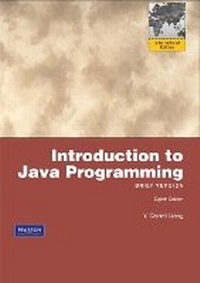
Introduction to Java Programming, Brief
International Edition
8th Edition
Published on 6. May 2010
Book
Paperback/Softback
744 pages
978-0-13-247311-8 (ISBN)
Description
Introduction to Java Programming, Brief, 8e consists of the first 20 chapters from the Comprehensive version of Introduction to Java Programming. It introduces fundamentals of programming, problem-solving, object-oriented programming, and GUI programming. The Brief version is suitable for a CS1 course.
Regardless of major, students will be able to grasp concepts of problem-solving and programming - thanks to Liang's fundamentals-first approach, students learn critical problem solving skills and core constructs before object-oriented programming. Liang's approach includes application-rich programming examples, which go beyond the traditional math-based problems found in most texts. Students are introduced to topics like control statements, methods, and arrays before learning to create classes. Later chapters introduce advanced topics including graphical user interface, exception handling, I/O, and data structures. Small, simple examples demonstrate concepts and techniques while longer examples are presented in case studies with overall discussions and thorough line-by-line explanations. In the Eighth Edition, only standard classes are used.
Regardless of major, students will be able to grasp concepts of problem-solving and programming - thanks to Liang's fundamentals-first approach, students learn critical problem solving skills and core constructs before object-oriented programming. Liang's approach includes application-rich programming examples, which go beyond the traditional math-based problems found in most texts. Students are introduced to topics like control statements, methods, and arrays before learning to create classes. Later chapters introduce advanced topics including graphical user interface, exception handling, I/O, and data structures. Small, simple examples demonstrate concepts and techniques while longer examples are presented in case studies with overall discussions and thorough line-by-line explanations. In the Eighth Edition, only standard classes are used.
Reviews / Votes
"All the topics and concepts are clearly explained with examples and tips to remember with side texts." - Syed Riaz Ahmed, North Georgia College and State University"The first, best feature of this text is the rich set of clear example code provided - which are located in concise textual explanations well-suited for the modern undergraduate. In addition, the wide coverage of material makes this book suitable for several courses. For an undergraduate student, it is a true "keeper"." - Frank Ducrest, University of Louisiana - Lafayette
"One book [Liang] for ALL Java courses." - Maureen Opkins, California State University - Long Beach
"The thorough nature of this text [Liang] should be stressed; it has utility as a reference far after the course is over." - Dale Parson, Kutztown University of Pennsylvania
"The interactive and animated online support for this text [Liang] will help students realize how Java syntax evolves into a Java program, which, in turn, executes." - Barbara Guillott, Louisiana State University
More details
Edition
8th edition
Language
English
Place of publication
United States
Publishing group
Pearson Education (US)
Target group
College/higher education
Dimensions
Height: 253 mm
Width: 211 mm
Thickness: 27 mm
Weight
1330 gr
ISBN-13
978-0-13-247311-8 (9780132473118)
Copyright in bibliographic data is held by Nielsen Book Services Limited or its licensors: all rights reserved.
Schweitzer Classification
Other editions
New editions
Y. Daniel Liang
Introduction to Java Programming, Brief Version
Book
04/2012
9th Edition
Pearson
€108.93
Article exhausted; check for reprint
Previous edition
Book
08/2008
7th Edition
Pearson
€59.41
Article exhausted; check for reprint
Person
Dr. Liang earned his Ph.D. in Computer Science from the University of Okalahoma in 1991, and an MS and BS in Computer Science from Fudan University in Shanghai, China, in 1986 and 1983. Prior to joining Armstrong, he was an associate professor in computer science at Purdue University in Fort Wayne, where he twice received the Excellence in Research award.
Dr. Liang was trained in theoretical computer science. He was active in graph algorithms from 1990 to 1995 and published more than ten papers in several established journals such as SIAM Journal on Computing, Discrete Applied Mathematics, Acta Informatics, and Information Processing Letters. Since 1996, he has devoted to writing texts and published more than thirty books with Prentice Hall. His popular computer science texts are widely adopted in the world.
Dr. Liang was elected a Java Champion in 2005 by Sun Microsystems. He has given lectures on Java internationally.
Dr. Liang was trained in theoretical computer science. He was active in graph algorithms from 1990 to 1995 and published more than ten papers in several established journals such as SIAM Journal on Computing, Discrete Applied Mathematics, Acta Informatics, and Information Processing Letters. Since 1996, he has devoted to writing texts and published more than thirty books with Prentice Hall. His popular computer science texts are widely adopted in the world.
Dr. Liang was elected a Java Champion in 2005 by Sun Microsystems. He has given lectures on Java internationally.
Content
Chapter 1 Introduction to Computers, Programs, and Java
Chapter 2 Elementary Programming
Chapter 3 Selections
Chapter 4 Loops
Chapter 5 Methods
Chapter 6 Single-Dimensional Arrays
Chapter 7 Multidimensional Arrays
Chapter 8 Objects and Classes
Chapter 9 Strings and Text I/O
Chapter 10 Thinking in Objects
Chapter 11 Inheritance and Polymorphism
Chapter 12 GUI Basics
Chapter 13 Exception Handling
Chapter 14 Abstract Classes and Interfaces
Chapter 15 Graphics
Chapter 16 Event-Driven Programming
Chapter 17 Creating Graphical User Interfaces
Chapter 18 Applets and Multimedia
Chapter 19 Binary I/O
Chapter 20 Recursion
Chapter 2 Elementary Programming
Chapter 3 Selections
Chapter 4 Loops
Chapter 5 Methods
Chapter 6 Single-Dimensional Arrays
Chapter 7 Multidimensional Arrays
Chapter 8 Objects and Classes
Chapter 9 Strings and Text I/O
Chapter 10 Thinking in Objects
Chapter 11 Inheritance and Polymorphism
Chapter 12 GUI Basics
Chapter 13 Exception Handling
Chapter 14 Abstract Classes and Interfaces
Chapter 15 Graphics
Chapter 16 Event-Driven Programming
Chapter 17 Creating Graphical User Interfaces
Chapter 18 Applets and Multimedia
Chapter 19 Binary I/O
Chapter 20 Recursion