

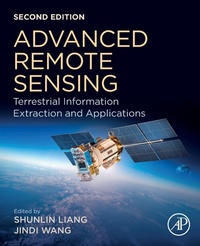
Advanced Remote Sensing
Terrestrial Information Extraction and Applications
2nd Edition
Published on 22. November 2019
Book
Paperback/Softback
1010 pages
978-0-12-815826-5 (ISBN)
Description
Advanced Remote Sensing: Terrestrial Information Extraction and Applications, Second Edition, is a thoroughly updated application-based reference that provides a single source on the mathematical concepts necessary for remote sensing data gathering and assimilation. It presents state-of-the-art techniques for estimating land surface variables from a variety of data types, including optical sensors like RADAR and LIDAR. The book provides scientists in a number of different fields, including geography, geophysics, geology, atmospheric science, environmental science, planetary science and ecology with access to critically-important data extraction techniques and their virtually unlimited applications.
While rigorous enough for the most experienced of scientists, the techniques presented are well designed and integrated, making the book's content intuitive and practical in its implementation.
While rigorous enough for the most experienced of scientists, the techniques presented are well designed and integrated, making the book's content intuitive and practical in its implementation.
More details
Edition
2nd edition
Language
English
Place of publication
San Diego
United States
Publishing group
Elsevier Science Publishing Co Inc
Target group
College/higher education
Researchers and students in remote sensing, geophysics, geology, geography, planetary science, environmental science
Product notice
Paperback (trade)
Dimensions
Height: 235 mm
Width: 191 mm
Thickness: 51 mm
Weight
1702 gr
ISBN-13
978-0-12-815826-5 (9780128158265)
Copyright in bibliographic data and cover images is held by Nielsen Book Services Limited or by the publishers or by their respective licensors: all rights reserved.
Schweitzer Classification
Other editions
Additional editions
Shunlin Liang | Jindi Wang
Advanced Remote Sensing
Terrestrial Information Extraction and Applications
E-Book
11/2019
2nd Edition
Academic Press
€160.00
Available for download
Previous edition
Shunlin Liang | Xiaowen Li | Jindi Wang
Advanced Remote Sensing
Terrestrial Information Extraction and Applications
Book
08/2012
Academic Press
€138.50
Shipment within 15-20 days
Persons
Dr. Liang received his Ph.D. from Boston University in 1993. He is a Chair Professor in the Department of Geography at the University of Hong Kong. He has published over 490 SCI journal papers, 43 book chapters, and ten special issues of various journals. He has authored/edited eight books, five of which have been translated into Chinese. Dr. Liang is a Fellow of the IEEE and AAAS, and a Global STEM Professor. He serves as an Editor-in-Chief of the Science of Remote Sensing journal.
Dr. Liang led the development of the Global LAnd Surface Satellite (GLASS) products, freely available at awww.glass.hku.hk and www.geodata.cn. He is also leading to develop the high-resolution (30 m) version of GLASS (Hi-GLASS) products. His Google Scholar H-index is 107, with over 46,000 citations. Clarivate recognizes him as a Highly Cited Researcher, placing him among the top 0.1% of scientists globally.
Prof. Wang graduated from Beijing University of Postal and Telecommunications, and received the B.S degree in Electronic Engineering in 1982. She is currently professor of the Research Center for Remote Sensing and GIS of Beijing Normal University. Prof. Wang hosted a number of research projects on remote sensing modeling and validation, land surface parameters retrieval, typical land object's spectrum database establishment, dynamic feature analysis and modeling of remote sensing information, supported by the National Basic Research Program of China, the National High Technology Research and Development Program of China, the National Natural Science Foundation of China.
Dr. Liang led the development of the Global LAnd Surface Satellite (GLASS) products, freely available at awww.glass.hku.hk and www.geodata.cn. He is also leading to develop the high-resolution (30 m) version of GLASS (Hi-GLASS) products. His Google Scholar H-index is 107, with over 46,000 citations. Clarivate recognizes him as a Highly Cited Researcher, placing him among the top 0.1% of scientists globally.
Prof. Wang graduated from Beijing University of Postal and Telecommunications, and received the B.S degree in Electronic Engineering in 1982. She is currently professor of the Research Center for Remote Sensing and GIS of Beijing Normal University. Prof. Wang hosted a number of research projects on remote sensing modeling and validation, land surface parameters retrieval, typical land object's spectrum database establishment, dynamic feature analysis and modeling of remote sensing information, supported by the National Basic Research Program of China, the National High Technology Research and Development Program of China, the National Natural Science Foundation of China.
Content
1. A Systematic View of Remote Sensing
2. Geometric Processing and Positioning Techniques
3. Compositing, Smoothing, and Gap-filling Techniques
4. Data Fusion
5. Atmospheric Correction of Optical Imagery
6. Solar Radiation
7. Broadband Albedo
8. Land-Surface Temperature and Thermal Infrared Emissivity
9. Surface Longwave Radiation Budget
10. Canopy Biochemical Characteristics
11. Leaf Area Index
12. Fraction of Absorbed Photosynthetically Active Radiation by Green Vegetation
13. Fractional Vegetation Cover
14. Vegetation Height and Vertical Structure
15. Above-ground Biomass
16. Vegetation Production in Terrestrial Ecosystems
17. Precipitation
18. Terrestrial Evapotranspiration
19. Soil Moisture Content
20. Snow Water Equivalence
21. Water Storage
22. High-level Land Product Integration Methods
23. Production Data Management Systems
24. Land Cover and Land Use Changes
2. Geometric Processing and Positioning Techniques
3. Compositing, Smoothing, and Gap-filling Techniques
4. Data Fusion
5. Atmospheric Correction of Optical Imagery
6. Solar Radiation
7. Broadband Albedo
8. Land-Surface Temperature and Thermal Infrared Emissivity
9. Surface Longwave Radiation Budget
10. Canopy Biochemical Characteristics
11. Leaf Area Index
12. Fraction of Absorbed Photosynthetically Active Radiation by Green Vegetation
13. Fractional Vegetation Cover
14. Vegetation Height and Vertical Structure
15. Above-ground Biomass
16. Vegetation Production in Terrestrial Ecosystems
17. Precipitation
18. Terrestrial Evapotranspiration
19. Soil Moisture Content
20. Snow Water Equivalence
21. Water Storage
22. High-level Land Product Integration Methods
23. Production Data Management Systems
24. Land Cover and Land Use Changes