

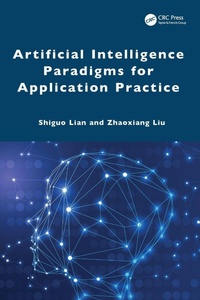
Artificial Intelligence Paradigms for Application Practice
1st Edition
Published on 14. August 2025
Book
Hardback
191 pages
978-1-041-08226-2 (ISBN)
Description
This book proposes practical application paradigms for deep neural networks, aiming to establish best practices for real-world implementation.
Over the past decade, deep neural networks have made significant progress. However, effectively applying these networks to solve various practical problems remains challenging, which has limited the widespread application of artificial intelligence. Artificial Intelligence Paradigms for Application Practice is the first to comprehensively address implementation paradigms for deep neural networks in practice. The authors begin by reviewing the development of artificial neural networks and provide a systematic introduction to the tasks, principles, and architectures of deep neural networks. They identify the practical limitations of deep neural networks and propose guidelines and strategies for successful implementation. The book then examines 14 representative applications in urban planning, industrial production, and transportation. For each case, the authors present a landing paradigm that effectively addresses practical challenges supported by illustrations, background information, related work, methods, experiments, and conclusions. The experimental results validate the effectiveness of the proposed implementation approaches.
The book will benefit researchers, engineers, undergraduate, and graduate students interested in artificial intelligence, deep neural networks, large models, stable diffusion models, video surveillance, smart cities, intelligent manufacturing, intelligent transportation, and other related areas.
Over the past decade, deep neural networks have made significant progress. However, effectively applying these networks to solve various practical problems remains challenging, which has limited the widespread application of artificial intelligence. Artificial Intelligence Paradigms for Application Practice is the first to comprehensively address implementation paradigms for deep neural networks in practice. The authors begin by reviewing the development of artificial neural networks and provide a systematic introduction to the tasks, principles, and architectures of deep neural networks. They identify the practical limitations of deep neural networks and propose guidelines and strategies for successful implementation. The book then examines 14 representative applications in urban planning, industrial production, and transportation. For each case, the authors present a landing paradigm that effectively addresses practical challenges supported by illustrations, background information, related work, methods, experiments, and conclusions. The experimental results validate the effectiveness of the proposed implementation approaches.
The book will benefit researchers, engineers, undergraduate, and graduate students interested in artificial intelligence, deep neural networks, large models, stable diffusion models, video surveillance, smart cities, intelligent manufacturing, intelligent transportation, and other related areas.
More details
Language
English
Place of publication
London
United Kingdom
Publishing group
Taylor & Francis Ltd
Target group
College/higher education
Professional and scholarly
Academic, Postgraduate, Professional Reference, Undergraduate Advanced, and Undergraduate Core
Illustrations
99 s/w Abbildungen, 57 s/w Photographien bzw. Rasterbilder, 42 s/w Zeichnungen, 18 s/w Tabellen
18 Tables, black and white; 42 Line drawings, black and white; 57 Halftones, black and white; 99 Illustrations, black and white
Dimensions
Height: 260 mm
Width: 183 mm
Thickness: 16 mm
Weight
592 gr
ISBN-13
978-1-041-08226-2 (9781041082262)
Copyright in bibliographic data and cover images is held by Nielsen Book Services Limited or by the publishers or by their respective licensors: all rights reserved.
Schweitzer Classification
Other editions
Additional editions
Shiguo Lian | Zhaoxiang Liu
Artificial Intelligence Paradigms for Application Practice
E-Book
08/2025
CRC Press
€90.99
Available for download
Shiguo Lian | Zhaoxiang Liu
Artificial Intelligence Paradigms for Application Practice
E-Book
08/2025
CRC Press
€90.99
Available for download
Persons
Shiguo Lian received his Ph.D. from Nanjing University of Science and Technology, China. He currently serves as Chief Scientist at the Data Science & Artificial Intelligence Research Institute and Chief Engineer of AI Technology, China Unicom. He is a member of the IEEE Multimedia Communications and Computational Intelligence Technical Committees. His research focuses on visual recognition, multimodal large models, robotics, and multimodal interactions.
Zhaoxiang Liu received his Ph.D. from the College of Information and Electrical Engineering at China Agricultural University, China. He currently serves as Director of AI Research at the Data Science & Artificial Intelligence Research Institute, China Unicom. His research interests include artificial intelligence, large language models, multimodal large models, deep learning, computer vision, and embodied AI.
Zhaoxiang Liu received his Ph.D. from the College of Information and Electrical Engineering at China Agricultural University, China. He currently serves as Director of AI Research at the Data Science & Artificial Intelligence Research Institute, China Unicom. His research interests include artificial intelligence, large language models, multimodal large models, deep learning, computer vision, and embodied AI.
Content
1. Introduction to Artificial Intelligence for Practical Application 2. Fine-grained Dataset Design Paradigm for Mask-Wearing Recognition 3. Hand-Held Action Detection Paradigm for Smoking Detection 4. Human Action Recognition Paradigm for Person Safety Supervision in Various Practical Scenarios 5. Person Counting Paradigm for Intelligent Video Surveillance in Various Practical Scenarios 6. Operation Procedure Detection Paradigm for Noncompliant Operations Detection of Oil Unloading 7. Object Measurement Paradigm for Length Measurement of Iron Chains 8. Quality Estimation Paradigm for Copper Scrap Granules Recycling 9. Human-in-the-Loop Learning Paradigm for Fabric Anomaly Detection 10. Supervised Learning Paradigm for Edible Oil Anomaly Detection 11. Unsupervised Learning Paradigm for Industrial Visual Anomaly Detection 12. Object Identity Recognition Paradigm for Fishing Boat Recognition 13. Image Editing Paradigm for Clothing Fashion Customization 14. Retrieval-Augmented Generation Paradigm for Professional Knowledge Acquisition Applications 15. Multimodal Generation Paradigm for Visualizing Historical Artifacts