

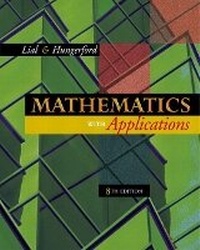
Mathematics with Applications
8th Edition
Published on 9. August 2002
Book
Hardback
936 pages
978-0-201-75529-9 (ISBN)
Description
Best known for realistic and varied applications, an abundance of helpful pedagogy, and solid algebra review, the new edition of this text offers updated and new applications, and increased optional graphing calculator technology. - NEW! New full color design is used pedagogically for clearer understanding of figures and concepts. - NEW! MyMathLab is now available for this text for the first time. All of the texts many electronic resources can be found on MyMathLab. - NEW! MathXL is now available for the text, allowing students to take tests and quizzes online. - NEW! A Finite Version of the text is now available, which includes Chapters 1-10. - Applications. A wide variety of realistic and timely applications are featured, both in text examples and problem sets. Many are based on real data cited from journals and periodicals. Application problems are labeled by subject: management, social science, natural science, or physical science. An Index of Applications groups applications by these categories. - Case Studies. Chapter-ending case studies based on real data give students the opportunity to further apply all theyve learned in the chapter. - Technology Tips.
For those who choose to use graphing technology, Technology Tips inform students of various features on their graphing calculators and give specific directions for accessing them. - Graphing Calculator Program Appendix now available for those who choose to use graphing calculators. Appendix includes two types of programs: those that do tasks discussed in the text, and those that update functions in older model calculators. - Margin Exercises allow students to get immediate feedback on their understanding of the material. - Writing and conceptual exercises promote critical thinking and deeper understanding of the mathematics. - Connection Exercises require students to call on material studied in earlier sections. - A flexible organization allows instructors to pick and choose the topics they would like to cover.
For those who choose to use graphing technology, Technology Tips inform students of various features on their graphing calculators and give specific directions for accessing them. - Graphing Calculator Program Appendix now available for those who choose to use graphing calculators. Appendix includes two types of programs: those that do tasks discussed in the text, and those that update functions in older model calculators. - Margin Exercises allow students to get immediate feedback on their understanding of the material. - Writing and conceptual exercises promote critical thinking and deeper understanding of the mathematics. - Connection Exercises require students to call on material studied in earlier sections. - A flexible organization allows instructors to pick and choose the topics they would like to cover.
More details
Edition
8th edition
Language
English
Place of publication
United States
Publishing group
Pearson Education (US)
Target group
Professional and scholarly
Dimensions
Height: 260 mm
Width: 262 mm
Thickness: 34 mm
Weight
1831 gr
ISBN-13
978-0-201-75529-9 (9780201755299)
Copyright in bibliographic data and cover images is held by Nielsen Book Services Limited or by the publishers or by their respective licensors: all rights reserved.
Schweitzer Classification
Other editions
New editions
Margaret L. Lial | Thomas W. Hungerford | John P. Holcomb
Mathematics with Applications
International Edition
Book
04/2006
9th Edition
Pearson
€66.84
Article exhausted; check for reprint
Previous edition

Lial | HUNGERFORD
Mathematics with Applications
Book
09/1998
7th Edition
Pearson
€64.36
Article exhausted; check for reprint
Persons
Marge Lial was always interested in math; it was her favorite subject in the first grade! Marge's intense desire to educate both her students and herself has inspired the writing of numerous best-selling textbooks. Marge, who received Bachelor's and Master's degrees from California State University at Sacramento, is now affiliated with American River College.
Marge is an avid reader and traveler. Her travel experiences often find their way into her books as applications, exercise sets, and feature sets. She is particularly interested in archeology. Trips to various digs and ruin sites have produced some fascinating problems for her textbooks involving such topics as the building of Mayan pyramids and the acoustics of ancient ball courts in the Yucatan.
Thomas W. Hungerford received his bachelor?s degree from Holy Cross and his Ph.D. from the University of Chicago. He taught for seventeen years at the University of Washington (Seattle) before coming to Cleveland State University, where is he is professor of mathematics. He has written a number of research articles in algebra and several in mathematics education. Dr. Hungerford is the author or co-author of more than a dozen mathematics textbooks, ranging from high school to graduate level, several of which are published by Addison-Wesley. He is active in promoting the use of technology in mathematics instruction and was one of the founders of the Cleveland Collaborative for Mathematics Education (C2ME), an ongoing project involving local universities, businesses, and mathematics teachers. Dr. Hungerford is also a referee and reviewer for various mathematical journals and has frequently served on National Science Foundation panels for selecting grant recipients.
Marge is an avid reader and traveler. Her travel experiences often find their way into her books as applications, exercise sets, and feature sets. She is particularly interested in archeology. Trips to various digs and ruin sites have produced some fascinating problems for her textbooks involving such topics as the building of Mayan pyramids and the acoustics of ancient ball courts in the Yucatan.
Thomas W. Hungerford received his bachelor?s degree from Holy Cross and his Ph.D. from the University of Chicago. He taught for seventeen years at the University of Washington (Seattle) before coming to Cleveland State University, where is he is professor of mathematics. He has written a number of research articles in algebra and several in mathematics education. Dr. Hungerford is the author or co-author of more than a dozen mathematics textbooks, ranging from high school to graduate level, several of which are published by Addison-Wesley. He is active in promoting the use of technology in mathematics instruction and was one of the founders of the Cleveland Collaborative for Mathematics Education (C2ME), an ongoing project involving local universities, businesses, and mathematics teachers. Dr. Hungerford is also a referee and reviewer for various mathematical journals and has frequently served on National Science Foundation panels for selecting grant recipients.
Content
(Chapter Summary and Review Exercises appear at the end of each chapter.)
1. Algebra and Equations.
The Real Numbers.
Polynomials.
Factoring.
Rational Expressions.
Exponents and Radicals.
First-degree Equations.
Quadratic Equations.
2. Graphs, Lines, and Inequalities.
Graphs.
Equations of Lines.
Linear Models (new section).
Linear Inequalities.
Polynomial and Rational Inequalities.
3. Functions and Graphs.
Functions.
Graphs of Functions.
Applications of Linear Functions.
Quadratic Functions.
Applications of Quadratic Functions.
Polynomial Functions (including polynomial regression models).
Rational Functions.
4. Exponential and Logarithmic Functions.
Exponential Functions.
Applications of Exponential Functions (including exponential regression models).
Logarithmic Functions.
Logarithmic and Exponential Functions.
5. Mathematics of Finance.
Simple Interest and Discount.
Compound Interest.
Future Value of an Annuity and Sinking Funds.
Present Value of an Annuity and Amortization.
6. Systems of Linear Equations and Matrices.
Systems of Linear Equations.
The Gauss-Jordan Method.
Basic Matrix Operations.
Matrix Products and Inverses.
Applications of Matrices.
7. Linear Programming.
Graphing Linear Inequalities in Two Variables.
Linear Programming: The Graphical Method.
Applications of Linear Programming.
The Simplex Method: Maximization.
Maximization Applications.
The Simplex Method: Duality and Minimization.
The Simplex Method: Nonstandard Problems.
8. Sets and Probability.
Sets.
Applications of Venn Diagrams.
Introduction to Probability.
Basic Concepts of Probability.
Conditional Probability and Independent Events.
Bayes' Formula.
9. Counting, Probability, Distributions, and Further Topics in Probability.
Permutations and Combinations.
Applications of Counting.
Binomial Probability.
Probability Distributions and Expected Value.
Markov Chains.
Decision Making.
10. Introduction to Statistics.
Frequency Distributions and Measures of Central Tendency.
Measures of Variation.
Normal Distributions.
Normal Approximation to the Binomial Distribution.
11. Differential Calculus.
Limits.
Rates of Change.
Tangent Lines and Derivative.
Techniques for Finding Derivatives.
Derivatives of Products and Quotients.
The Chain Rule.
Derivatives of Exponential and Logarithmic Functions.
Continuity and Differentiability.
12. Applications of the Derivative.
Derivatives and Graphs.
The Second Derivative.
Optimization Applications.
Curve Sketching.
13. Integral Calculus.
Antideriviatives.
Integration by Substitution.
Area and the Definite Integral.
The Fundamental Theorem of Calculus.
Applications of Integrals.
Tables of Integrals (Optional).
Differential Equations.
14. Multivariate Calculus.
Functions of Several Variables.
Partial Derivatives.
Extrema of Functions of Several Variables.
Appendix A: Graphing Calculators.
Appendix B: Tables.
1. Algebra and Equations.
The Real Numbers.
Polynomials.
Factoring.
Rational Expressions.
Exponents and Radicals.
First-degree Equations.
Quadratic Equations.
2. Graphs, Lines, and Inequalities.
Graphs.
Equations of Lines.
Linear Models (new section).
Linear Inequalities.
Polynomial and Rational Inequalities.
3. Functions and Graphs.
Functions.
Graphs of Functions.
Applications of Linear Functions.
Quadratic Functions.
Applications of Quadratic Functions.
Polynomial Functions (including polynomial regression models).
Rational Functions.
4. Exponential and Logarithmic Functions.
Exponential Functions.
Applications of Exponential Functions (including exponential regression models).
Logarithmic Functions.
Logarithmic and Exponential Functions.
5. Mathematics of Finance.
Simple Interest and Discount.
Compound Interest.
Future Value of an Annuity and Sinking Funds.
Present Value of an Annuity and Amortization.
6. Systems of Linear Equations and Matrices.
Systems of Linear Equations.
The Gauss-Jordan Method.
Basic Matrix Operations.
Matrix Products and Inverses.
Applications of Matrices.
7. Linear Programming.
Graphing Linear Inequalities in Two Variables.
Linear Programming: The Graphical Method.
Applications of Linear Programming.
The Simplex Method: Maximization.
Maximization Applications.
The Simplex Method: Duality and Minimization.
The Simplex Method: Nonstandard Problems.
8. Sets and Probability.
Sets.
Applications of Venn Diagrams.
Introduction to Probability.
Basic Concepts of Probability.
Conditional Probability and Independent Events.
Bayes' Formula.
9. Counting, Probability, Distributions, and Further Topics in Probability.
Permutations and Combinations.
Applications of Counting.
Binomial Probability.
Probability Distributions and Expected Value.
Markov Chains.
Decision Making.
10. Introduction to Statistics.
Frequency Distributions and Measures of Central Tendency.
Measures of Variation.
Normal Distributions.
Normal Approximation to the Binomial Distribution.
11. Differential Calculus.
Limits.
Rates of Change.
Tangent Lines and Derivative.
Techniques for Finding Derivatives.
Derivatives of Products and Quotients.
The Chain Rule.
Derivatives of Exponential and Logarithmic Functions.
Continuity and Differentiability.
12. Applications of the Derivative.
Derivatives and Graphs.
The Second Derivative.
Optimization Applications.
Curve Sketching.
13. Integral Calculus.
Antideriviatives.
Integration by Substitution.
Area and the Definite Integral.
The Fundamental Theorem of Calculus.
Applications of Integrals.
Tables of Integrals (Optional).
Differential Equations.
14. Multivariate Calculus.
Functions of Several Variables.
Partial Derivatives.
Extrema of Functions of Several Variables.
Appendix A: Graphing Calculators.
Appendix B: Tables.