

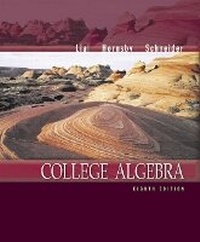
College Algebra
8th Edition
Published on 18. December 2000
Book
Hardback
644 pages
978-0-321-05658-0 (ISBN)
Description
This book, intended for a graphing calculator optional college algebra course, offers students the content and tools they will need to successfully learn college algebra. The authors have addressed the needs of students who will continue their study of mathematics as well as those who are taking college algebra as their final mathematics course. Emphasis is placed on exploring mathematical concepts by using real data, current applications and optional technology.
More details
Edition
8th edition
Language
English
Place of publication
United States
Publishing group
Pearson Education (US)
Target group
Professional and scholarly
Dimensions
Height: 262 mm
Width: 214 mm
Thickness: 31 mm
Weight
1482 gr
ISBN-13
978-0-321-05658-0 (9780321056580)
Copyright in bibliographic data and cover images is held by Nielsen Book Services Limited or by the publishers or by their respective licensors: all rights reserved.
Schweitzer Classification
Other editions
New editions
Margaret L. Lial | John Hornsby | David I. Schneider
College Algebra
Book
04/2004
9th Edition
Pearson
€68.08
Article exhausted; check for reprint
Previous edition

M. L. Lial | E. J. Hornsby | D. I. Schneider
College Algebra
Book
06/1998
7th Edition
Longman
€43.32
Article exhausted; check for reprint
Persons
Marge Lial was always interested in math; it was her favorite subject in the first grade! Marge's intense desire to educate both her students and herself has inspired the writing of numerous best-selling textbooks. Marge, who received Bachelor's and Master's degrees from California State University at Sacramento, is now affiliated with American River College.
Marge is an avid reader and traveler. Her travel experiences often find their way into her books as applications, exercise sets, and feature sets. She is particularly interested in archeology. Trips to various digs and ruin sites have produced some fascinating problems for her textbooks involving such topics as the building of Mayan pyramids and the acoustics of ancient ball courts in the Yucatan.
John Hornsby When John Hornsby enrolled as an undergraduate at Louisiana State University, he was uncertain whether he wanted to study mathematics, education, or journalism. His ultimate decision was to become a teacher, but after twenty-five years of teaching at the high school and university levels and ten years of writing mathematics textbooks, both of his goals have been realized. His love for teaching and for mathematics is evident in his passion for working with students and fellow teachers as well. His specific professional interests are recreational mathematics, mathematics history, and incorporating graphing calculators into the curriculum.
John's personal life is busy as he devotes time to his family (wife Gwen, and sons Chris, Jack, and Josh). He has been a rabid baseball fan all of his life. John's other hobbies include numismatics (the study of coins) and record collecting. He loves the music of the 1960s and has an extensive collection of the recorded works of Frankie Valli and the Four Seasons.
Marge is an avid reader and traveler. Her travel experiences often find their way into her books as applications, exercise sets, and feature sets. She is particularly interested in archeology. Trips to various digs and ruin sites have produced some fascinating problems for her textbooks involving such topics as the building of Mayan pyramids and the acoustics of ancient ball courts in the Yucatan.
John Hornsby When John Hornsby enrolled as an undergraduate at Louisiana State University, he was uncertain whether he wanted to study mathematics, education, or journalism. His ultimate decision was to become a teacher, but after twenty-five years of teaching at the high school and university levels and ten years of writing mathematics textbooks, both of his goals have been realized. His love for teaching and for mathematics is evident in his passion for working with students and fellow teachers as well. His specific professional interests are recreational mathematics, mathematics history, and incorporating graphing calculators into the curriculum.
John's personal life is busy as he devotes time to his family (wife Gwen, and sons Chris, Jack, and Josh). He has been a rabid baseball fan all of his life. John's other hobbies include numismatics (the study of coins) and record collecting. He loves the music of the 1960s and has an extensive collection of the recorded works of Frankie Valli and the Four Seasons.
Content
(Each chapter ends with a Summary, Review Exercises, Test, and an Internet Project.)
1. Algebraic Expressions.
Real Numbers and Their Properties.
Order and Absolute Value.
Polynomials; The Binomial Theorem.
Factoring Polynomials.
Rational Expressions.
Rational Exponents.
Radical Expressions.
2. Equations and Inequalities.
Linear Equations.
Linear Applications and Modeling.
Complex Numbers.
Quadratic Equations.
Quadratic Applications and Modeling.
Other Types of Equations.
Inequalities.
Absolute Value Equations and Inequalities.
3. Relations, Functions, and Graphs.
Relations and the Rectangular Coordinate System; Circles.
Functions.
Linear Functions.
Equations of Lines; Curve Fitting.
Graphs of Relations and Functions.
General Graphing Techniques.
Operations and Composition.
4. Polynomial and Rational Functions.
Quadratic Functions; Curve Fitting.
Synthetic Division.
Zeros of Polynomial Functions.
Polynomials Functions: Graphs, Applications, and Models.
Rational Functions: Graphs, Applications, and Models.
Variation.
5. Exponential and Logarithmic Functions.
Inverse Functions.
Exponential Functions.
Logarithmic Functions.
Evaluating Logarithms and the Change-of-Base Theorem.
Exponential and Logarithmic Equations.
Applications and Models of Exponential Growth and Decay.
6. Systems of Equations and Inequalities.
Linear Systems of Equations.
Matrix Solution of Linear Systems.
Determinant Solution of Linear Systems.
Partial Fractions.
Nonlinear Systems.
Systems of Inequalities and Linear Programming.
Properties of Matrices.
Matrix Inverses.
7. Analytic Geometry.
Parabolas.
Ellipses.
Hyperbolas.
Summary of the Conic Sections.
8. Further Topics in Algebra.
Sequences and Series.
Arithmetic Sequences and Series.
Geometric Sequences and Series.
The Binomial Theorem Revisited.
Mathematical Induction.
Counting Theory.
Basics of Probability.
1. Algebraic Expressions.
Real Numbers and Their Properties.
Order and Absolute Value.
Polynomials; The Binomial Theorem.
Factoring Polynomials.
Rational Expressions.
Rational Exponents.
Radical Expressions.
2. Equations and Inequalities.
Linear Equations.
Linear Applications and Modeling.
Complex Numbers.
Quadratic Equations.
Quadratic Applications and Modeling.
Other Types of Equations.
Inequalities.
Absolute Value Equations and Inequalities.
3. Relations, Functions, and Graphs.
Relations and the Rectangular Coordinate System; Circles.
Functions.
Linear Functions.
Equations of Lines; Curve Fitting.
Graphs of Relations and Functions.
General Graphing Techniques.
Operations and Composition.
4. Polynomial and Rational Functions.
Quadratic Functions; Curve Fitting.
Synthetic Division.
Zeros of Polynomial Functions.
Polynomials Functions: Graphs, Applications, and Models.
Rational Functions: Graphs, Applications, and Models.
Variation.
5. Exponential and Logarithmic Functions.
Inverse Functions.
Exponential Functions.
Logarithmic Functions.
Evaluating Logarithms and the Change-of-Base Theorem.
Exponential and Logarithmic Equations.
Applications and Models of Exponential Growth and Decay.
6. Systems of Equations and Inequalities.
Linear Systems of Equations.
Matrix Solution of Linear Systems.
Determinant Solution of Linear Systems.
Partial Fractions.
Nonlinear Systems.
Systems of Inequalities and Linear Programming.
Properties of Matrices.
Matrix Inverses.
7. Analytic Geometry.
Parabolas.
Ellipses.
Hyperbolas.
Summary of the Conic Sections.
8. Further Topics in Algebra.
Sequences and Series.
Arithmetic Sequences and Series.
Geometric Sequences and Series.
The Binomial Theorem Revisited.
Mathematical Induction.
Counting Theory.
Basics of Probability.