

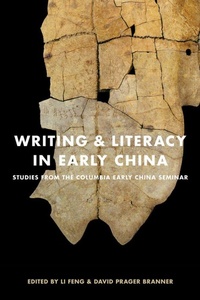
Writing and Literacy in Early China
Studies from the Columbia Early China Seminar
Published on 27. June 2013
Book
Paperback/Softback
480 pages
978-0-295-99337-9 (ISBN)
Description
The emergence and spread of literacy in ancient human society an important topic for all who study the ancient world, and the development of written Chinese is of particular interest, as modern Chinese orthography preserves logographic principles shared by its most ancient forms, making it unique among all present-day writing systems. In the past three decades, the discovery of previously unknown texts dating to the third century BCE and earlier, as well as older versions of known texts, has revolutionized the study of early Chinese writing.
The long-term continuity and stability of the Chinese written language allow for this detailed study of the role literacy played in early civilization. The contributors to Writing and Literacy in Early China inquire into modes of manuscript production, the purposes for which texts were produced, and the ways in which they were actually used. By carefully evaluating current evidence and offering groundbreaking new interpretations, the book illuminates the nature of literacy for scribes and readers.
The long-term continuity and stability of the Chinese written language allow for this detailed study of the role literacy played in early civilization. The contributors to Writing and Literacy in Early China inquire into modes of manuscript production, the purposes for which texts were produced, and the ways in which they were actually used. By carefully evaluating current evidence and offering groundbreaking new interpretations, the book illuminates the nature of literacy for scribes and readers.
Reviews / Votes
". . . elucidate[s] the origins, early development and structure of the Chinese script, but also discuss[es] material aspects, practical uses, and social contexts of writing up to the second century CE. . . . fascinating and carefully edited . . ." -- Oliver Weingarten * Bulletin of the School of Oriental and African Studies *More details
Language
English
Place of publication
Seattle
United States
Target group
College/higher education
US School Grade: College Graduate Student
Product notice
Paperback (trade)
Dimensions
Height: 228 mm
Width: 149 mm
Thickness: 40 mm
Weight
690 gr
ISBN-13
978-0-295-99337-9 (9780295993379)
Copyright in bibliographic data and cover images is held by Nielsen Book Services Limited or by the publishers or by their respective licensors: all rights reserved.
Schweitzer Classification
Persons
Li Feng is professor of early Chinese history and archaeology at Columbia University. David Prager Branner is retired as a professor of Chinese at the University of Maryland. The other contributors are Anthony Barbieri-Low, William Boltz, Constance Cook, Lothar von Falkenhausen, David Pankenier, Matthias Richter, Adam Smith, Ken-ichi Takashima , and Robin Yates.
Content
Acknowledgments
Early China Chronology
Map of Important Archaeological Sites
Introduction: Writing as a Phenomenon of Literacy / Li Feng and David Prager Branner
Part One | Origins and the Linguistic Dimension
1. Getting "Right" with Heaven and the Origins of Writing in China / David W. Pankenier
2. Literacy and the Emergence of Writing in China / William G. Boltz
3. Phonology in the Chinese Script and Its Relationship to Early Chinese Literacy / David Prager Branner
Part Two | Scribal Training and Practice
4. Literacy to the South and the East of Anyang in Shang China: Zhengzhou and Daxinzhuang / Ken-ichi Takashima
5. The Evidence for Scribal Training at Anyang / Adam Smith
6. Textual Identity and the Role of Literacy in the Transmission of Early Chinese Literature / Matthias L. Richter
Part Three | Literacy and Social Contexts
7. The Royal Audience and Its Reflections in Western Zhou Bronze Inscriptions / Lothar von Falkenhausen
8. Literacy and the Social Contexts of Writing in the
Western Zhou / Li Feng
9. Education and the Way of the Former Kings / Constance A. Cook
Part Four | The Extent of Literacy in the Early Empire
10. Soldiers, Scribes, and Women: Literacy among the Lower Orders in Early China / Robin D. S. Yates
11. Craftsman's Literacy: Uses of Writing by Male and Female Artisans in Qin and Han China / Anthony J. Barbieri-Low
Abbreviations
Bibliography
Contributors
Index
Early China Chronology
Map of Important Archaeological Sites
Introduction: Writing as a Phenomenon of Literacy / Li Feng and David Prager Branner
Part One | Origins and the Linguistic Dimension
1. Getting "Right" with Heaven and the Origins of Writing in China / David W. Pankenier
2. Literacy and the Emergence of Writing in China / William G. Boltz
3. Phonology in the Chinese Script and Its Relationship to Early Chinese Literacy / David Prager Branner
Part Two | Scribal Training and Practice
4. Literacy to the South and the East of Anyang in Shang China: Zhengzhou and Daxinzhuang / Ken-ichi Takashima
5. The Evidence for Scribal Training at Anyang / Adam Smith
6. Textual Identity and the Role of Literacy in the Transmission of Early Chinese Literature / Matthias L. Richter
Part Three | Literacy and Social Contexts
7. The Royal Audience and Its Reflections in Western Zhou Bronze Inscriptions / Lothar von Falkenhausen
8. Literacy and the Social Contexts of Writing in the
Western Zhou / Li Feng
9. Education and the Way of the Former Kings / Constance A. Cook
Part Four | The Extent of Literacy in the Early Empire
10. Soldiers, Scribes, and Women: Literacy among the Lower Orders in Early China / Robin D. S. Yates
11. Craftsman's Literacy: Uses of Writing by Male and Female Artisans in Qin and Han China / Anthony J. Barbieri-Low
Abbreviations
Bibliography
Contributors
Index