

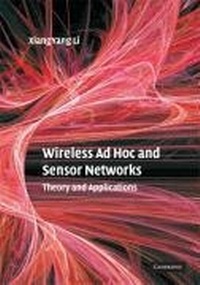
Wireless Ad Hoc and Sensor Networks
Theory and Applications
Published on 30. June 2008
Book
Hardback
616 pages
978-0-521-86523-4 (ISBN)
Description
If you have to understand and optimize the performance of wireless ad hoc and sensor networks, this explanation provides you with the information and insights you need. It delivers an understanding of the underlying problems, and the techniques to develop efficient solutions and maximize network performance. Taking an algorithmic and theoretical approach, Li dissects key layers of a wireless network, from the physical and MAC layers (covering the IEEE 802.11 and 802.16 protocols, and protocols for wireless sensor networks and Bluetooth) through to the network routing layer. In doing so he reviews the practical protocols, formulates problems mathematically, solves them algorithmically and then analyses the performance. Graduate students, researchers and practitioners needing an overview of the various algorithmic, graph theoretical, computational geometric and probabilistic approaches to solving problems in designing these networks will find this an invaluable resource. Additional resources for this title are available online at www.cambridge.org/9780521865234.
More details
Language
English
Place of publication
Cambridge
United Kingdom
Target group
Professional and scholarly
Product notice
Laminated cover
Illustrations
Worked examples or Exercises; 7 Tables, unspecified
Dimensions
Height: 260 mm
Width: 182 mm
Thickness: 31 mm
Weight
1200 gr
ISBN-13
978-0-521-86523-4 (9780521865234)
Copyright in bibliographic data and cover images is held by Nielsen Book Services Limited or by the publishers or by their respective licensors: all rights reserved.
Schweitzer Classification
Other editions
Additional editions
E-Book
09/2008
1st Edition
Cambridge University Press
€148.99
Available for download
Person
Xiang Yang Li is currently an Associate Professor of Computer Science at the Illinois Institute of Technology. He also holds a visiting professorship or adjunct-professorship at TianJing University, WuHan University and NanJing University, in China. He was awarded his PhD in 2001 from the Department of Computer Science at the University of Illinois at Urbana-Champaign. A leading researcher in the field of wireless networks, he has made important contributions in the areas of network topology and routing. His current research interests include cooperation, energy efficiency, and distributed algorithms for wireless ad hoc and sensor networks.
Content
Part I. Introduction: 1. History of wireless networks; 2. Wireless transmission fundamentals; Part II. Wireless MACs: 3. Wireless medium access control protocols; 4. TDMA channel assignment; 5. Spectrum channel assignment; 6. CDMA code channel assignment; Part III. Topology Control and Clustering: 7. Clustering and network backbone; 8. Weighted network backbone; 9. Topology control with flat structures; 10. Power assignment; 11. Critical transmission ranges for connectivity; 12. Other transition phenomena; Part IV. Wireless Network Routing Protocols: 13. Energy efficient unicast routing; 14. Energy efficient broadcast/multicast routing; 15. Routing with selfish terminals; 16. Joint routing, channel assignment and link scheduling; Part V. Other Issues: 17. Localization and location tracking; 18. Performance limitations of random wireless ad hoc networks; 19. Security of wireless ad hoc networks.