

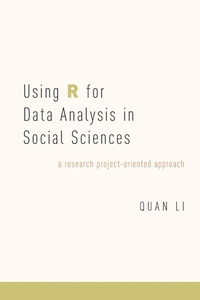
Using R for Data Analysis in Social Sciences
A Research Project-Oriented Approach
Published on 5. July 2018
Book
Paperback/Softback
368 pages
978-0-19-065622-5 (ISBN)
Description
Statistical analysis is common in the social sciences, and among the more popular programs is R. This book provides a foundation for undergraduate and graduate students in the social sciences on how to use R to manage, visualize, and analyze data. The focus is on how to address substantive questions with data analysis and replicate published findings.
Using R for Data Analysis in Social Sciences adopts a minimalist approach and covers only the most important functions and skills in R to conduct reproducible research. It emphasizes the practical needs of students using R by showing how to import, inspect, and manage data, understand the logic of statistical inference, visualize data and findings via histograms, boxplots, scatterplots, and diagnostic plots, and analyze data using one-sample t-test, difference-of-means test, covariance, correlation, ordinary least squares (OLS) regression, and model assumption diagnostics. It also demonstrates how to replicate the findings in published journal articles and diagnose model assumption violations. Because the book integrates R programming, the logic and steps of statistical inference, and the process of empirical social scientific research in a highly accessible and structured fashion, it is appropriate for any introductory course on R, data analysis, and empirical social-scientific research.
Using R for Data Analysis in Social Sciences adopts a minimalist approach and covers only the most important functions and skills in R to conduct reproducible research. It emphasizes the practical needs of students using R by showing how to import, inspect, and manage data, understand the logic of statistical inference, visualize data and findings via histograms, boxplots, scatterplots, and diagnostic plots, and analyze data using one-sample t-test, difference-of-means test, covariance, correlation, ordinary least squares (OLS) regression, and model assumption diagnostics. It also demonstrates how to replicate the findings in published journal articles and diagnose model assumption violations. Because the book integrates R programming, the logic and steps of statistical inference, and the process of empirical social scientific research in a highly accessible and structured fashion, it is appropriate for any introductory course on R, data analysis, and empirical social-scientific research.
Reviews / Votes
"In this useful new book, Quan Li is your expert guide to the R Project for Statistical Computing and the Replication Movement-two massive, ongoing revolutions in quantitative social analysis. If you missed some of the revolutions, do not miss this book."-Gary King, Weatherhead University Professor and director of the Institute for Quantitative Social Science, Harvard University"Using R for Data Analysis in Social Sciences is a tremendous resource for students encountering R and quantitative methods for the first time. Professor Li teaches students nuts and bolts R skills while laying the foundation for statistical inference in the context of motivating questions about politics. Students learn how to describe data, apply the logic of statistical inference, and estimate, diagnose, and interpret linear regression models using
data from published research. Along the way, Professor Li instills good programming habits and reinforces the importance of replication in the social sciences. This practical approach to data analysis means
Using R for Data Analysis in Social Sciences will become students' go-to resource and a standard text assigned in undergraduate methods courses in the social sciences." -Suzanna Linn, Professor of Political Science, Penn State University
"For any student who is interested in computational social science, this book provides useful guidance into the process of managing, visualizing, and analyzing data. It is unique and clever and contains practical insights into using an open-source R programming environment. The chapter with replication exercises will guide you through applying various statistical methods to conduct independent research. "-In Song Kim, Assistant Professor of
Political Science, MIT
More details
Language
English
Place of publication
New York
United States
Target group
Professional and scholarly
Dimensions
Height: 234 mm
Width: 156 mm
Thickness: 20 mm
Weight
553 gr
ISBN-13
978-0-19-065622-5 (9780190656225)
Copyright in bibliographic data and cover images is held by Nielsen Book Services Limited or by the publishers or by their respective licensors: all rights reserved.
Schweitzer Classification
Other editions
Additional editions
Book
07/2018
Oxford University Press Inc
€186.00
Shipment within 15-20 days
E-Book
05/2018
1st Edition
OUP eBook
€24.49
Available for download
E-Book
05/2018
1st Edition
OUP eBook
€31.49
Available for download
Person
Dr. Quan Li is Professor of Political Science at Texas A&M University. His research has appeared in over thirty articles in numerous journals and two coauthored books, Democracy and Economic Openness in an Interconnected System: Complex Transformations and Politics and Foreign Direct Investment. He has served on the editorial boards of American Journal of Political Science, Journal of Politics, International Studies Quarterly, and International Interactions.
Content
List of Figures
List of Tables
1. Learn about R and Write First Toy Programs
2. Get Data Ready: Import, Inspect, and Prepare Data
3. One-Sample and Difference of Means Tests
4. Covariance and Correlation
5. Regression Analysis
6. Regression Diagnostics and Sensitivity Analysis
7. Replicate Findings in Published Analyses
8. Appendix: A Brief Introduction to Analyzing Discrete Data
List of Tables
1. Learn about R and Write First Toy Programs
2. Get Data Ready: Import, Inspect, and Prepare Data
3. One-Sample and Difference of Means Tests
4. Covariance and Correlation
5. Regression Analysis
6. Regression Diagnostics and Sensitivity Analysis
7. Replicate Findings in Published Analyses
8. Appendix: A Brief Introduction to Analyzing Discrete Data