

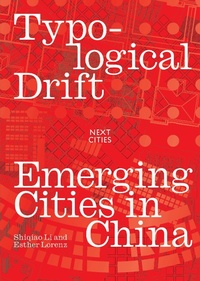
Typological Drift
Emerging Cities in China
Published on 24. December 2021
Book
Paperback/Softback
336 pages
978-1-951541-71-2 (ISBN)
Description
Neither derivatives of Western cities nor isolated from them, Chinese cities in the past four decades are perhaps best captured in their characteristic complexity through a concept in biological evolution: drift. Unlike mutation, adaptation, and migration, drift of phenotypes takes place when chance events terminate some features and allow other features to flourish. The Chinese culture, structurally divergent from the common Indo-European civilizational roots of Western cultures, can be seen to function as a set of "chance events" in the normative processes of urban change. The consequences of these "bottlenecks" of urban evolution are both fascinating and instructive: Chinese cities, when studied with this framework, begin to acquire an entirely different order of significance, injecting urban theory and practice with fresh vigor and insights. Through 13 case studies, more than 60 original maps and drawings, and extensive photographic documentation, the book reveals how three "drift triggers" - ten thousand things, figuration, and group action - have altered typological development in Chinese cities in recent decades.
More details
Series
Language
English
Place of publication
San Rafael
United States
Product notice
With flaps
Illustrations
300 Illustrations, color
Dimensions
Height: 174 mm
Width: 245 mm
Thickness: 24 mm
Weight
756 gr
ISBN-13
978-1-951541-71-2 (9781951541712)
Copyright in bibliographic data and cover images is held by Nielsen Book Services Limited or by the publishers or by their respective licensors: all rights reserved.
Schweitzer Classification
Persons
Shiqiao Li is Weedon Professor in Asian Architecture, School of Architecture, University of Virginia, where he teaches history, theory, and design of architecture, and directs PhD in the Constructed Environment Program. He is author of Understanding the Chinese City (2014), Architecture and Modernization (2009, in Chinese) and Power and Virtue, Architecture and Intellectual Change in England 1650-1730 (2006).
Esther Lorenz is a licensed architect and academic, and Associate Professor at the School of Architecture, University of Virginia. Her research explores the connections between architecture and culture, from the study of new urban formations to cultural and spatial practices in relation to built form, to investigations of the intersections between media and architecture.
Esther Lorenz is a licensed architect and academic, and Associate Professor at the School of Architecture, University of Virginia. Her research explores the connections between architecture and culture, from the study of new urban formations to cultural and spatial practices in relation to built form, to investigations of the intersections between media and architecture.