

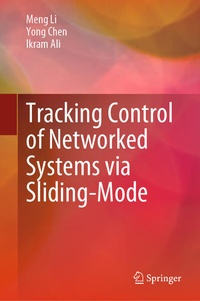
Tracking Control of Networked Systems via Sliding-Mode
Published on 30. October 2021
Book
Hardback
X, 192 pages
978-981-16-6513-4 (ISBN)
Description
The book focuses on the research methods of networked control systems via sliding mode. The problems with network disturbances, network induced delay, out-of-sequence and packet loss, and network attacks are studied in detail. The content studied in this book is introduced in detail and is verified by simulation or experiment. It is especially suitable for readers who are interested in learning the control scheme of networked systems. This book can benefit researchers, engineers, and students in related fields such as electrical, control, automation, and cyber security.
More details
Edition
2022 ed.
Language
English
Place of publication
Singapore
Singapore
Target group
Professional and scholarly
Illustrations
70 farbige Abbildungen, 10 s/w Abbildungen
X, 192 p. 80 illus., 70 illus. in color.
Dimensions
Height: 241 mm
Width: 160 mm
Thickness: 17 mm
Weight
477 gr
ISBN-13
978-981-16-6513-4 (9789811665134)
DOI
10.1007/978-981-16-6514-1
Schweitzer Classification
Other editions
Additional editions
Meng Li | Yong Chen | Ikram Ali
Tracking Control of Networked Systems via Sliding-Mode
Book
10/2022
Springer
€139.09
Shipment within 3-4 weeks
Meng Li | Yong Chen | Ikram Ali
Tracking Control of Networked Systems via Sliding-Mode
E-Book
10/2021
1st Edition
Springer
€128.39
Available for download
Persons
Meng Li received the Ph.D. degree in control science and engineering from the School of Automation Engineering, University of Electronic Science and Technology of China (UESTC) in 2018. From 2017 to 2018, he was a Joint Ph.D. student with the School of Electrical and Electronic Engineering, University of Adelaide. Since January 2019, he has been a postdoctoral researcher with UESTC, where he is currently an associate researcher with the School of Automation Engineering. He has published over 20 technical papers in journals and conferences. His current research interests include networked control systems, cyber-physical systems, and sliding mode control.
Yong Chen (Senior Member, IEEE) was born in Sichuan, China, in 1977. He was a visiting scholar with the School of Mechanical Engineering, The University of Adelaide. Since 2015, he has been a professor and a Ph.D. supervisor with the School of Automation Engineering and the director of the Institute of Electric Vehicle Driving System and Safety Technology, University of Electronic Science and Technology of China (UESTC). He has published over 80 technical articles in journals and conferences and holds 15 Chinese patents. His current research interests include power electronics, motor control, energy control, and network control.
Yong Chen (Senior Member, IEEE) was born in Sichuan, China, in 1977. He was a visiting scholar with the School of Mechanical Engineering, The University of Adelaide. Since 2015, he has been a professor and a Ph.D. supervisor with the School of Automation Engineering and the director of the Institute of Electric Vehicle Driving System and Safety Technology, University of Electronic Science and Technology of China (UESTC). He has published over 80 technical articles in journals and conferences and holds 15 Chinese patents. His current research interests include power electronics, motor control, energy control, and network control.
Content
Chapter 1. Related background and pre-knowledge.- Chapter 2. Adaptive sliding-mode tracking control for networked systems with disturbance.- Chapter 3. Robust sliding-mode tracking control for networked system with random delay and packet dropouts.- Chapter 4. High-order sliding-mode tracking control of networked systems with communication constraints.- Chapter 5. Fast sliding-mode tracking control for networked systems with actuator faults.- Chapter 6. Finite-time sliding-mode tracking control for networked systems with faults and disturbances.- Chapter 7. Super-twisting sliding-mode tracking control for networked systems with multi-channels transmission.- Chapter 8. Resilient sliding-mode tracking control for networked systems with Denial of Service (DoS) attack.- Chapter 9. Terminal integral sliding-mode tracking control for networked systems with False Data Injection (FDI) attacks