

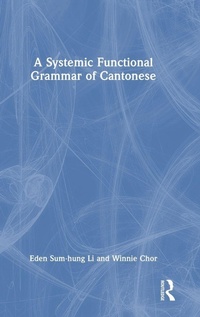
A Systemic Functional Grammar of Cantonese
From Clausal Grammar to Discourse Semantics
1st Edition
Published on 18. May 2026
Book
Hardback
690 pages
978-0-367-41543-3 (ISBN)
Description
A Systemic Functional Grammar of Cantonese adopts Systemic Functional Linguistics to describe the grammar of Cantonese, and to push the description beyond the clausal level to the discourse level.
The book provides a comprehensive description of the Cantonese language, starting from the social and historical background, and the sound and word structure of Cantonese, including word, group, and phrase, to the grammar of clause and sentence. It then advances into the discourse of Cantonese, examining the compound and complex sentences, as well as the flow of information in Cantonese discourse and the elements which regulate the flow.
This volume will be informative for scholars and students studying the Cantonese language, and will provide a good starting point for those researching the language.
The book provides a comprehensive description of the Cantonese language, starting from the social and historical background, and the sound and word structure of Cantonese, including word, group, and phrase, to the grammar of clause and sentence. It then advances into the discourse of Cantonese, examining the compound and complex sentences, as well as the flow of information in Cantonese discourse and the elements which regulate the flow.
This volume will be informative for scholars and students studying the Cantonese language, and will provide a good starting point for those researching the language.
More details
Language
English
Place of publication
London
United Kingdom
Publishing group
Taylor & Francis Ltd
Target group
College/higher education
Professional and scholarly
Academic, Postgraduate, and Undergraduate Advanced
Product notice
Laminated cover
Illustrations
82 s/w Abbildungen, 1 s/w Photographie bzw. Rasterbild, 81 s/w Zeichnungen, 102 s/w Tabellen
91 Tables, black and white; 66 Line drawings, black and white; 1 Halftones, black and white; 67 Illustrations, black and white
Dimensions
Height: 234 mm
Width: 156 mm
Thickness: 38 mm
Weight
1172 gr
ISBN-13
978-0-367-41543-3 (9780367415433)
Copyright in bibliographic data and cover images is held by Nielsen Book Services Limited or by the publishers or by their respective licensors: all rights reserved.
Schweitzer Classification
Other editions
Additional editions
Eden Sum-hung Li | Winnie Chor
A Systemic Functional Grammar of Cantonese
From Clausal Grammar to Discourse Semantics
Book
05/2026
1st Edition
Routledge
€92.00
Shipment within 15-20 days
Eden Sum-hung Li | Winnie Chor
A Systemic Functional Grammar of Cantonese
From Clausal Grammar to Discourse Semantics
E-Book
05/2026
1st Edition
Routledge
€97.99
Available for download
Eden Sum-hung Li | Winnie Chor
A Systemic Functional Grammar of Cantonese
From Clausal Grammar to Discourse Semantics
E-Book
05/2026
1st Edition
Routledge
€97.99
Available for download
Persons
Eden Sum-hung Li has taught at the Open University of Hong Kong, Macquarie University and the University of Hong Kong. He is the author of A Systemic Functional Grammar of Chinese and Language, Society and Culture in Hong Kong, the first author of Systemic Functional Political Discourse Analysis: A Text-based Study and English Today: Forms, Functions and Uses and the co-author of Analysing, and Applying English Grammar and The Corpus of Hong Kong Political Discourse. In addition, Li has published more than 60 book chapters, international journal articles, proceedings, and conference papers, including Chapter 21, 'The nominal group of Chinese', in The Routledge Handbook of Systemic Functional Linguistics.
Winnie Chor is an Associate Professor at the Hong Kong Baptist University. Her research focuses on semantic change (from a grammaticalization perspective), discourse analysis, Cantonese linguistics (with a focus on particles), and the stance-taking phenomenon. She is the author of the book Directional Particles in Cantonese: Form, Function, and Grammaticalization (published by John Benjamins). Her articles appear in journals such as Journal of Pragmatics, Journal of Historical Linguistics, Language and Linguistics, and Taiwan Journal of Linguistics. She has also authored and co-authored numerous articles in books published by publishers such as John Benjamins, Routledge, Peter Lang, and China Social Sciences Press.
Winnie Chor is an Associate Professor at the Hong Kong Baptist University. Her research focuses on semantic change (from a grammaticalization perspective), discourse analysis, Cantonese linguistics (with a focus on particles), and the stance-taking phenomenon. She is the author of the book Directional Particles in Cantonese: Form, Function, and Grammaticalization (published by John Benjamins). Her articles appear in journals such as Journal of Pragmatics, Journal of Historical Linguistics, Language and Linguistics, and Taiwan Journal of Linguistics. She has also authored and co-authored numerous articles in books published by publishers such as John Benjamins, Routledge, Peter Lang, and China Social Sciences Press.
Content
Preface
1 The study of Cantonese: an overview
2 Systemic Functional Linguistics: an introductory note
3 Phonology and morphology in Cantonese
4 Below the clause: word classes
5 Below the clause: group and phrase
6 Clause as representation: Construing experience I
7 Clause as representation: construing experience II
8 Clause as representation: construing circumstantial profiles
9 Clause as exchange: enacting relationship
10 Clause as exchange: expressing personal assessment
11 Clause as message: enabling discourse
12 Clause as message: regulating information flow
13 Above the clause: clausal relationship
14 Around the clause: textual connexity
1 The study of Cantonese: an overview
2 Systemic Functional Linguistics: an introductory note
3 Phonology and morphology in Cantonese
4 Below the clause: word classes
5 Below the clause: group and phrase
6 Clause as representation: Construing experience I
7 Clause as representation: construing experience II
8 Clause as representation: construing circumstantial profiles
9 Clause as exchange: enacting relationship
10 Clause as exchange: expressing personal assessment
11 Clause as message: enabling discourse
12 Clause as message: regulating information flow
13 Above the clause: clausal relationship
14 Around the clause: textual connexity