

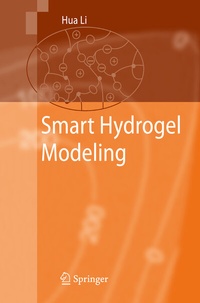
Smart Hydrogel Modelling
Published on 21. October 2009
Book
Hardback
XVII, 359 pages
978-3-642-02367-5 (ISBN)
Description
The science of mathematical modelling and numerical simulation is generally accepted as the third mode of scienti?c discovery (with the other two modes being experiment and analysis), making this ?eld an integral component of c- ting edge scienti?c and industrial research in most domains. This is especially so in advanced biomaterials such as polymeric hydrogels responsive to biostimuli for a wide range of potential BioMEMS applications, where multiphysics and mul- phase are common requirements. These environmental stimuli-responsive hydrogels are often known as smart hydrogels. In the published studies on the smart or stimu- responsive hydrogels, the literature search clearly indicates that the vast majority are experimental based. In particular, although there are a few published books on the smart hydrogels, none is involved in the modelling of smart hydrogels. For the few published journal papers that conducted mathematical modelling and numerical simulation, results were far from satisfactory, and showed signi?cant d- crepancies when compared with existing experimental data. This has resulted in ad hoc studies of these hydrogel materials mainly conducted by trial and error. This is a very time-consuming and inef?cient process, and certain aspects of fun- mental knowledge are often missed or overlooked, resulting in off-tangent research directions.
More details
Edition
2009 ed.
Language
English
Place of publication
Berlin
Germany
Publishing group
Springer Berlin
Target group
Professional and scholarly
Research
Illustrations
XVII, 359 p.
Dimensions
Height: 241 mm
Width: 160 mm
Thickness: 25 mm
Weight
735 gr
ISBN-13
978-3-642-02367-5 (9783642023675)
DOI
10.1007/978-3-642-02368-2
Schweitzer Classification
Other editions
Additional editions
Person
Dr. He received his B. Eng. Degree in Mechanical Engineering (major in Industrial Design) and Ph.D. degree in Engineering Mechanics from Nanyang Technological University in Singapore in 2009 and 2014, respectively. Currently, Dr. He is a research fellow in Energy Research Institute at Nanyang Technological University (ERIAN). He is strong at multiphysics modelling and simulation, especially at developing fast and efficient models for fuel cells whose performance typically involves multiphysical behaviours such as transport phenomena, thermal dynamics, and electrochemical performance. His research interests also include electrostatic precipitation, steam soaking, and acoustic agglomeration to remove particulate matters from air.
Dr. Hua Li received his B.Sc and M.Eng degrees in Engineering Mechanics from Wuhan University of Technology, P.R.C., in 1982 and 1987, respectively. He obtained his Ph.D degree in Mechanical Engineering from the National University of Singaporein 1999. From 2000 to 2001, Dr. Li was a Postdoctoral Associate at the Beckman Institute for Advanced Science and Technology, University of Illinois at Urbana-Champaign. At the end of 2005, he was a Visiting Scientist (on invitation) at the Department of Chemical and Biomolecular Engineering of Johns Hopkins University. From 2001 to 2006, he was a Research Scientist in the A*STAR Institute of High Performance Computing. Dr Li joined Nanyang Technological University (NTU) as an Assistant Professor in June 2006 and he was promoted to Associate Professor in March 2013. He is currently in the School of Mechanical & Aerospace Engineering at NTU. His research interests include the multiphysics modelling of soft matters (smart hydrogel in bioMEMS and biological cell in microscale fields); development of highly efficient numerical computational methodology (meshless & multiscale algorithms); simulation of sustainable energy (building energy efficiency and fuel cell system); and dynamics (high-speed rotating shell and composite materials structure). He has sole-authored a monograph book entitled "Smart Hydrogel Modelling" published by Springer, co-authored two monograph books entitled "Meshless Methods and Their Numerical Properties" by CRC Press and "Rotating Shell Dynamics" by Elsevier, and 2 book chapters, one on MEMS simulation and the other on hydrogel drug delivery system modelling, and authored/co-authored over 140 articles published in peer-reviewed international journals. He received the Silver Award in HPC Quest 2003 - The Blue Challenge presented by IBM & IHPC in 2003. He is also extensively funded by agencies and industry, for example, the principal investigator of a computational BioMEMS project awarded under A*STAR's strategic research programme in MEMS.
Dr. Karl Erik BIRGERSSON is an associate professor at the Chemical and Biomolecular Department and an affiliate of the Engineering Science Programme at the National University of Singapore (NUS) and the Solar Energy Research Institute of Singapore. He was awarded his Ph.D. in Fluid Mechanics from the Royal Institute of Technology (KTH), Stockholm, in 2004. He also holds an MS degree in Chemical Engineering from KTH (1998) and a Licentiate degree (2003). He was a postdoctoral fellow (2004-2005) and research engineer (2005-2006) at the Institute of High Performance Computing, A*Star, Singapore. He specializes in mathematical modelling and transport phenomena; his current research focuses on electrochemical energy systems and organic solar cells. He has published around 150 papers (journal, conference and book chapters). Besides research, he enjoys teaching and experimenting with teaching strategies; he has been awarded twelve teaching awards since 2006 in NUS.
Content
Multi-Effect-Coupling pH-Stimulus (MECpH) Model for pH-Sensitive Hydrogel.- Multi-Effect-Coupling Electric-Stimulus (MECe) Model for Electric-Sensitive Hydrogel.- Multi-Effect-Coupling pH-Electric-Stimuli (MECpHe) Model for Smart Hydrogel Responsive to pH-Electric Coupled Stimuli.- Multi-Effect-Coupling Thermal-Stimulus (MECtherm) Model for Temperature-Sensitive Hydrogel.- Novel Models for Smart Hydrogel Responsive to Other Stimuli: Glucose Concentration and Ionic Strength.- Simulation of Controlled Drug Release from Non-Swellable Micro-Hydrogel Particle.