

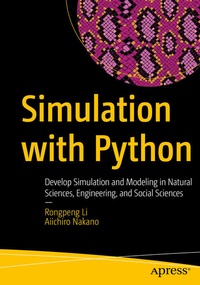
Simulation with Python
Develop Simulation and Modeling in Natural Sciences, Engineering, and Social Sciences
Published on 24. August 2022
Book
Paperback/Softback
XV, 166 pages
978-1-4842-8184-0 (ISBN)
Description
Understand the theory and implementation of simulation. This book covers simulation topics from a scenario-driven approach using Python and rich visualizations and tabulations.
The book discusses simulation used in the natural and social sciences and with simulations taken from the top algorithms used in the industry today. The authors use an engaging approach that mixes mathematics and programming experiments with beginning-intermediate level Python code to create an immersive learning experience that is cohesive and integrated.
After reading this book, you will have an understanding of simulation used in natural sciences, engineering, and social sciences using Python.
What You'll Learn
Who This Book Is For
Entry-level to mid-level Python developers from various backgrounds, including backend developers, academic research programmers, data scientists, and machine learning engineers. The book is also useful to high school students and college undergraduates and graduates with STEM backgrounds.
The book discusses simulation used in the natural and social sciences and with simulations taken from the top algorithms used in the industry today. The authors use an engaging approach that mixes mathematics and programming experiments with beginning-intermediate level Python code to create an immersive learning experience that is cohesive and integrated.
After reading this book, you will have an understanding of simulation used in natural sciences, engineering, and social sciences using Python.
What You'll Learn
- Use Python and numerical computation to demonstrate the power of simulation
- Choose a paradigm to run a simulation
- Draw statistical insights from numerical experiments
- Know how simulation is used to solve real-world problems
Who This Book Is For
Entry-level to mid-level Python developers from various backgrounds, including backend developers, academic research programmers, data scientists, and machine learning engineers. The book is also useful to high school students and college undergraduates and graduates with STEM backgrounds.
More details
Edition
1st ed.
Language
English
Place of publication
Berkeley
United States
Target group
Professional and scholarly
Illustrations
10 s/w Abbildungen, 80 farbige Abbildungen
XV, 166 p. 90 illus., 80 illus. in color.
Dimensions
Height: 254 mm
Width: 178 mm
Thickness: 11 mm
Weight
358 gr
ISBN-13
978-1-4842-8184-0 (9781484281840)
DOI
10.1007/978-1-4842-8185-7
Schweitzer Classification
Other editions
Additional editions
Rongpeng Li | Aiichiro Nakano
Simulation with Python
Develop Simulation and Modeling in Natural Sciences, Engineering, and Social Sciences
E-Book
08/2022
APress
€56.99
Available for download
Persons
Ron Li
is a long-term and enthusiastic educator. He has been a researcher, data science instructor, and business intelligence engineer. Ron published a highly rated (4.5-star rating out of 5 on amazon) book titled
Essential Statistics for Non-STEM Data Analysts
. He has also authored/co-authored academic papers, taught (pro bono) data science to non-STEM professionals, and gives talks at conferences such as PyData.
Aiichiro Nakano is a Professor of Computer Science with joint appointments in Physics & Astronomy, Chemical Engineering & Materials Science, Biological Sciences, and at the Collaboratory for Advanced Computing and Simulations at the University of Southern California. He received a PhD in physics from the University of Tokyo, Japan, in 1989. He has authored more than 360 refereed articles in the areas of scalable scientific algorithms, massive data visualization and analysis, and computational materials science.
Content
Chapter 1: Calculating Pi and Beyond: Searching Order in Disorder with Simulation.- Chapter 2: Markov Chain: A Peek into the Future.Chapter 3: Multi-Armed Bandits: Probability Simulation and Bayesian Statistics.- Chapter 4: Balls in 2D Box: A Simplest Physics Engine.- Chapter 5: Percolation: Threshold and Phase Change.- Chapter 6: Queuing System: How Stock Trades are Made.- Chapter 7: Rock, Scissor and Paper: Multi-Agent Simulation.- Chapter 8: Matthew Effect and Tax Policy: Why the Rich Keeps Getting Richer.- Chapter 9: Misinformation Spreading: Simulation on a Graph (Centrality, Networkx).- Chapter 10: Simulated Annealing and Genetic Algorithm.