

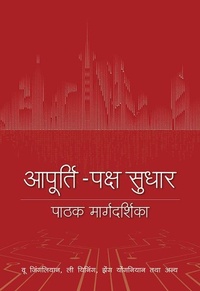
A Reader's Guide to Supply-Side Reform (Hindi Edition)
Published on 1. May 2022
Book
Hardback
206 pages
978-1-4878-0922-5 (ISBN)
Description
In A Reader's Guide to Supply-Side Reform, 22 mainstream scholars, experts, and senior think tanks behind the 13th Five-year Plan offer insight into what supply side reform is, why it should be conducted, how to view it, and what to do. This book offers a thorough overview. As a major strategic proposition, the supply side structural reform is a new expression that provides a new perspective and route for China's economic development. It is a new engine driving the 13th Five-year Plan and economic growth, which will determine the direction of China's economic and social reform in the future. What is supply side reform? What role does it play in China's economy? What is at its core? What is its focus? How does it integrate with other current important financial reforms and innovations? What are the possible mistakes that should be avoided? The interpretation and discussion of these issues will help clarify how to view and implement supply-side reform.
More details
Language
Other
Product notice
sewn/stitched
Cloth over boards
Dimensions
Height: 240 mm
Width: 162 mm
Thickness: 18 mm
Weight
454 gr
ISBN-13
978-1-4878-0922-5 (9781487809225)
Copyright in bibliographic data and cover images is held by Nielsen Book Services Limited or by the publishers or by their respective licensors: all rights reserved.
Schweitzer Classification
Persons
Li Yining, renowned economist, is now director of the Department of Social Sciences at Beijing University and honorary Dean of Guanghua School of Management of Beijing University. Zheng Yongnian holds a Ph.D. in political science from Princeton University. He is now director of the Institute of East Asian Studies at the National University of Singapore and chairman of the academic committee of the Institute of Public Policy, South China University of Technology. Wu Jinglian is one of the most influential economists in contemporary China. He won the Sun Yefang Economic Science Award five times, in 1984, 1986, 1988, 1990, and 1992.