

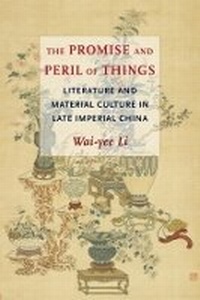
The Promise and Peril of Things
Literature and Material Culture in Late Imperial China
Published on 17. May 2022
Book
Paperback/Softback
376 pages
978-0-231-20103-2 (ISBN)
Description
Winner, 2023 Choice Outstanding Academic Title
Our relationship with things abounds with paradoxes. People assign value to objects in ways that are often deeply personal or idiosyncratic yet at the same time rooted in specific cultural and historical contexts. How do things become meaningful? How do our connections with the world of things define us? In Ming and Qing China, inquiry into things and their contradictions flourished, and its depth and complexity belie the notion that material culture simply reflects status anxiety or class conflict.
Wai-yee Li traces notions of the pleasures and dangers of things in the literature and thought of late imperial China. She explores how aesthetic claims and political power intersect, probes the objective and subjective dimensions of value, and questions what determines authenticity and aesthetic appeal. Li considers core oppositions-people and things, elegance and vulgarity, real and fake, lost and found-to tease out the ambiguities of material culture. With examples spanning the late sixteenth to the mid-eighteenth centuries, she shows how relations with things can both encode and resist social change, political crisis, and personal loss.
The Promise and Peril of Things reconsiders major works such as The Plum in the Golden Vase, The Story of the Stone, Li Yu's writings, and Wu Weiye's poetry and drama, as well as a host of less familiar texts. It offers new insights into Ming and Qing literary and aesthetic sensibilities, as well as the intersections of material culture with literature, intellectual history, and art history.
Our relationship with things abounds with paradoxes. People assign value to objects in ways that are often deeply personal or idiosyncratic yet at the same time rooted in specific cultural and historical contexts. How do things become meaningful? How do our connections with the world of things define us? In Ming and Qing China, inquiry into things and their contradictions flourished, and its depth and complexity belie the notion that material culture simply reflects status anxiety or class conflict.
Wai-yee Li traces notions of the pleasures and dangers of things in the literature and thought of late imperial China. She explores how aesthetic claims and political power intersect, probes the objective and subjective dimensions of value, and questions what determines authenticity and aesthetic appeal. Li considers core oppositions-people and things, elegance and vulgarity, real and fake, lost and found-to tease out the ambiguities of material culture. With examples spanning the late sixteenth to the mid-eighteenth centuries, she shows how relations with things can both encode and resist social change, political crisis, and personal loss.
The Promise and Peril of Things reconsiders major works such as The Plum in the Golden Vase, The Story of the Stone, Li Yu's writings, and Wu Weiye's poetry and drama, as well as a host of less familiar texts. It offers new insights into Ming and Qing literary and aesthetic sensibilities, as well as the intersections of material culture with literature, intellectual history, and art history.
Reviews / Votes
This wide-ranging exploration of human-object interactions provides a heightened appreciation of the complexity and variety of these relations and of the aptness of a material culture lens for approaching the literary culture of the Ming-Qing transition. -- David Porter, editor of <i>Comparative Early Modernities: 1100-1800</i> Although owning things may always be transient, the late Ming and early Qing witnessed obsessions, spiritual essence, political significance, and cultural values associated with objects both real and fake. Wai-yee Li brings those complex cultural phenomena to life through a brilliant array of translations and citations. -- Robert E. Hegel, cotranslator of <i>A Couple of Soles</i> Subtly revising Geertz, Li delves into the irony that humans are suspended in the web of things when trying to discover significance. Readers would likewise get lost in the massive textual labyrinth had Li not thrown us an Ariadne's thread coordinating things along four tropistic axes: agency, value, identity, and temporality. -- Ling Hon Lam, author of <i>The Spatiality of Emotion in Early Modern China: From Dreamscapes to Theatricality</i> The themes of the book permeate Ming-Qing literature and reward the sustained engagement with them here. * Journal of Chinese History * Highly recommended. * Choice Reviews * A perceptive and sweeping examination of Ming and Qing literature on objects. * H-Material-Culture, H-Net Reviews * The book presents an astonishing number of texts, and one of its strengths is that this enables us to watch themes and shifts emerging organically from the landscape in a way that more focused studies cannot. * Harvard Journal of Asiatic Studies *More details
Language
English
Place of publication
New York
United States
Target group
Professional and scholarly
Product notice
Paperback (trade)
Dimensions
Height: 229 mm
Width: 152 mm
ISBN-13
978-0-231-20103-2 (9780231201032)
Copyright in bibliographic data and cover images is held by Nielsen Book Services Limited or by the publishers or by their respective licensors: all rights reserved.
Schweitzer Classification
Other editions
Additional editions
E-Book
06/2022
1st Edition
Columbia University Press
€34.49
Available for download
Person
Wai-yee Li is the 1879 Professor of Chinese Literature at Harvard University. Her recent books include Plum Shadows and Plank Bridge (Columbia, 2020), Keywords in Chinese Culture (2020), and Women and National Trauma in Late Imperial Chinese Literature (2014).
Content
Acknowledgments
Abbreviations
Introduction
1. People and Things
2. Elegance and Vulgarity
3. The Real and the Fake
4. Lost and Found
Epilogue
Notes
Bibliography
Index
Abbreviations
Introduction
1. People and Things
2. Elegance and Vulgarity
3. The Real and the Fake
4. Lost and Found
Epilogue
Notes
Bibliography
Index