

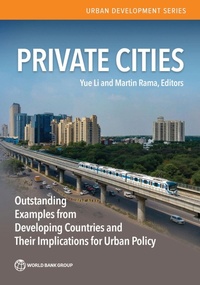
Private Cities
Outstanding Examples from Developing Countries and Their Implications for Urban Policy
Published on 31. July 2023
Book
Paperback/Softback
200 pages
978-1-4648-1833-2 (ISBN)
Description
Institutional weaknesses limit the capacity of local governments to support efficient urbanization in developing countries. They also lead to the emergence of large developers with the clout to build entire cities. This paper analyzes the urbanization process when local governments are weak and large developers are powerful. Results from a non-cooperative game setting with minimal assumptions show that multiple equilibria can emerge depending on key institutional parameters of the model and the nature of the game, but all of them are inefficient. In this simple setting, increasing the capacity of the local government may not lead to better outcomes, because it may crowd out urban land development by the more effective private investor. Subsidizing the large investor can ensure efficiency, but it makes the rest of society worse off. Selling the rights to the city can be Pareto efficient, but only provided that the price at which the rights are sold are sufficiently high. However, more analytical and empirical work is needed before these analyses can be deemed relevant in practice. Competition among jurisdictions, time consistency challenges, and the social implications of private cities deserve special attention.
More details
Series
Language
English
Place of publication
Washington
United States
Target group
Professional and scholarly
Product notice
Paperback (trade)
Unsewn / adhesive bound
Dimensions
Height: 254 mm
Width: 178 mm
Thickness: 18 mm
Weight
662 gr
ISBN-13
978-1-4648-1833-2 (9781464818332)
Copyright in bibliographic data and cover images is held by Nielsen Book Services Limited or by the publishers or by their respective licensors: all rights reserved.
Schweitzer Classification
Persons
The World Bank came into formal existence in 1945 following the international ratification of the Bretton Woods agreements. It is a vital source of financial and technical assistance to developing countries around the world. The organization's activities are focused on education, health, agriculture and rural development, environmental protection, establishing and enforcing regulations, infrastructure development, governance and legal institutions development. The World Bank is made up of two unique development institutions owned by its 185 Member Countries. The International Bank for Reconstruction and Development (IBRD) focuses on middle income and creditworthy poor countries and the International Development Association (IDA), which focuses on the poorest countries in the world.