

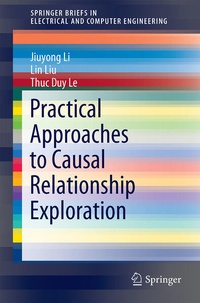
Practical Approaches to Causal Relationship Exploration
Published on 25. March 2015
Book
Paperback/Softback
X, 80 pages
978-3-319-14432-0 (ISBN)
Description
This brief presents four practical methods to effectively explore causal relationships, which are often used for explanation, prediction and decision making in medicine, epidemiology, biology, economics, physics and social sciences. The first two methods apply conditional independence tests for causal discovery. The last two methods employ association rule mining for efficient causal hypothesis generation, and a partial association test and retrospective cohort study for validating the hypotheses. All four methods are innovative and effective in identifying potential causal relationships around a given target, and each has its own strength and weakness. For each method, a software tool is provided along with examples demonstrating its use. Practical Approaches to Causal Relationship Exploration is designed for researchers and practitioners working in the areas of artificial intelligence, machine learning, data mining, and biomedical research. The material also benefits advanced students interested in causal relationship discovery.
More details
Series
Edition
2015 ed.
Language
English
Place of publication
Cham
Switzerland
Publishing group
Springer International Publishing
Target group
Professional and scholarly
Research
Illustrations
55 s/w Abbildungen
X, 80 p. 55 illus.
Dimensions
Height: 235 mm
Width: 155 mm
Thickness: 6 mm
Weight
154 gr
ISBN-13
978-3-319-14432-0 (9783319144320)
DOI
10.1007/978-3-319-14433-7
Schweitzer Classification
Other editions
Additional editions
Jiuyong Li | Lin Liu | Thuc Duy Le
Practical Approaches to Causal Relationship Exploration
E-Book
03/2015
1st Edition
Springer
€53.49
Available for download
Content
Introduction.- Local causal discovery with a simple PC algorithm.- A local causal discovery algorithm for high dimensional data.- Causal rule discovery with partial association test.- Causal rule discovery with cohort studies.- Experimental comparison and discussions.