

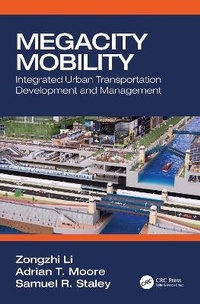
Megacity Mobility
Integrated Urban Transportation Development and Management
1st Edition
Published on 15. December 2021
Book
Hardback
230 pages
978-0-367-36358-1 (ISBN)
Description
World population growth and economic prosperity have given rise to ever-increasing demands on cities, transportation planning, and goods movement. This growth, coupled with a slower pace of transportation capacity expansion and deteriorated facility restoration, has led to rapid changes in the transportation planning and policy environment. These stresses are particularly acute for megacities where degradation of mobility and facility performance have reached alarming rates. Addressing these transportation challenges requires innovative solutions.
Megacity Mobility grapples with these challenges by addressing transportation policy, planning, and facilities in a multimodal context. It discusses innovative short- and long-term solutions for meeting current and future mobility needs for the world's most dynamic cities by addressing the influence of urban land use on mobility, 3D spiderweb transportation planning, travel demand management, multimodal transportation with flexible capacity, efficient capacity utilization driven by new technologies, innovative transportation funding and financing, and performance-based budget allocation using asset management principles. It discusses emerging issues, highlights potential challenges affecting proposed solutions, and provides policymakers, planners, and transportation professionals a road map to achieving sustainable mobility in the 21st century.
Zongzhi Li is a professor and the director of the Sustainable Transportation and Infrastructure Research (STAIR) Center at Illinois Institute of Technology (IIT).
Adrian T. Moore is vice president of policy at Reason Foundation in Washington, D.C., with focuses on privatization, transportation and urban growth, and more.
Samuel R. Staley is the director of the DeVoe L. Moore Center in the College of Social Sciences and Public Policy at Florida State University.
Megacity Mobility grapples with these challenges by addressing transportation policy, planning, and facilities in a multimodal context. It discusses innovative short- and long-term solutions for meeting current and future mobility needs for the world's most dynamic cities by addressing the influence of urban land use on mobility, 3D spiderweb transportation planning, travel demand management, multimodal transportation with flexible capacity, efficient capacity utilization driven by new technologies, innovative transportation funding and financing, and performance-based budget allocation using asset management principles. It discusses emerging issues, highlights potential challenges affecting proposed solutions, and provides policymakers, planners, and transportation professionals a road map to achieving sustainable mobility in the 21st century.
Zongzhi Li is a professor and the director of the Sustainable Transportation and Infrastructure Research (STAIR) Center at Illinois Institute of Technology (IIT).
Adrian T. Moore is vice president of policy at Reason Foundation in Washington, D.C., with focuses on privatization, transportation and urban growth, and more.
Samuel R. Staley is the director of the DeVoe L. Moore Center in the College of Social Sciences and Public Policy at Florida State University.
More details
Language
English
Place of publication
London
United Kingdom
Publishing group
Taylor & Francis Ltd
Target group
College/higher education
Professional and scholarly
Postgraduate and Professional
Illustrations
70 s/w Abbildungen, 36 s/w Photographien bzw. Rasterbilder, 34 s/w Zeichnungen, 22 s/w Tabellen
22 Tables, black and white; 34 Line drawings, black and white; 36 Halftones, black and white; 70 Illustrations, black and white
Dimensions
Height: 260 mm
Width: 183 mm
Thickness: 18 mm
Weight
683 gr
ISBN-13
978-0-367-36358-1 (9780367363581)
Copyright in bibliographic data and cover images is held by Nielsen Book Services Limited or by the publishers or by their respective licensors: all rights reserved.
Schweitzer Classification
Other editions
Additional editions
Zongzhi Li | Adrian T. Moore | Samuel R. Staley
Megacity Mobility
Integrated Urban Transportation Development and Management
Book
01/2024
1st Edition
CRC Press
€74.60
Shipment within 10-20 days
Zongzhi Li | Adrian T. Moore | Samuel R. Staley
Megacity Mobility
Integrated Urban Transportation Development and Management
E-Book
12/2021
1st Edition
CRC Press
€69.99
Available for download
Zongzhi Li | Adrian T. Moore | Samuel R. Staley
Megacity Mobility
Integrated Urban Transportation Development and Management
E-Book
12/2021
1st Edition
CRC Press
€69.99
Available for download
Persons
Dr. ZONGZHI LI received his BE from Chang'an University, China. He obtained his MSCE and PhD in transportation and infrastructure systems engineering, as well as MSIE in operations research from Purdue University, USA. He holds full professor rank with tenure and serves as director of the Sustainable Transportation and Infrastructure Research (STAIR) Center at Illinois Institute of Technology (IIT), USA. His research interests include multimodal transportation demand and system performance modeling, asset management, and network economics.
Dr. ADRIAN T. MOORE holds a Master's and PhD in economics from the University of California, Irvine; a Master's in history from California State University, USA. He is vice president of policy at Reason Foundation, Washington, D.C., USA. Prior to joining Reason, Dr. Moore served 10 years in the U.S. Army on active duty and reserves. He leads Reason's policy implementation efforts and conducts research on privatization, government and regulatory reform, air quality, transportation and urban growth, prisons, and utilities.
Dr. SAMUEL R. STALEY earned a BA in economics and public policy from Colby College, Maine; an MS in applied economics from Wright State University, Ohio; and a PhD in public administration from The Ohio State University, USA. Dr. Staley was Robert W. Galvin Fellow at Reason Foundation, Washington, D.C., and currently serves as director of the DeVoe L. Moore Center at Florida State University, USA, with research focuses on urban planning, social entrepreneurship, and urban economics.
Dr. ADRIAN T. MOORE holds a Master's and PhD in economics from the University of California, Irvine; a Master's in history from California State University, USA. He is vice president of policy at Reason Foundation, Washington, D.C., USA. Prior to joining Reason, Dr. Moore served 10 years in the U.S. Army on active duty and reserves. He leads Reason's policy implementation efforts and conducts research on privatization, government and regulatory reform, air quality, transportation and urban growth, prisons, and utilities.
Dr. SAMUEL R. STALEY earned a BA in economics and public policy from Colby College, Maine; an MS in applied economics from Wright State University, Ohio; and a PhD in public administration from The Ohio State University, USA. Dr. Staley was Robert W. Galvin Fellow at Reason Foundation, Washington, D.C., and currently serves as director of the DeVoe L. Moore Center at Florida State University, USA, with research focuses on urban planning, social entrepreneurship, and urban economics.
Content
1 Introduction
2 New perspectives of urban transportation decision-making
3 Travel demand management
4 Building out 3D highway transportation with flexible capacity
5 Building out transit and multimodal transportation
6 Mobility management for efficient capacity utilization
7 Innovative transportation funding and financing
8 Performance-based, mobility-centered transportation budget allocation
9 The path to sustainable megacity mobility
2 New perspectives of urban transportation decision-making
3 Travel demand management
4 Building out 3D highway transportation with flexible capacity
5 Building out transit and multimodal transportation
6 Mobility management for efficient capacity utilization
7 Innovative transportation funding and financing
8 Performance-based, mobility-centered transportation budget allocation
9 The path to sustainable megacity mobility