

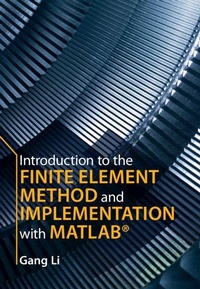
Introduction to the Finite Element Method and Implementation with MATLAB (R)
Published on 30. July 2020
Book
Hardback
522 pages
978-1-108-47168-8 (ISBN)
Description
Connecting theory with numerical techniques using MATLAB (R), this practical textbook equips students with the tools required to solve finite element problems. This hands-on guide covers a wide range of engineering problems through nine well-structured chapters including solid mechanics, heat transfer and fluid dynamics; equilibrium, steady state and transient; and 1-D, 2-D and 3-D problems. Engineering problems are discussed using case study examples, which are solved using a systematic approach, both by examining the steps manually and by implementing a complete MATLAB (R)code. This topical coverage is supplemented by discourse on meshing with a detailed explanation and implementation of 2-D meshing algorithms. Introducing theory and numerical techniques alongside comprehensive examples this text increases engagement and provides students with the confidence needed to implement their own computer codes to solve given problems.
Reviews / Votes
'From one of the experts in the field, this book on the finite element method is a comprehensive and thorough guide for graduate and senior undergraduate students. The book is engaging not just in content but also in delivery. Its focus on step-by-step explanation and implementation is particularly useful for helping students to connect the theory and practice. The reusable MATLAB (R) functions and programs that are integrated with the theoretical content reinforce the important components of FEA and provide a unique learning experience. Detailed description of numerical analysis and meshing techniques is also a major plus since these topics are barely covered in existing FEA textbooks. This introductory FEA book is suitable for students of all engineering majors.' Narayana Aluru, University of Illinois 'An enormously accessible, didactic, and comprehensive text treating key engineering topics and providing the reader with the necessary elements of linear algebra, numerical methods, and meshing techniques, as well as numerous programming examples using MATLAB (R). Professor Li's book can be used by teachers in the classroom for final-year undergraduate and graduate students, and by anyone else interested in learning the theory and computational implementation of the finite element method.' Gabriel Potirniche, University of IdahoMore details
Language
English
Place of publication
Cambridge
United Kingdom
Target group
College/higher education
Professional and scholarly
Product notice
sewn/stitched
Cloth over boards
Illustrations
Worked examples or Exercises; 34 Tables, black and white; 265 Line drawings, black and white
Dimensions
Height: 246 mm
Width: 193 mm
Thickness: 28 mm
Weight
1134 gr
ISBN-13
978-1-108-47168-8 (9781108471688)
Copyright in bibliographic data and cover images is held by Nielsen Book Services Limited or by the publishers or by their respective licensors: all rights reserved.
Schweitzer Classification
Other editions
Additional editions
E-Book
07/2020
Cambridge University Press
€73.99
Available for download
E-Book
07/2020
Cambridge University Press
€78.99
Available for download
Person
Dr. Gang Li is a professor and D. W. Reynolds Emerging Scholar of Mechanical Engineering at Clemson University. He was an awardee of the National Science Foundation Early Career Award. He is an Associate Editor of the Journal of Computational Electronics and has been serving on the ASME Committee on Computing in Applied Mechanics since 2007. Dr. Li's scholarly articles on computational mechanics and finite element method frequently appear in International Journal for Numerical Methods in Engineering, Computer Methods in Applied Mechanics and Engineering, and Journal of Applied Physics.
Content
Preface; 1. Introduction; 2. Mathematical preliminaries; 3. Numerical analysis methods; 4. General procedure of FEA for linear static analysis: 1-D problems; 5. FEA for multi-dimensional scalar field problems; 6. Mesh generation; 7. FEA for multi-dimensional vector field problems; 8. Structural elements; 9. FEA for linear time-dependent analysis; Index.