

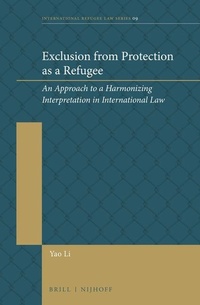
Exclusion from Protection as a Refugee
An Approach to a Harmonizing Interpretation in International Law
Published on 5. October 2017
Book
Hardback
396 pages
978-90-04-34970-4 (ISBN)
Description
In Exclusion from Protection as a Refugee, Yao Li analyses Article 1F of the 1951 Refugee Convention. She argues that the exclusion clause is a quasi-punitive provision and must therefore be interpreted with due regard to (International) Criminal Law. Having developed an interpretation approach to consider external legal notions, Li provides a solution for all the relevant issues in the context of Article 1F, based on a "harmonizing interpretation". The study therefore not only comprehensively examines the exclusion clause at the intersection of International Refugee Law and International Criminal Law, but also contributes to anti-fragmentation efforts in International Law.
Reviews / Votes
"The topic of this book is especially pertinent considering the revival of the exclusion clause in recent decades rendering it a 'regular feature in refugee status determination hearings...The exclusion clause is a key provision in refugee law which 'helps to preserve the integrity of the asylum concept'. It is vital, as the author has shown, that it is applied restrictively and that there is consistency in its interpretation and application. The study is exceptionally clear and concise particularly when analysing and interpreting key instruments such as the Refugee Convention, which can be arduous and convoluted....Li makes a compelling argument for a harmonizing approach to interpret the exclusion clause in which she successfully illustrates that this approach 'contributes to a more human rights sensitive' application of the exclusion clause, as well as establishing that such an approach will lead to a more comprehensive and cohesive utilization of the exclusion clause. This argument renders this study an important contribution, whereby a restrictive and human rights-centred application of the exclusion clause is welcomed, a particularly positive conclusion given recent developments in State practice."(International Journal of Refugee Law, 30/4, December 2018)
More details
Series
Language
English
Place of publication
Netherlands
Publishing group
Brill
Target group
Professional and scholarly
Product notice
sewn/stitched
Cloth over boards
Dimensions
Height: 241 mm
Width: 156 mm
Thickness: 30 mm
Weight
685 gr
ISBN-13
978-90-04-34970-4 (9789004349704)
Copyright in bibliographic data and cover images is held by Nielsen Book Services Limited or by the publishers or by their respective licensors: all rights reserved.
Schweitzer Classification
Person
Yao Li, Ph.D. (2016), University of Cologne, former research assistant at the Institute for International Law, University of Cologne, is a research assistant at the Chair for Criminal Law and Criminal Procedure Law, University of Potsdam.
Content
Acknowledgements
List of Abbreviations
1 Introduction
?A?The Undeserving Refugee
?B?Objective and Methodology
2 Exclusion at the Intersection of Different Legal Systems
?A?Introduction
?B?Implications of International Refugee Law
??i?Objectives of International Refugee Law
??ii?The Nature of Granting Asylum
??iii?Conclusion
?C?Exclusion
??i?Objectives of the Exclusion Clause
??ii?Consequences of Exclusion
??iii?Consequences of Non-exclusion
??iv?Conclusion
?D?Implications of International Criminal Law
??i?Interrelations with Exclusion in Refugee Law
??ii?Conclusion
?E?Implications of Human Rights Law
??i?Differences between Human Rights Law and Refugee Law
??ii?Relationship between Human Rights Law and Refugee Law
??iii?International Human Rights Law and Non-refoulement Obligations
??iv?Conclusion
?F?Intersections with Extradition Law
??i?Principles of Extradition Law
??ii?Hierarchy of Obligations
??iii?Intersections of Refugee Law and Extradition Law
??iv?Intersections of Article 1F CSR51 and Extradition Law
??v?Conclusion
?G?Conclusion: Complementarities of International Refugee Law, International Criminal Law, Human Rights Law, Extradition Law, and the Exclusion Clause
3 Harmonizing Interpretation in International Law
?A?Introduction
?B?The Objective: Including Principles with a Principled Method
?C?Interpretation According to Article 31(1) VCLT69
??1?Ordinary Meaning
??2?Context
??3?Object and Purpose
??4?Good Faith
?D?Interpretation beyond Article 31(1) VCLT69
??i?Subsequent Agreement and Subsequent Practice
??ii?Evolutionary/Dynamic Interpretation
??iii?Analogy
??iv?Fundamental Change Pursuant to Article 62 VCLT69
?E?Harmonizing Interpretation
??i?"Systemic Integration" Pursuant to Article 31(3)(c) VCLT69
??ii?Practical Concordance
??iii?Harmonizing Interpretation of Article 1F CSR51
?F?Conclusion
4 Exclusion in the Light of Harmonizing Interpretation
?A?Introduction
?B?General Matters in Article 1F CSR51
??i?Exclusion Assessment v. Criminal Trial
??ii?Proportionality
??iii?Inclusion before Exclusion
??iv?Procedural Matters
??v?Substantive Matters
??vi?Terrorism
?C?Article 1F(a) CSR51
??i?International Instruments
??ii?Crimes against Peace
??iii?War Crimes
??iv?Crimes against Humanity
??v?Genocide
?D?Article 1F(b) CSR51
??i?Crime
??ii?Serious
??iii?Non-political
??iv?Outside the Country of Refuge/Prior to His Admission
?E?Article 1F(c) CSR51
??i?Residual Character
??ii?"Guilty"
??iii?Acts Contrary to the Principles and Purposes of the United Nations
??iv?Offenders within Article 1F(c) CSR51
?F?Conclusion
5 Conclusion
Bibliography
List of Abbreviations
1 Introduction
?A?The Undeserving Refugee
?B?Objective and Methodology
2 Exclusion at the Intersection of Different Legal Systems
?A?Introduction
?B?Implications of International Refugee Law
??i?Objectives of International Refugee Law
??ii?The Nature of Granting Asylum
??iii?Conclusion
?C?Exclusion
??i?Objectives of the Exclusion Clause
??ii?Consequences of Exclusion
??iii?Consequences of Non-exclusion
??iv?Conclusion
?D?Implications of International Criminal Law
??i?Interrelations with Exclusion in Refugee Law
??ii?Conclusion
?E?Implications of Human Rights Law
??i?Differences between Human Rights Law and Refugee Law
??ii?Relationship between Human Rights Law and Refugee Law
??iii?International Human Rights Law and Non-refoulement Obligations
??iv?Conclusion
?F?Intersections with Extradition Law
??i?Principles of Extradition Law
??ii?Hierarchy of Obligations
??iii?Intersections of Refugee Law and Extradition Law
??iv?Intersections of Article 1F CSR51 and Extradition Law
??v?Conclusion
?G?Conclusion: Complementarities of International Refugee Law, International Criminal Law, Human Rights Law, Extradition Law, and the Exclusion Clause
3 Harmonizing Interpretation in International Law
?A?Introduction
?B?The Objective: Including Principles with a Principled Method
?C?Interpretation According to Article 31(1) VCLT69
??1?Ordinary Meaning
??2?Context
??3?Object and Purpose
??4?Good Faith
?D?Interpretation beyond Article 31(1) VCLT69
??i?Subsequent Agreement and Subsequent Practice
??ii?Evolutionary/Dynamic Interpretation
??iii?Analogy
??iv?Fundamental Change Pursuant to Article 62 VCLT69
?E?Harmonizing Interpretation
??i?"Systemic Integration" Pursuant to Article 31(3)(c) VCLT69
??ii?Practical Concordance
??iii?Harmonizing Interpretation of Article 1F CSR51
?F?Conclusion
4 Exclusion in the Light of Harmonizing Interpretation
?A?Introduction
?B?General Matters in Article 1F CSR51
??i?Exclusion Assessment v. Criminal Trial
??ii?Proportionality
??iii?Inclusion before Exclusion
??iv?Procedural Matters
??v?Substantive Matters
??vi?Terrorism
?C?Article 1F(a) CSR51
??i?International Instruments
??ii?Crimes against Peace
??iii?War Crimes
??iv?Crimes against Humanity
??v?Genocide
?D?Article 1F(b) CSR51
??i?Crime
??ii?Serious
??iii?Non-political
??iv?Outside the Country of Refuge/Prior to His Admission
?E?Article 1F(c) CSR51
??i?Residual Character
??ii?"Guilty"
??iii?Acts Contrary to the Principles and Purposes of the United Nations
??iv?Offenders within Article 1F(c) CSR51
?F?Conclusion
5 Conclusion
Bibliography