

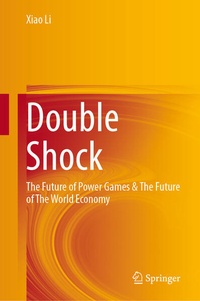
Double Shock
Description
This book offers a rational analysis of the transformation of the global economic order amid intensifying great power competition. By reassessing the United States' hegemonic position and the strategic responses of the emerging power, it examines the institutional foundations and evolution of the U.S.-led global economic system, particularly the international monetary system. It pays special attention to the evolving dynamics and trends in U.S.-China relations in the context of "globalization fragmentation."
Focusing on China's strategic options in the new era, the book argues that U.S.-China competition is fundamentally a contest of reform capacity and governance effectiveness. Drawing on both the history of monetary and financial systems and contemporary U.S.-China rivalry, it advocates for China to prioritize "leveraging internal efforts" and pursue a path of "promoting opening up through reform" under new historical conditions. Financial deepening is highlighted as critical for preventing systemic decoupling, enhancing industrial and financial resilience, promoting technological innovation, and advancing the internationalization of the renminbi. These strategies are essential for China's sustainable economic development and long-term rise.
More details
Persons
Li Xiao, a "Kuang Yaming Scholar" Distinguished Professor at Jilin University, Honorary President of Guangzhou College of Commerce, and a recipient of the China National Talent Award.
Content
Chapter 1.- Assessment of US Hegemony and Responses from Emerging Powers.
Chapter 2.- Why is the United States able to dominate the world.
Chapter 3.- Why did Trump initiate the trade dispute with China.
Chapter 4.-The world order and Sino-US relations after the US election.
Chapter 5.-What will "Biden-omics" bring to the world.
Chapter 6.-The essence of the competition between China and the United States is a race for reform.
Chapter 7.- Can the global pandemic become an accelerator for a world economic recession.
Chapter 8.- Four major trends in the evolution of the world economic landscape under dual impact.
Chapter 9.- From "globalization illusion" to "globalization division".
Chapter 10.-The impact of global currency over issuance on world economic development.
Chapter 11.- Challenges faced by global governance in crisis-ridden countries.
Chapter 12.- Research on China's international political economy in the new era.
Chapter 13.-The world of currency manipulation.
Chapter 14.-Financial development and the rise of major powers.
Chapter 15.-Preventing "decoupling" between China and the United States, from the expansion of industrial chains to the monetary and financialfields.
Chapter 16.-Building a new development pattern of "dual circulation" requires a higher level of openness.
Chapter 17.-Responding to "hard decoupling" with "hard reforms".
Chapter 18.-Promoting the internationalization of the Renminbi through high-level openness and development of the financial industry.
Chapter 19.-Adjustment of global industrial chains and new approaches for China's participation in East Asian regional economic cooperation.