

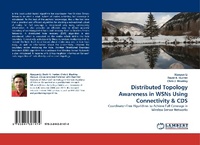
Distributed Topology Awareness in Wsns Using Connectivity & CDs
Coordinator-Free Algorithms to Achieve Full Coverage in Wireless Sensor Networks
Published on 6. June 2011
Book
Paperback/Softback
88 pages
978-3-8443-8147-4 (ISBN)
Description
In this book a distributed algorithm for coordinate- free Wireless Sensor Networks to elect a small subset of nodes achieving full coverage is introduced. To the best of the authors' knowledge, this is the first time that a practical and efficient algorithm for electing a sub-optimal subset of nodes for full coverage is introduced only using connectivity information. It also provides an efficient way to detect accurate boundary of un-triangulated holes and recovery them in Wireless Sensor Networks. A distributed hole recovery (DHR) algorithm is also introduced, which is executed on the nodes which define the hole boundary. It iteratively activates only those redundant nodes required to recover the hole. Each node knows about nodes only one or two hops away, as well as information about the connectivity between the boundary nodes enclosing the hole. Another Distributed Boundary Detection (DBD) algorithm for coordinate-free Wireless Sensor Networks is also introduced. It requires only 2-hop neighbor information for each node regardless of node density and network topology.
More details
Language
English
Place of publication
Germany
Product notice
Paperback (trade)
Unsewn / adhesive bound
Dimensions
Height: 220 mm
Width: 150 mm
Thickness: 6 mm
Weight
149 gr
ISBN-13
978-3-8443-8147-4 (9783844381474)
Copyright in bibliographic data and cover images is held by Nielsen Book Services Limited or by the publishers or by their respective licensors: all rights reserved.
Schweitzer Classification
Persons
Xiaoyun Li es profesor asociado del Instituto de Tecnología Avanzada de Shenzhen en la Academia de Ciencias de China. Trabajó como investigador postdoctoral en University College Dublin y University of Essex (Reino Unido) entre 2008 y 2011. Sus intereses de investigación incluyen protocolos MAC como IEEE 802.15.4 y algoritmos de posicionamiento.