

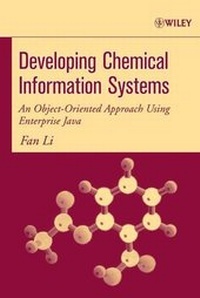
Developing Chemical Information Systems
An Object-Oriented Approach Using Enterprise Java
1st Edition
Published on 9. January 2007
Book
Hardback
216 pages
978-0-471-75157-1 (ISBN)
Description
Develop and manage chemical information systems
This text provides a comprehensive overview of analyzing chemical problems using computer-aided methods for both newcomers and advanced computer scientists and chemists. In addition to practical how-to information and step-by-step descriptions, this resource includes case studies from Merck & Co., Inc., to further aid your understanding.
This guide covers a wide range of cheminformatics topics, including:
* Software development principles
* Object-oriented approach
* Building and buying
* Agile and Iterative Development Process
* UML Modeling
* Deployment and Software Architecture
* Presentation, Business, and Data Persistence Layer
* Producing an entity dictionary
* Chemistry Intelligence API
* Plug and play--integrating with third-party tools
Written by a former lead architect on the design of said systems at Merck & Co., Inc., this text not only lays out information, but also shares the author's experiences and advice on cheminformatics.
Reviews / Votes
"...a practical how-to guide for applying the Java technology with an object-oriented approach to developing chemical information systems." (E-STREAMS, September 2007)More details
Product info
GB
Edition
1., Auflage
Language
English
Place of publication
New York
United States
Target group
Professional and scholarly
Product notice
Unsewn / adhesive bound
Paper over boards
Dimensions
Height: 240 mm
Width: 161 mm
Thickness: 17 mm
Weight
516 gr
ISBN-13
978-0-471-75157-1 (9780471751571)
Schweitzer Classification
Other editions
Additional editions
E-Book
01/2007
Wiley
€248.99
Available for download
Person
FAN LI, PHD, is the team leader and chief architect of the Merck Basic Research Chemical Information Systems development team. Some of his past jobs include programming analyst for MCI Communications and software engineer for Conduit Software. At Merck, he has received many awards for excellence.
Content
1. Introduction.
2. Software Development Principles: High-Low Open-Closed Principles.
3. Introduction to the Object-Oriented Approach and Its Benefits.
4. Build Versus Buy.
5. The Agile and Iterative Development Process.
6. UML Modeling.
7. Deployment Architecture.
8. Software Architecture.
9. A Case Study: Develop a Chemical Registration System (CRS).
10. A Chemical Informatics Domain Analysis Object Model.
11. Presentation Layer.
12. Business Layer.
13. Entity Dictionary.
14. Chemistry Intelligence API.
15. Data Persistence Layer.
16. Put Everything Together.
Bibliography.
Index.