

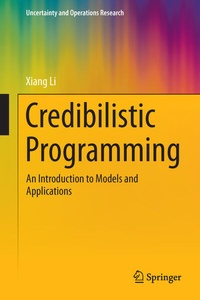
Credibilistic Programming
An Introduction to Models and Applications
Published on 19. May 2015
Book
Paperback/Softback
IX, 144 pages
978-3-642-42717-6 (ISBN)
Description
It provides fuzzy programming approach to solve real-life decision problems in fuzzy environment. Within the framework of credibility theory, it provides a self-contained, comprehensive and up-to-date presentation of fuzzy programming models, algorithms and applications in portfolio analysis.
Reviews / Votes
From the reviews:
"This book summarizes the basic principles of credibilistic programming and its applications to fuzzy portfolio selection problems. . used as a textbook at the graduate level and also as a reference guide for mathematicians who are interested in credibility theory in a fuzzy environment." (R?bert Fullér, Mathematical Reviews, November, 2013)
"The author of this book explores a specialized fuzzy measure and its application for developing solutions to several optimization problems. . this book is inspirational and motivational. It is also a concise, well-written display of definitions, characterizations, and applications for real-life decision making." (Goran Trajkovski, Computing Reviews, August, 2013)More details
Series
Edition
2013 ed.
Language
English
Place of publication
Berlin
Germany
Publishing group
Springer Berlin
Target group
Professional and scholarly
Illustrations
IX, 144 p.
Dimensions
Height: 235 mm
Width: 155 mm
Thickness: 9 mm
Weight
248 gr
ISBN-13
978-3-642-42717-6 (9783642427176)
DOI
10.1007/978-3-642-36376-4
Schweitzer Classification
Other editions
Additional editions
Book
04/2013
Springer
€53.49
Shipment within 7-9 days
E-Book
03/2013
1st Edition
Springer
€53.49
Available for download
Person
Yaguo Lei is a full professor in School of Mechanical Engineering at Xi'an Jiaotong University (XJTU), P. R. China, which he joined as an associate professor in 2010. Prior to that, he worked at the University of Alberta, Canada, as a postdoctoral research fellow. He ever worked at the University of Duisburg-Essen, Germany, as an Alexander von Humboldt fellow in 2012. He was promoted to full professor in 2013. He received the B.S. and the Ph.D. degrees both in Mechanical Engineering from XJTU, in 2002 and 2007, respectively. He is an associate editor or a member of the editorial boards of more than ten journals, including IEEE Transactions on Industrial Electronics, Mechanical Systems and Signal Processing, Measurement Science & Technology, and Neural Computing & Applications. He is also a Fellow of the Institution of Engineering and Technology (IET), a Fellow of the International Society of Engineering Asset Management (ISEAM), a senior member of IEEE and a member of ASME, respectively. He has pioneered many signal processing techniques, intelligent fault diagnosis methods, and remaining useful life prediction models for mechanical systems.
Naipeng Li is currently an assistant professor in School of Mechanical Engineering at Xi'an Jiaotong University, P. R. China. He received the B.S. degree in Mechanical Engineering from Shandong Agricultural University, P. R. China, in 2012, and the Ph.D. degree in Mechanical Engineering from Xi'an Jiaotong University, P. R. China, in 2019. He was also a visiting scholar of Georgia Institute of Technology, Atlanta, USA, from 2016 to 2018. His research interests include condition monitoring, intelligent fault diagnostics, and RUL prediction of rotating machinery.
Xiang Li is currently an associate professor in School of Mechanical Engineering at Xi'an Jiaotong University, P. R. China. He received the B.S. and Ph.D. degrees both in Mechanics from Tianjin University, P. R. China, in 2012 and 2017, respectively. Prior to joining Xi'an Jiaotong University, he was a postdoctoral fellow in Intelligent Maintenance Systems Center at University of Cincinnati, USA, and an associate professor at Northeastern University, P. R. China. He was also a visiting scholar in School of Engineering at University of California, Merced, USA, from 2015 to 2016. His research interests include industrial artificial intelligence, industrial big data, and machinery fault diagnosis and prognosis. He is an early career advisory board member of IEEE/CAA Journal of Automatica Sinica, and an editor of three international journals.
Content
Preface.- Credibility Theory.- Credibilistic Programming.- Mathematical Programming.- Expected Value Model.- Chance-Constrained Programming.- Entropy Maximization Model.- Cross-Entropy Minimization Model.- Regret Minimization Model.