

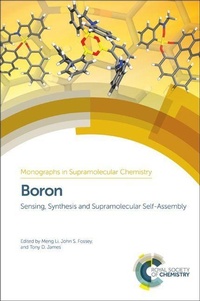
Boron
Sensing, Synthesis and Supramolecular Self-Assembly
Published on 12. November 2015
Book
Hardback
440 pages
978-1-84973-674-9 (ISBN)
Description
The ability to monitor analytes within physiological, environmental, and industrial scenarios is of prime importance in many scenarios. Chemists have striven to mimic nature's ability to produce robust chemosensors with the capacity to detect molecules and signal their presence. The covalent coupling interaction between boronic acids and saccharides has been exploited to monitor saccharides. The boronic acid-and Lewis acid base interaction is also suitable for the capture and recognition of anions, which are involved in fundamental processes in all living things.
There have been significant advances in the field of boronic acid based receptors and this book provides a comprehensive overview and update on the topic. Not only are the applications of boron in chemical molecular sensors covered in detail, but their synthesis and supramolecular self-assembly are also presented. Topics include: the molecular recognition of saccharides, the complexation of boronic acids with saccharides, fluorescent sensors and the modular construct of fluorescent sensors, further sensory systems for saccharide recognition and an extensive bibliography.
Edited by experts in the area and containing international contributions from leading research groups on the subject, this book provides a useful resource for graduate students, academic and industrial researchers in organic chemistry, supramolecular chemistry, materials science and bio-organic chemistry.
There have been significant advances in the field of boronic acid based receptors and this book provides a comprehensive overview and update on the topic. Not only are the applications of boron in chemical molecular sensors covered in detail, but their synthesis and supramolecular self-assembly are also presented. Topics include: the molecular recognition of saccharides, the complexation of boronic acids with saccharides, fluorescent sensors and the modular construct of fluorescent sensors, further sensory systems for saccharide recognition and an extensive bibliography.
Edited by experts in the area and containing international contributions from leading research groups on the subject, this book provides a useful resource for graduate students, academic and industrial researchers in organic chemistry, supramolecular chemistry, materials science and bio-organic chemistry.
More details
Series
Language
English
Place of publication
Cambridge
United Kingdom
Target group
Professional and scholarly
Product notice
Unsewn / adhesive bound
Dimensions
Height: 241 mm
Width: 161 mm
Thickness: 32 mm
Weight
806 gr
ISBN-13
978-1-84973-674-9 (9781849736749)
Copyright in bibliographic data and cover images is held by Nielsen Book Services Limited or by the publishers or by their respective licensors: all rights reserved.
Schweitzer Classification
Other editions
Additional editions
E-Book
11/2015
1st Edition
Royal Society of Chemistry
€246.99
Available for download
E-Book
11/2015
1st Edition
Royal Society of Chemistry
€246.99
Available for download
Persons
Frank Marken is a Professor in the Department of Chemistry at the University of Bath, UK. His research interests lie in both the fundamental and applied aspects of electrochemistry.
Content
Supramolecular Chemistry of Boronic Acids;
11B NMR and its uses in structural characterisation of boronic acids and boronate esters;
Preparations and applications of hexylenehlycol organiboronic esters;
Fluorescent chemosensors based on boronic acid derivatives;
Boronic acid functionalised viologens as saccharide sensors;
chiral recognition using fluorescent boronic acids chemosensors;
boron-containing BIDIPY chemophore for fluorescent sensing;
boron in electroanalysis;
polymer self-assembly mediated by boronic acid;
Boronic acid-containing hydrogels: synthesis and their applications;
Boronate affinity materials for the selective capture of cis-diol-cintaining biomolecules;
boronate microparticles: preparation, characterisation and functionalisation;
Recent advances / contributions in the Suzuki-Miyaura reaction
11B NMR and its uses in structural characterisation of boronic acids and boronate esters;
Preparations and applications of hexylenehlycol organiboronic esters;
Fluorescent chemosensors based on boronic acid derivatives;
Boronic acid functionalised viologens as saccharide sensors;
chiral recognition using fluorescent boronic acids chemosensors;
boron-containing BIDIPY chemophore for fluorescent sensing;
boron in electroanalysis;
polymer self-assembly mediated by boronic acid;
Boronic acid-containing hydrogels: synthesis and their applications;
Boronate affinity materials for the selective capture of cis-diol-cintaining biomolecules;
boronate microparticles: preparation, characterisation and functionalisation;
Recent advances / contributions in the Suzuki-Miyaura reaction