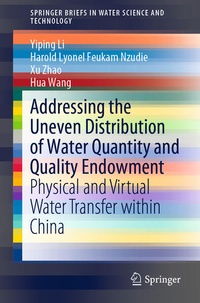
This book presents a selected literature review and case studies for both physical and virtual water transfer. It offers an overview to showcase the interprovincial physical and virtual water transfer within China, and then demonstrates the effects of both approaches in dealing with regional water scarcity; the three cases presented in the Yangtze River Basin demonstrate the role of physical water transfer in improving water quality and restoring water ecosystems; while a Shanghai case highlights the impact of Shanghai's virtual water import on water quantity and quality stress to other regions. This book promotes systematic approaches combining both virtual and physical water transfer solutions to deal with water quantity and quality issues. The book is intended for senior undergraduates, graduate students, lecturers and researchers in water management.
Series
Edition
Language
Place of publication
Target group
Professional and scholarly
Illustrations
9 s/w Abbildungen, 23 farbige Abbildungen
XIII, 76 p. 32 illus., 23 illus. in color.
Dimensions
Height: 235 mm
Width: 155 mm
Thickness: 6 mm
Weight
ISBN-13
978-981-13-9162-0 (9789811391620)
DOI
10.1007/978-981-13-9163-7
Schweitzer Classification
Yiping Li received the Ph.D. degree in 2006 from the Department of Environmental Engineering, School of Environment, Hohai University. Currently, he is Deputy Dean of School of Environment, Hohai University, and Guest Professor in University of North Carolina at Chapel Hill, USA. He has hold with 18 patents and 14 software copyright. He won the first prize of the IBM Global Shared University Research Award issued by IBM and the second prize of Science and Technology Progress Award of Jiangsu Province, China.
Lixiao Ni received the Ph.D. degree in 2004 from the Department of Environmental Engineering, School of Environment, Nanjing University. She now works at School of Environment, Hohai University. Currently, she leads several national and provincial natural science fund projects.
Yong Guo is Associate Professor and Director of environmental engineering department, Hohai University, Nanjing. He won his Ph.D. degree from Nanjing University in year 2008. He specializes in the synthesis of water-cleaning material and their application in environmental remediation. He has been leading several projects funded by the Natural Science Foundation of Jiangsu Province. He won the first prize of Outstanding Achievement Award of scientific research in institutions of higher learning from the Ministry of Education.
Xu Zhao is Full Professor of environmental economics at Institute of Blue and Green Development, Shandong University, Weihai. He obtained his Ph.D. degree from Beijing Normal University in year 2009. He specializes in environmental economics, water footprint and virtual water, water scarcity assessment, water resources management, and input-output techniques. He has been leading several projects funded by the National Natural Science Foundation of China (NSFC), Swiss National Science Foundation (SNSF), and World Wildlife Fund (WWF), and won the first prize of Scientific and Technological ProgressAward from the Ministry of Education.
Yu Cheng received the Ph.D. degree in 2020 from the Department of Water Science, School of Earth Sciences and Engineering, Nanjing University. After graduation, he entered School of Environment, Hohai University. He specializes in the transformation and migration mechanism of contaminants in the soil-water system. Dr. Cheng was selected in the Plan of Highlevel innovative and Entrepreneurial Talents of Jiangsu Province.
Comparison between physical and virtual water transfer.- Pattern of physical and virtual water flows: the impact to water quantity stress among China's provinces.- Physical water transfer and its impact on water quality: case of Yangtze River Diversions.- Water transfer to achieve environmental issues: waterfront body.- Case of physical water transfer from Yangtze River: different routes.- Virtual water transfer within China: case of Shanghai.