

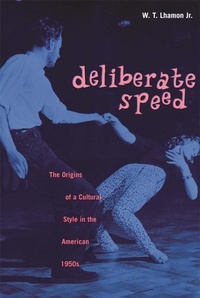
Deliberate Speed
The Origins of a Cultural Style in the American 1950s, with a New Preface
Published on 31. May 2002
Book
Paperback/Softback
336 pages
978-0-674-00873-1 (ISBN)
Description
W. T. Lhamon 's Deliberate Speed is a cultural history of the 1950s in the United States that directly confronts the typical view of this decade as an arid wasteland. By surveying the artistic terrain of the period--examining works by figures as varied as Miles Davis, Ralph Ellison, Robert Frank, Allen Ginsberg, Little Richard, Charlie Parker, Jackson Pollock, Thomas Pynchon, and Ludwig Wittgenstein--Lhamon demonstrates how many of the distinctive elements that so many attribute to the revolutionary period of the 1960s had their roots in the fertile soil of the 1950s.
Taking his title from Chief Justice Earl Warren's desegregation decree of 1955, Lhamon shows how this phrase, "deliberate speed," resonates throughout the culture of the entire decade. The 1950s was a period of transition--a time when the United States began its shift from an industrial society to a postindustrial society, and the era when the first barriers between African-American culture and white culture began to come down.
Deliberate Speed is the story of a nation and a culture making the rapid transition to the increasingly complex world that we inhabit today.
Taking his title from Chief Justice Earl Warren's desegregation decree of 1955, Lhamon shows how this phrase, "deliberate speed," resonates throughout the culture of the entire decade. The 1950s was a period of transition--a time when the United States began its shift from an industrial society to a postindustrial society, and the era when the first barriers between African-American culture and white culture began to come down.
Deliberate Speed is the story of a nation and a culture making the rapid transition to the increasingly complex world that we inhabit today.
Reviews / Votes
Lhamon's main point is that in the '50s high and vernacular culture penetrated each other in a big way and that, behind the decade's vaunted illusion of 18-hole tranquility, both neighborhoods were jiving with experimentation. He manages the feat of fingering common impulses in the artistry of Ornette Coleman, Jackson Pollock, Chuck Berry and Thomas Pynchon without blurring the obvious distinctions among their works. * Washington Post Book World * Ingenious...Lhamon's brief analysis of mid-fifties rock 'n' roll is one of the best in print...[Lhamon's] readings sustain his claim that the decade of the 1950s was the heart of an intellectual watershed: on the one side, modernism, industrial society, a culture of production, the primacy of unity; on the other side, post-modernism, post-industrial society, a culture of consumption, the primacy of particularity. * New England Quarterly * [Lhamon] not only recaptures the '50's--the people, both square and Beat, and the styles--but offers a wonderfully rich analysis of hesitant movements that sought to challenge what David Riesman once labeled 'the other-directed society' and succeeded beyond the innovators' wildest dreams. The oxymoron 'deliberate speed' is a fitting title for this superb book about America in transition. -- P. I. Rose * Choice *More details
Language
English
Place of publication
Cambridge, Mass
United States
Target group
College/higher education
Professional and scholarly
Product notice
Paperback (trade)
Unsewn / adhesive bound
Illustrations
none
Dimensions
Height: 228 mm
Width: 152 mm
Thickness: 24 mm
Weight
449 gr
ISBN-13
978-0-674-00873-1 (9780674008731)
Copyright in bibliographic data and cover images is held by Nielsen Book Services Limited or by the publishers or by their respective licensors: all rights reserved.
Schweitzer Classification
Other editions
Previous edition

Book
10/1990
Smithsonian Books
€39.23
Article exhausted; check for reprint
Person
W. T. Lhamon, Jr., is Emeritus Professor of English at Florida State University and Lecturer in American Studies at Smith College.