

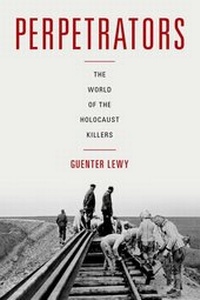
Perpetrators
The World of the Holocaust Killers
Published on 14. September 2017
Book
Hardback
208 pages
978-0-19-066113-7 (ISBN)
Description
The Nazis' attempt to annihilate the Jewish people, the Holocaust, continues to raise a disturbing question. About six million defenseless men, women, and children were murdered for no reason but their ancestry. Close to two million Jews were killed in mass shootings, while the remainder were asphyxiated or worked and starved to death. How could such terrible deeds happen in the heart of Christian Europe and among a nation known for its poets and thinkers, a people that had produced Schiller, Goethe, Bach, and Beethoven? What had converted so many seemingly ordinary people into killers, willing participants in what is probably the worst crime in modern history? That is the question Guenter Lewy seeks to answer in this book.
Lewy provides a critical synthesis of recent literature on the perpetrators, broadening the discussion and developing a more complete and systematic answer to the question of why so many ordinary German people became mass murderers, drawing on previously untapped valuable sources, including officers' and soldiers' diaries; some 35,000 letters written by soldiers serving in the East, many of which describe the murder of Jews; the recollections of Jewish survivors, and most importantly, the record of the trials of hundreds of Nazi perpetrators by German courts. The result is a wealth of information about the Holocaust in all its horrible particulars and about those who carried out those hideous deeds. The book systematically examines the role of individual pathology, of specifically German factors such as obedience to authority, and the impact of ideology on group behavior. The actual perpetrators, Lewy concludes, acted out of a variety of motives. Some were convinced haters of Jews, while others killed out of a sense of duty, to advance their career, because they followed orders, or because they wanted to conform to the group. There was no uniform Nazi perpetrator type.
Guenter Lewy grew up in Germany and lived some six years under Nazi rule. During the November 1938 pogrom known as Kristallnacht, he was on the receiving end of storm-trooper brutality, and his father was taken to the Buchenwald concentration camp, barely surviving his three-month ordeal there. The question of "why they did it," therefore, is of far more than theoretical interest for the author-it is a passionate attempt to illuminate a dismal chapter of history that cannot be forgotten.
Lewy provides a critical synthesis of recent literature on the perpetrators, broadening the discussion and developing a more complete and systematic answer to the question of why so many ordinary German people became mass murderers, drawing on previously untapped valuable sources, including officers' and soldiers' diaries; some 35,000 letters written by soldiers serving in the East, many of which describe the murder of Jews; the recollections of Jewish survivors, and most importantly, the record of the trials of hundreds of Nazi perpetrators by German courts. The result is a wealth of information about the Holocaust in all its horrible particulars and about those who carried out those hideous deeds. The book systematically examines the role of individual pathology, of specifically German factors such as obedience to authority, and the impact of ideology on group behavior. The actual perpetrators, Lewy concludes, acted out of a variety of motives. Some were convinced haters of Jews, while others killed out of a sense of duty, to advance their career, because they followed orders, or because they wanted to conform to the group. There was no uniform Nazi perpetrator type.
Guenter Lewy grew up in Germany and lived some six years under Nazi rule. During the November 1938 pogrom known as Kristallnacht, he was on the receiving end of storm-trooper brutality, and his father was taken to the Buchenwald concentration camp, barely surviving his three-month ordeal there. The question of "why they did it," therefore, is of far more than theoretical interest for the author-it is a passionate attempt to illuminate a dismal chapter of history that cannot be forgotten.
Reviews / Votes
[M]akes an important contribution to our understanding of the Holocaust... Perpetrators is organized clearly and logically... [T]he author makes a valuable contribution by providing detail on the perpetrators and by offering his views on what motivated the killers. * Mark Monesclaros, H-War * Lewy succeeds in compressing and thoughtfully analysing a huge amount of information in a slim volume. * Paul Hollander, The New Criterion *More details
Language
English
Place of publication
New York
United States
Target group
College/higher education
Dimensions
Height: 236 mm
Width: 160 mm
Thickness: 15 mm
Weight
454 gr
ISBN-13
978-0-19-066113-7 (9780190661137)
Copyright in bibliographic data and cover images is held by Nielsen Book Services Limited or by the publishers or by their respective licensors: all rights reserved.
Schweitzer Classification
Other editions
Additional editions
E-Book
07/2017
1st Edition
OUP eBook
€9.99
Available for download
E-Book
07/2017
1st Edition
OUP eBook
€9.99
Available for download
Person
Guenter Lewy is Professor Emeritus of Political Science at the University of Massachusetts. His books include Harmful and Undesirable: Book Censorship in Nazi Germany and The Catholic Church and Nazi Germany. He lives in Washington, D.C.
Content
Preface
Introduction
1: Jews in Concentration Camps
2: Massacres by Shooting
3: Portraits of Killers
4: Serving in a Death Factory
5: Evading Participation and Opposing the Killing
6: The Perpetrators on Trial: Flawed Justice
7: Explaining the Holocaust
Abbreviations and Glossary
Notes
Bibliography
Introduction
1: Jews in Concentration Camps
2: Massacres by Shooting
3: Portraits of Killers
4: Serving in a Death Factory
5: Evading Participation and Opposing the Killing
6: The Perpetrators on Trial: Flawed Justice
7: Explaining the Holocaust
Abbreviations and Glossary
Notes
Bibliography