

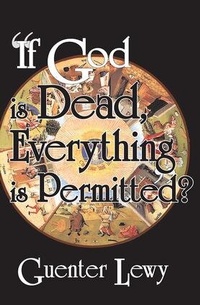
If God is Dead, Everything is Permitted?
1st Edition
Published on 15. August 2008
Book
Hardback
126 pages
978-1-4128-0756-2 (ISBN)
Description
Dostoevsky's dictum that when God is dead everything is permitted can have several meanings. It can refer to the behavior of individuals suggesting that someone who is or becomes an unbeliever will conduct himself immorally. Alternatively, the saying can pertain to the moral character of an entire country and mean a society that rejects God is doomed to moral decay. Guenter Lewy presents a few of the major arguments of those who question the relationship between morality and religion, and examines the case for the continuing dependence of morality upon religion.
Beginning with Dostoevsky's The Brothers Karamazov Lewy introduces the reader to the position that morality depends on religious belief. He then follows the idea throughout history, from its origin, to its extension during the Enlightment, to the Victorians, to the roots of atheism. Lewy then presents a critical discussion of Sweden as a model of a secular nation where morality is retained although most of the population is not religious. He shows that Sweden offers a serious and unique illustration of how democracy and morality can flourish in a post-modern environment.
"If God is Dead, Everything is Permitted"? as the author acknowledges, is more of an essay than a seemless history of the relationship of religion and morality. Lewy's fascination with the intersection and influence of religion on morality is not a new topic. Indeed the discussion is important and alive today in light of new technological and scientific advances. Although Lewy may not put closure to the debate about whether morality is dependent on religion the evidence presented here sheds light on the morality of today by examining its historical past.
Beginning with Dostoevsky's The Brothers Karamazov Lewy introduces the reader to the position that morality depends on religious belief. He then follows the idea throughout history, from its origin, to its extension during the Enlightment, to the Victorians, to the roots of atheism. Lewy then presents a critical discussion of Sweden as a model of a secular nation where morality is retained although most of the population is not religious. He shows that Sweden offers a serious and unique illustration of how democracy and morality can flourish in a post-modern environment.
"If God is Dead, Everything is Permitted"? as the author acknowledges, is more of an essay than a seemless history of the relationship of religion and morality. Lewy's fascination with the intersection and influence of religion on morality is not a new topic. Indeed the discussion is important and alive today in light of new technological and scientific advances. Although Lewy may not put closure to the debate about whether morality is dependent on religion the evidence presented here sheds light on the morality of today by examining its historical past.
More details
Language
English
Place of publication
New York
United States
Publishing group
Taylor & Francis Inc
Target group
College/higher education
Professional and scholarly
Dimensions
Height: 229 mm
Width: 152 mm
Weight
340 gr
ISBN-13
978-1-4128-0756-2 (9781412807562)
Copyright in bibliographic data and cover images is held by Nielsen Book Services Limited or by the publishers or by their respective licensors: all rights reserved.
Schweitzer Classification
Other editions
Additional editions
Guenter Lewy
If God is Dead, Everything is Permitted?
Book
10/2017
1st Edition
Routledge
€78.17
Shipment within 10-20 days
Guenter Lewy
If God is Dead, Everything is Permitted?
E-Book
07/2017
Routledge
€65.99
Available for download
Guenter Lewy
If God is Dead, Everything is Permitted?
E-Book
07/2017
Routledge
€65.99
Available for download
Person
Guenter Lewy is professor emeritus of political science at the University of Massachusetts. He has also served on the faculty of Columbia and Smith College. He is the author of many books and articles and he has notably published False Consciousness: An Essay on Mystification (Transaction), The Armenian Massacres in Ottoman Turkey (University of Utah Press), and The Nazi Persecution of the Gypsies (Oxford University Press). This new effort emerges from general concerns raised in his previous writings.
Content
Preface, 1 Introduction: Dostoyevsky's Proposition, 2 The Enlightenment: From Skepticism to Unbelief, 3 The Religion of Humanity, 4 The Victorians: Disbelieving Religiously, 5 Atheism: Proclaiming the Death of God, 6 Christian Morality: God and Moral Truth, 7 Is Modern Totalitarianism the Result of the Abandonment of God?, 8 The Case of Secular Sweden, 9 Unbelief and the Future of Morality, Notes, Index