

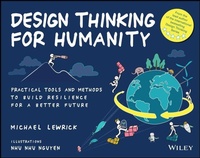
Design Thinking for Humanity
Practical Tools and Methods to Build Resilience for a Better Future
1st Edition
Will be published approx. on 22. September 2026
Book
Paperback/Softback
320 pages
978-1-394-36639-2 (ISBN)
Description
A paradigm-shifting look at design that empowers readers to tackle the world's hardest problems
In Design Thinking For Humanity: Cultivating a Transformative Mindset for a Better and Sustainable Future, Design Thinking and Business Ecosystems Design Thought Leader, Michael Lewrick, delivers an insightful discussion of a "Designing for Humanity" framework. The author demonstrates the interconnectedness of all living beings and the urgent need for ecological and social justice, showing you how those interconnections can empower designers and innovators to address complex global challenges.
The book is divided into five parts: Future Thinking, Design Thinking, Ecological Thinking, Systems Thinking, and Exponential Thinking. Each part addresses how to tackle a variety of hard problems, from climate change to inequality and resource depletion. You'll also find:
Strategies for fostering empathy, collaboration, and an understanding of the intricate web of life
Tools to help you become an agent of positive change in the world
Proven ways to cultivate empathy and compassion for all living things and develop innovative solutions to complicated global problems
Perfect for managers, executives, and other leaders in the sustainability, innovation, design, business, technology, and social impact spaces, Design Thinking For Humanity is a fascinating and practical addition to the Wiley Design Thinking Series. It belongs on the bookshelves of everyone with an interest in solving seemingly intractable problems and improving the world around them.
In Design Thinking For Humanity: Cultivating a Transformative Mindset for a Better and Sustainable Future, Design Thinking and Business Ecosystems Design Thought Leader, Michael Lewrick, delivers an insightful discussion of a "Designing for Humanity" framework. The author demonstrates the interconnectedness of all living beings and the urgent need for ecological and social justice, showing you how those interconnections can empower designers and innovators to address complex global challenges.
The book is divided into five parts: Future Thinking, Design Thinking, Ecological Thinking, Systems Thinking, and Exponential Thinking. Each part addresses how to tackle a variety of hard problems, from climate change to inequality and resource depletion. You'll also find:
Strategies for fostering empathy, collaboration, and an understanding of the intricate web of life
Tools to help you become an agent of positive change in the world
Proven ways to cultivate empathy and compassion for all living things and develop innovative solutions to complicated global problems
Perfect for managers, executives, and other leaders in the sustainability, innovation, design, business, technology, and social impact spaces, Design Thinking For Humanity is a fascinating and practical addition to the Wiley Design Thinking Series. It belongs on the bookshelves of everyone with an interest in solving seemingly intractable problems and improving the world around them.
More details
Series
Language
English
Place of publication
New York
United States
ISBN-13
978-1-394-36639-2 (9781394366392)
Copyright in bibliographic data and cover images is held by Nielsen Book Services Limited or by the publishers or by their respective licensors: all rights reserved.
Schweitzer Classification
Persons
Michael Lewrick is the visionary architect of the Design Thinking for Humanity movement and the lead author of the bestselling Wiley Design Thinking Series. As a preeminent global authority on business ecosystems and exponential innovation, his pioneering methodologies have redefined the innovation landscape for multinational organizations and high-growth startups globally. His work serves as the definitive global benchmark for practitioners committed to aligning technological power with the restoration of human and ecological systems.