

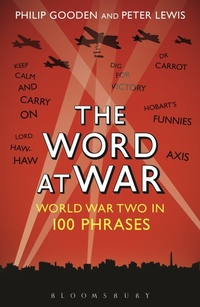
The Word at War
World War Two in 100 Phrases
Published on 30. July 2015
Book
Paperback/Softback
256 pages
978-1-4729-2248-9 (ISBN)
Description
War words have embedded themselves in our collective psyche; British politicians are fond of invoking the 'Dunkirk spirit' whenever the country is faced with major crisis or even minor adversity, and Roosevelt's famous description of Pearl Harbor as 'a date which will live in infamy' was echoed by many US commentators after the 9/11 attacks.
So far, so familiar. Or is it? How many of us know, for instance, that 'Keep Calm and Carry On', far from achieving its morale-boosting aim, was considered at the time to be deeply patronizing by the people it was directed at, and so had only limited distribution?
The Word at War explores 100 phrases spawned and popularized in the lead-up and during the conflict of World War Two. Substantial essays explore and explain the derivations of, and the stories behind, popular terms and phraseology of the period, including wartime speeches (and the words of Churchill, Hitler and FDR); service slang; national stereotypes; food and drink; and codewords.
So far, so familiar. Or is it? How many of us know, for instance, that 'Keep Calm and Carry On', far from achieving its morale-boosting aim, was considered at the time to be deeply patronizing by the people it was directed at, and so had only limited distribution?
The Word at War explores 100 phrases spawned and popularized in the lead-up and during the conflict of World War Two. Substantial essays explore and explain the derivations of, and the stories behind, popular terms and phraseology of the period, including wartime speeches (and the words of Churchill, Hitler and FDR); service slang; national stereotypes; food and drink; and codewords.
Reviews / Votes
This eloquent pair of authors are a language lover's dream. The book captures the pugnacious parlance of wartime in all its oxymorons, its inventive acronyms, its clever rhetoric, its racy slang and its appalling euphemisms. There are surprises, too: humour, sexiness and neology: Jeep, SPAM, flak, kamikaze and mega, to name a few linguistic creations. The enduring semantic legacy, over seven decades, teaches us a lot about how we communicate in a crisis; something that's particularly pertinent today. -- Gary Nunn * Guardian 'Mind your language' columnist * Much of the value in this little book lies in the similarly extensive background details that Gooden and Lewis supply throughout. -- Michael Quinion * World Wide Words * This wonderful book defines the wartime words and phrases that still resonate in the language of peacetime. -- Iain Finlayson * Saga Magazine *More details
Language
English
Place of publication
London
United Kingdom
Product notice
Paperback (trade)
Unsewn / adhesive bound
Dimensions
Height: 195 mm
Width: 126 mm
Thickness: 22 mm
Weight
271 gr
ISBN-13
978-1-4729-2248-9 (9781472922489)
Copyright in bibliographic data and cover images is held by Nielsen Book Services Limited or by the publishers or by their respective licensors: all rights reserved.
Schweitzer Classification
Other editions
Additional editions
E-Book
09/2014
1st Edition
A&C Black Business Information and Development
€9.99
Available for download
E-Book
09/2014
1st Edition
A&C Black Business Information and Development
€9.99
Available for download
Persons
Philip Gooden read English at Magdalen College, Oxford, and then taught at secondary school level for many years. In 2001 he became a full-time writer. Philip writes books on the English language as well as historical crime novels and mysteries. He was chairman of the Crime Writers' Association in 2007-8 and is part of the writing collective, The Medieval Murderers. He has also written the popular Who's Whose?: A No-Nonsense Guide to Easily-Confused Words, published by Bloomsbury.
Peter Lewis taught German at St Anne's College, Oxford and worked as a publishing commissioning editor before becoming a freelance translator, writer and project manager. Recent translations include The Mad Science Book (Quercus) and Roman Elegy (Haus Publishing).
Peter Lewis taught German at St Anne's College, Oxford and worked as a publishing commissioning editor before becoming a freelance translator, writer and project manager. Recent translations include The Mad Science Book (Quercus) and Roman Elegy (Haus Publishing).