

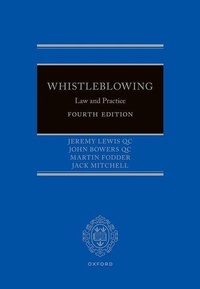
Whistleblowing
Law and Practice
4th Edition
Published on 26. April 2022
Book
Hardback
1120 pages
978-0-19-284809-3 (ISBN)
Description
Whistleblowing: Law and Practice is the leading reference work on whistleblowing law and practice in England and Wales, offering up-to-date, practical guidance on the key issues that arise in practice, and making use of checklists and worked examples. The book provides comprehensive coverage of the protection given to whistleblowers by the Employment Rights Act and other legislation, and the way in which the European Convention on Human Rights affects the approach to statutory interpretation. It also provides a detailed survey of the principles of the common law and equity as they relate to whistleblowing, and the interface between copyright and defamation law and whistleblowing.
The 4th edition of Whistleblowing: Law and Practice provides analysis of judgements made since the previous edition, including the Supreme Court judgements on Royal Mail Group Ltd v Jhuti and Gilham v Ministry of Justice, and Court of Appeal judgements on Kilraine v London Borough of Wandsworth and International Petroleum Ltd and others v Osipov and other. The book also includes changes to NHS and EU legislation regarding whistleblowing.
The 4th edition of Whistleblowing: Law and Practice provides analysis of judgements made since the previous edition, including the Supreme Court judgements on Royal Mail Group Ltd v Jhuti and Gilham v Ministry of Justice, and Court of Appeal judgements on Kilraine v London Borough of Wandsworth and International Petroleum Ltd and others v Osipov and other. The book also includes changes to NHS and EU legislation regarding whistleblowing.
More details
Edition
4th Revised edition
Language
English
Place of publication
Oxford
United Kingdom
Target group
Professional and scholarly
Edition type
Revised edition
Product notice
sewn/stitched
Cloth over boards
Dimensions
Height: 253 mm
Width: 181 mm
Thickness: 57 mm
Weight
1835 gr
ISBN-13
978-0-19-284809-3 (9780192848093)
Copyright in bibliographic data and cover images is held by Nielsen Book Services Limited or by the publishers or by their respective licensors: all rights reserved.
Schweitzer Classification
Persons
Jeremy Lewis is a Barrister at Littleton Chambers, specializing in employment law and business protection, and is a part time Employment Judge in the South East region.
John Bowers QC is the Principal of Brasenose College, Oxford, a leading barrister, and former co-head of Littleton Chambers. He specializes in employment law, discrimination, pensions, and judicial review. He is a Deputy High Court Judge, a frequent lecturer on employment law, and a former Chair of the Employment Law Bar Association.
Martin Fodder is a Barrister at Littleton Chambers, specializing in employment law. He has extensive experience of heavyweight whistleblowing cases in both the public and private sectors.
Jack Mitchell is a Barrister at Old Square Chambers, specializing exclusively in employment law.
John Bowers QC is the Principal of Brasenose College, Oxford, a leading barrister, and former co-head of Littleton Chambers. He specializes in employment law, discrimination, pensions, and judicial review. He is a Deputy High Court Judge, a frequent lecturer on employment law, and a former Chair of the Employment Law Bar Association.
Martin Fodder is a Barrister at Littleton Chambers, specializing in employment law. He has extensive experience of heavyweight whistleblowing cases in both the public and private sectors.
Jack Mitchell is a Barrister at Old Square Chambers, specializing exclusively in employment law.
Content
1: Introduction
2: Overview of the Protected Disclosure Provisions and Related Protections
3: Interpretation and the European Convention of Human Rights
4: Qualifying Disclosure of Information
5: The Public Interest Test
6: The Three Tiers of Protection
7: Who is Protected Under PIDA?
8: Workers Whose Employment is not Confined to England and Wales
9: The Right Not to Suffer Detriment
10: Vicarious and Individual Liability
11: Unfair Dismissal for Making a Protected Disclosure
12: Remedies in Dismissal and Detriement Claims
13: Employment Tribunal Procedure and Alternative Dispute Resolution
14: Privilege and Immunity
15: Protection of Workers Beyond the Statutory Scheme
16: Obligations to Blow the Whistle
17: Obligations to Maintain Confidentiality, Rights to Privacy, and Whistleblowing
18: Protection of the Identity of Informants
19: Whistleblowing and Copyright
20: Defamation
21: Whistleblowing in the Health and Financial Services Sectors
22: Whistleblowing Procedures in the Public and Private Sectors
Appendix 1: Case Study
Appendix 2: Detriment Cases
Appendix 3: Precedents
2: Overview of the Protected Disclosure Provisions and Related Protections
3: Interpretation and the European Convention of Human Rights
4: Qualifying Disclosure of Information
5: The Public Interest Test
6: The Three Tiers of Protection
7: Who is Protected Under PIDA?
8: Workers Whose Employment is not Confined to England and Wales
9: The Right Not to Suffer Detriment
10: Vicarious and Individual Liability
11: Unfair Dismissal for Making a Protected Disclosure
12: Remedies in Dismissal and Detriement Claims
13: Employment Tribunal Procedure and Alternative Dispute Resolution
14: Privilege and Immunity
15: Protection of Workers Beyond the Statutory Scheme
16: Obligations to Blow the Whistle
17: Obligations to Maintain Confidentiality, Rights to Privacy, and Whistleblowing
18: Protection of the Identity of Informants
19: Whistleblowing and Copyright
20: Defamation
21: Whistleblowing in the Health and Financial Services Sectors
22: Whistleblowing Procedures in the Public and Private Sectors
Appendix 1: Case Study
Appendix 2: Detriment Cases
Appendix 3: Precedents