

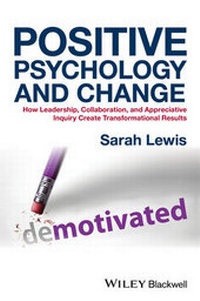
Positive Psychology and Change
How Leadership, Collaboration, and Appreciative Inquiry Create Transformational Results
Published on 29. April 2016
Book
Hardback
272 pages
978-1-118-78884-4 (ISBN)
Description
Positive Psychology and Change explores how areas of positive psychology such as strengths, flow, and psychological capital can be applied to the everyday challenges of leading a dynamic and adaptive work community, and how collaborative group approaches to transformational change can be combined with a positive mindset to maintain optimism and motivation in an unpredictable working environment.
* Articulates a unique vision for organizational leadership in the 21st century that combines positive psychology, Appreciative Inquiry (AI), and collaborative group technologies
* Focuses on four specific co-creative approaches (Appreciative Inquiry, Open Space, World Café and SimuReal) and the ways in which they surpass traditional methods for organizational change
* Explains the latest theory, research, and practice, and translates it into concrete, actionable ideas for meeting the day-to-day challenges of effective and adaptive leadership and management
* Includes learning features such as boxed text, short case studies, stories, and cartoons
Reviews / Votes
"This book is a doorway into generative, strengths-inspired and solutions-focused change. It gives leaders the gift of new eyes and teaches how humility might just be a leader's greatest strength. It brings the joy of high quality connections back into the field of organization development. And it reminds us that we can create conditions - the evidence base is there - to confirm our deepest conviction: that human beings are good. Read this wonderful book carefully." David Cooperrider, Weatherhead School of Management, Case Western Reserve University "We need to develop work organizations in which people thrive and find positive meaning in life rather than being impoverished and exhausted by organizational change. This book offers a profoundly important guide to how we can create such organizations, providing the theoretical rationale, evidence and practical steps necessary to achieve transformational change. Every manager and leader of every organization should not only read it but immediately put it into practice." Michael West, Lancaster University Management School "Sarah Lewis is one of those rare management writers able to combine academic research with practical relevance. In Positive Psychology and Change she offers a fresh, evidence-based rethinking of how large group organizational change methods work and many practical suggestions for how to use them successfully." Gervase R. Bushe, Beedie School of Business, Simon Fraser UniversityMore details
Other editions
Additional editions
Sarah Lewis
Positive Psychology and Change
How Leadership, Collaboration, and Appreciative Inquiry Create Transformational Results
E-Book
03/2016
Wiley-Blackwell
€29.99
Available for download
Sarah Lewis
Positive Psychology and Change
How Leadership, Collaboration, and Appreciative Inquiry Create Transformational Results
E-Book
03/2016
Wiley-Blackwell
€29.99
Available for download
Person
Sarah Lewis, an acknowledged expert on positive psychology and Appreciative Inquiry, is Managing Director and Principal Psychologist at Appreciating Change (www.acukltd.com). She is an Associated Fellow of the British Psychological Society and a Principal Member of the Association of Business Psychologists. She is the author of Appreciative Inquiry for Change Management (Second Edition, 2016) and Positive Psychology at Work (Wiley-Blackwell, 2011). Her work is informed by a positive and appreciative view of organizations, and she also has particular expertise in systemic consultation, Open Space, World Café, and SimuReal. She is a frequent presenter at national and international conferences, facilitates large group events and regularly runs workshops on "The Psychology of Change" through the CIPD.
Content
About the author
Foreword
Preface
Acknowledgements
Chapter One: The Legacy Of Twentieth Century Idea About Organisational Change
Introduction
A Changing World
The Roots Of Many Change Models
Legacy Thinking About Organisational Change
The Legacy Beliefs Of Lewin And Taylor In Our Understanding Of Organisational Change
Conclusion
Chapter Two: The Challenge Of Leadership
Introduction
Should Decisiveness Be The Priority In Leaders?
The Need To Make A Difference
What Does Shifting The Organizational Metaphor Mean For Leaders?
New Definition Of Leadership
Doing Leadership Differently
Characteristics Of A New Leadership Style
Conclusion
Chapter Three: Helping People Engage Positively With Imposed Change
Introduction
Unintended Consequences Of Imposed Change
Understanding The Psychological Impact Of Imposed Change On People
Accessing Psychological Resources To Increase Efficacy And Resilience.
Conclusion
Chapter Four: How The Methodologies Described Later Approach Organisations And Change
Introduction
Key Factors That Create Living Human System Learning And Change
Distinctive Features Of Co-Creative Approaches To Change
Principles Of Practice For Achieving Change In Living Human Systems
Conclusion
Chapter 5: Using Positive Psychology To Achieve Change At The Team And Individual Level
Introduction
Principles
Positive And Appreciative Practices
Conclusion
Chapter Six: Appreciative Inquiry
Introduction
Process
Purpose
Recommended Use
Key Ideas
Critical Success Factors
Key Skills
Background And History
When To Use And Counter-Indications
Conclusion
Chapter Seven: World Café
Introduction
The Process
Purpose
Recommended Use
Key Ideas
Critical Success Factors
Key Skills
Background And History
Conclusion
Chapter 8: Open Space
Introduction
Purpose
Process
Recommended Use
Key Ideas
Critical Success Factors
Key Skills
Background And History
Conclusion
Chapter Nine: Simu-Real
Introduction
Purpose
The Process
Recommended Use
Key Ideas
Critical Success Factors
Key Skills
Background And History
Long-Term Effects
When To Use And Counter-Indications
Chapter 10. Pulling It All Together
Introduction
Rise Of Planned Change Approaches
Co-Creative Approaches To Change
Feature Of Co-Created Change
Linking, Theory, Research And Practice
Time For Something Different
Blended Interventions General Principles For Bringing Emergent Change Insights To Planned Change Projects
POSITIVE: The Whole Strengths Spectrum Approach To Change
Conclusion
References
Index