

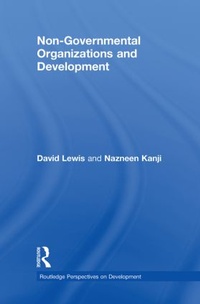
Non-Governmental Organizations and Development
1st Edition
Published on 8. June 2009
Book
Hardback
256 pages
978-0-415-45429-2 (ISBN)
Description
Non-governmental organizations (NGOs) are high profile actors in the field of international development, both as providers of services to vulnerable individuals and communities and as campaigning policy advocates. This book provides a critical introduction to the wide-ranging topic of NGOs and development. Written by two authors with more than twenty years experience of research and practice in the field, the book combines a critical overview of the main research literature with a set of up-to-date theoretical and practical insights drawn from experience in Asia, Europe, Africa and elsewhere. It highlights the importance of NGOs in development, but it also engages fully with the criticisms that the increased profile of NGOs in development now attracts.
Non-Governmental Organizations and Development begins with a discussion of the wide diversity of NGOs and their roles, and locates their recent rise to prominence within broader histories of struggle as well as within the ideological context of neo-liberalism. It then moves on to analyze how interest in NGOs has both reflected and informed wider theoretical trends and debates within development studies, before analyzing NGOs and their practices, using a broad range of short case studies of successful and unsuccessful interventions. David Lewis and Nazneen Kanji then moves on to describe the ways in which NGOs are increasingly important in relation to ideas and debates about 'civil society', globalization and the changing ideas and practices of international aid. The book argues that NGOs are now central to development theory and practice and are likely to remain important actors in development in the years to come. In order to appreciate the issues raised by their increasing diversity and complexity, the authors conclude that it is necessary to deploy a historically and theoretically informed perspective.
This critical overview will be useful to students of development studies at undergraduate and masters levels, as well as to more general readers and practitioners. The format of the book includes figures, photographs and case studies as well as reader material in the form of summary points and questions. Despite the growing importance of the topic, no single short, up-to-date book exists that sets out the main issues in the form of a clearly written, academically-informed text: until now.
Non-Governmental Organizations and Development begins with a discussion of the wide diversity of NGOs and their roles, and locates their recent rise to prominence within broader histories of struggle as well as within the ideological context of neo-liberalism. It then moves on to analyze how interest in NGOs has both reflected and informed wider theoretical trends and debates within development studies, before analyzing NGOs and their practices, using a broad range of short case studies of successful and unsuccessful interventions. David Lewis and Nazneen Kanji then moves on to describe the ways in which NGOs are increasingly important in relation to ideas and debates about 'civil society', globalization and the changing ideas and practices of international aid. The book argues that NGOs are now central to development theory and practice and are likely to remain important actors in development in the years to come. In order to appreciate the issues raised by their increasing diversity and complexity, the authors conclude that it is necessary to deploy a historically and theoretically informed perspective.
This critical overview will be useful to students of development studies at undergraduate and masters levels, as well as to more general readers and practitioners. The format of the book includes figures, photographs and case studies as well as reader material in the form of summary points and questions. Despite the growing importance of the topic, no single short, up-to-date book exists that sets out the main issues in the form of a clearly written, academically-informed text: until now.
Reviews / Votes
"Lewis & Kanji have given us the most comprehensive overview of the work of development NGOs produced to date and this book contains more practical insights into the activities of development NGOs than available in any other single text. Wonderfully sensitive to the diversity of NGOs, the book is full of nuanced summaries and perceptive insights. It should become required reading for every development NGO from the Chief Executive down to the newest intern." Dr Gerard Clarke, Swansea University, UK"This essential introduction to NGOs will be of interest to both students and practitioners. The authors provide an accessible and scholarly account of what remains one of the most significant development phenomena of recent decades." Diana Mitlin, University of Manchester, UK
More details
Series
Language
English
Place of publication
London
United Kingdom
Publishing group
Taylor & Francis Ltd
Target group
College/higher education
Product notice
Paper over boards
Illustrations
6 s/w Zeichnungen, 21 s/w Photographien bzw. Rasterbilder, 27 s/w Abbildungen
6 Line drawings, black and white; 21 Halftones, black and white; 27 Illustrations, black and white
Dimensions
Height: 234 mm
Width: 156 mm
Weight
630 gr
ISBN-13
978-0-415-45429-2 (9780415454292)
Copyright in bibliographic data and cover images is held by Nielsen Book Services Limited or by the publishers or by their respective licensors: all rights reserved.
Schweitzer Classification
Other editions
New editions
David Lewis | Nazneen Kanji | Nuno S. Themudo
Non-Governmental Organizations and Development
Book
12/2020
2nd Edition
Routledge
€206.60
Shipment within 10-20 days
Additional editions
David Lewis | Nazneen Kanji
Non-Governmental Organizations and Development
Book
06/2009
1st Edition
Routledge
€73.31
Article exhausted; check for reprint
Persons
David Lewis teaches in the Department of Social policy at the London School of Economics, where he has specialised in development policy issues in South Asia, with a particular focus on Bangladesh. An anthropologist by background, he is co-author with Katy Gardner of Anthropology, Development and the Postmodern Challenge (Pluto, 1996), and author of The Management of Non-Governmental Development Organizations (Routledge, 2007).
Nazneen Kanji is director of a research programme on 'quality of life' at the Aga Khan Development Network. She has specialised in gender, livelihoods and social policy, with extensive policy research, consultancy and field experience in Africa and Asia. She is the author of Cashing in on Cashew Nuts: Women Producers and Factory Workers in Mozambique in M. Carr (ed) Chains of Fortune: Linking Women Producers and Workers with Global Markets (Commonwealth Secretariat, London. 2004) and co-editor of Poverty Reduction: What role for the State in Today's Globalised Economy? (Zed Press, 2001)
Nazneen Kanji is director of a research programme on 'quality of life' at the Aga Khan Development Network. She has specialised in gender, livelihoods and social policy, with extensive policy research, consultancy and field experience in Africa and Asia. She is the author of Cashing in on Cashew Nuts: Women Producers and Factory Workers in Mozambique in M. Carr (ed) Chains of Fortune: Linking Women Producers and Workers with Global Markets (Commonwealth Secretariat, London. 2004) and co-editor of Poverty Reduction: What role for the State in Today's Globalised Economy? (Zed Press, 2001)
Content
1. Introduction: What are Non-Governmental Organizations? 2. Understanding NGOs in Historical Context 3. NGOs and Development Theory 4. NGOs and Development Practice: From Alternative to Mainstream? 5. NGO Roles in Development 6. NGOs and 'Civil Society' 7. NGOs and Globalization 8. NGOs and the Aid System 9. NGOs and International Humanitarian Action 10. Development NGOs in Perspective