

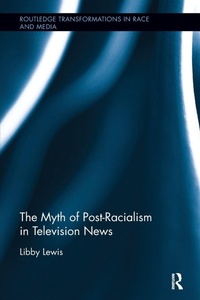
The Myth of Post-Racialism in Television News
1st Edition
Published on 22. December 2017
Book
Paperback/Softback
202 pages
978-0-8153-8642-1 (ISBN)
Description
This book explores the written and unwritten requirements Black journalists face in their efforts to get and keep jobs in television news. Informed by interviews with journalists themselves, Lewis examines how raced Black journalists and their journalism organizations process their circumstances and choose to respond to the corporate and institutional constraints they face. She uncovers the social construction and attempted control of "Blackness" in news production and its subversion by Black journalists negotiating issues of objectivity, authority, voice, and appearance along sites of multiple differences of race, gender, and sexuality.
Reviews / Votes
"Libby Lewis has provided an essential tool in giving agency and voice to the many Black journalists who have tirelessly worked to provide complex representations of people of color in their stories and news organizations."-Akil Housten, Ohio University, USA
"The book's argument is strengthened by firsthand accounts by TV journalists who discuss their experiences with management decisions, including promotions and management of African American journalists within media corporations. Lewis also underscores the complexity of the newsroom environment for black female journalists. The focus of the book is about not just journalists, but also media portrayals of blackness, especially as observed in reporting on Barack and Michelle Obama. Lewis offers a convincing case that the myth of postracialism is nothing but a myth, and that the reality of American journalism is filled with examples of marginalization of African Americans."
- Y. Kiuchi, Michigan State University, CHOICE
"The strength of this book lies in its detailed use of qualitative approaches featuring more than 100 interviews with mostly Black journalists who discussed their experiences of enduring multiple forms of oppression while working in
the television news industry. (...) Lewis's book represents a timely contribution, as we need insights into the seeming paradox of heightened aspirations of racial transcendence celebrated during Obamamania and the invisible hand of Whiteness that ultimately influence social transactions between Black journalists and their White counterparts."
- Christopher Brown, Minnesota State University, USA, Journalism & Mass Communication Quarterly
More details
Series
Language
English
Place of publication
New York
United States
Publishing group
Taylor & Francis Inc
Target group
College/higher education
Postgraduate and Undergraduate
Illustrations
2 s/w Abbildungen, 2 s/w Zeichnungen
2 Line drawings, black and white; 2 Illustrations, black and white
Dimensions
Height: 229 mm
Width: 152 mm
Thickness: 11 mm
Weight
304 gr
ISBN-13
978-0-8153-8642-1 (9780815386421)
Copyright in bibliographic data and cover images is held by Nielsen Book Services Limited or by the publishers or by their respective licensors: all rights reserved.
Schweitzer Classification
Other editions
Additional editions
Libby Lewis
The Myth of Post-Racialism in Television News
Book
09/2015
1st Edition
Routledge
€231.40
Shipment within 10-20 days
Libby Lewis
The Myth of Post-Racialism in Television News
E-Book
08/2015
Routledge
€69.99
Available for download
Libby Lewis
The Myth of Post-Racialism in Television News
E-Book
08/2015
Routledge
€69.99
Available for download
Person
Libby Lewis is a Lecturer in African American Studies at the University of California, Los Angeles, USA. She earned a Ph.D. in African Diaspora Studies with a Designated Emphasis in Women, Gender, and Sexuality Studies from the University of California, Berkeley, USA.
Content
Introduction 1. Professionalizing and Palatable "Blackness" 2. Branding and Marketing "Blackness" 3. From Stumbling Block to Stepping Stone 4. Owning the "Ghetto" Shows 5. Rules of Engagement: The Politics of Race, Gender, and Sexuality 6. Barack and Michelle Obama as Signs of Progress and Threat Concluding Remarks