

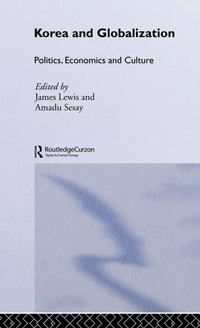
Korea and Globalization
Politics, Economics and Culture
Published on 28. March 2002
Book
Hardback
256 pages
978-0-7007-1512-1 (ISBN)
Description
Korea faces two challenges in the twenty-first century: unification and globalization. Both entail problems of economic, political and cultural integration. In the past, Koreans successfully 'unified' in various forms, and 'globalized' in many ways. This book is a study of the theme of globalization, addressing various aspects of Korea's integration into the global community from a social scientific or humanistic perspective. This investigation begins with a focus on contemporary South and North Korea: the 'globalized' southern daily life, South Korean labour as a global player, the southern development state, and the cultural division that poses the greatest threat to reunification.
Moving outwards in concentric circles, chapters address Korea's connections with its region and Koreans' contributions to the wider world. Relations with Japan, Korea's most difficult bi-lateral relationship, are surveyed to identify both patterns and images. The thirteenth century Tripitaka Koreana is the most complete collection of Buddhist scripture in Chinese and its recent digitization points towards a renaissance of this world religion. South Korea's pursuit of a Nobel Prize in Literature is put in perspective when one considers Korean contribution to the pre-modern Sinitic literary world. South Korea may owe its existence to the United Nations, but since entering the UN in 1991, it has taken to heart the altruistic urge of global peacekeeping.
Moving outwards in concentric circles, chapters address Korea's connections with its region and Koreans' contributions to the wider world. Relations with Japan, Korea's most difficult bi-lateral relationship, are surveyed to identify both patterns and images. The thirteenth century Tripitaka Koreana is the most complete collection of Buddhist scripture in Chinese and its recent digitization points towards a renaissance of this world religion. South Korea's pursuit of a Nobel Prize in Literature is put in perspective when one considers Korean contribution to the pre-modern Sinitic literary world. South Korea may owe its existence to the United Nations, but since entering the UN in 1991, it has taken to heart the altruistic urge of global peacekeeping.
More details
Language
English
Place of publication
London
United Kingdom
Publishing group
Taylor & Francis Ltd
Target group
College/higher education
Dimensions
Height: 222 mm
Width: 145 mm
Thickness: 19 mm
Weight
497 gr
ISBN-13
978-0-7007-1512-1 (9780700715121)
Copyright in bibliographic data and cover images is held by Nielsen Book Services Limited or by the publishers or by their respective licensors: all rights reserved.
Schweitzer Classification
Other editions
Additional editions
Book
04/2016
1st Edition
Routledge
€73.10
Shipment within 10-20 days
E-Book
07/2013
1st Edition
Routledge
€67.49
Available for download
E-Book
07/2013
Routledge
€67.49
Available for download
Persons
James B. Lewis, Amadu Sesay
Content
Introduction, James Lewis; Chapter 1 Globalization and Recent Changes to Daily Life in the Republic of Korea, Yi Jeong Duk; Chapter 2 Labor, Capital, and the Globalization of the Korean Economy, Yin Bao Yun; Chapter 3 From Insularity to segyehwa, Nahzeem Oluwafemi Mimiko; Chapter 4 Commonalities and Differences between the Cultures of North and South Korea and the Unification of the Peninsula, Jin Jing Yi; Chapter 5 The Japan That Does Not Exist and The Ugly Korean, James Lewis; Chapter 6 The Tripitaka Koreana, Kim Jong-myung; Chapter 7 The Re-globalization of Korean Literature, Alexander Fedotoff; Chapter 8 In the Global Arena, Amadu Sesay;