

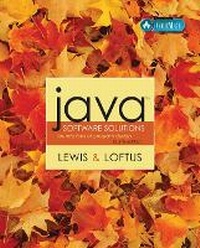
Java Software Solutions
Foundations of Program Design: United States Edition
4th Edition
Published on 23. July 2004
Book
Paperback/Softback
900 pages
978-0-321-24583-0 (ISBN)
Description
Java Software Solutions, Fourth Edition takes full advantage of the Java 5.0 release in a way that is appropriate for those just learning to write high quality programs. This new edition has an earlier evolution of object concepts, developed in a way that capitalizes on the power of objects without overwhelming beginning programmers.
More details
Edition
4th edition
Language
English
Place of publication
United States
Publishing group
Pearson Education (US)
Target group
College/higher education
Dimensions
Height: 232 mm
Width: 187 mm
Weight
1000 gr
ISBN-13
978-0-321-24583-0 (9780321245830)
Copyright in bibliographic data and cover images is held by Nielsen Book Services Limited or by the publishers or by their respective licensors: all rights reserved.
Schweitzer Classification
Other editions
New editions
John Lewis | William Loftus
Java Software Solutions (Java 5.0 version)
Foundations of Program Design: United States Edition
Book
12/2004
4th Edition
Pearson
€78.18
Article exhausted; check for reprint
Previous edition
John Lewis | William Loftus
Java Software Solutions
Foundations of Program Design, CodeMate Enhanced Edition: United States Edition
Book
08/2003
3rd Edition
Pearson
€73.21
Article exhausted; check for reprint
Content
(* indicates Graphics Track Section.)
Preface.
1. Introduction.
Computer Processing.
Hardware Components.
Networks.
The Java Programming Language.
Program Development.
Object-Oriented Programming.
2. Data and Expressions.
Character Strings.
Variables and Assignments.
Primitive Data Types.
Expressions.
Data Conversion.
Interactive Programs.
*Graphics.
*Applets.
*Drawing Shapes.
3. Using Classes and Objects.
Creating Objects.
The String Class.
The Random Class.
The Math Class.
Formatting Output.
Enumerated Types.
Wrapper Classes.
*Components and Containers.
*Nested Panels.
*Images.
4. Writing Classes.
Anatomy of a Class.
Encapsulation.
Anatomy of a Method.
Constructors.
*Graphical Objects.
*Graphical User Interfaces.
*Buttons.
*Text Fields.
5. Conditionals and Loops.
Flow of Control.
Boolean Expressions.
The if Statement.
Comparing Data.
The switch Statement.
The while Statement.
Iterators.
The do Statement.
The for Statement.
*Drawing with Loops and Conditionals.
*Determining Event Sources.
*Dialog Boxes.
*Check Boxes and Ratio Buttons.
6. Object-Oriented Design.
Identifying Objects and Classes.
Object Relationships.
Static Class Members.
Interfaces.
Enumerated Types Revisited.
Method Overloading.
Method Design.
Scope.
Testing.
*GUI Design.
*Layout Managers.
*Containment Hierarchies.
7. Arrays.
Array Elements.
Declaring and Using Arrays.
Arrays of Objects.
Command-Line Arguments.
Variable Length Parameter Lists.
Searching.
Sorting.
Two-Dimensional Arrays.
The ArrayList Class.
*Polygons and Polylines.
*Mouse Events.
*Key Events.
8. Inheritance.
Creating Subclasses.
Overriding Methods.
Class Hierarchies.
Visibility.
Interface Hierarchies.
Designing for Inheritance.
*Component Class Hierarchy.
*Extending Adaptor Classes.
*The Timer Class.
9. Polymorphism.
Binding.
Polymorphism via Inheritance.
Polymorphism via Interfaces.
Designing for Polymorphism.
*Event Processing.
*File Choosers.
*Color Choosers.
*Sliders.
10. Exceptions.
Errors and Exceptions.
Uncaught Exceptions.
The try-catch Statement.
Exception Propagation.
The Exception Class Hierarchy.
I/O Exceptions.
*Mneumonics and Tool Tips.
*Combo Boxes.
*Scroll Panes and Split Panes.
11. Recursion.
Recursive Thinking.
Recursive Programming.
Using Recursion.
*Recursion in Graphics.
12. Collections.
Collections and Data Structures.
Dynamic Representations.
Generic Types.
Linear Data Structures.
Non-Linear Data Structures.
Appendicies.
A: Glossary.
B: Number Systems.
C: The Unicode Character Set.
D: Java Operators.
E: Java Modifiers.
F: Coding Guidelines.
G: Java Applets.
H: Regular Expressions.
I: JavaDoc Doumentation Generator.
J: The PaintBox Project.
K: GUI Events.
L: Java Syntax.
M: Java Class Libraries.
Index.
Preface.
1. Introduction.
Computer Processing.
Hardware Components.
Networks.
The Java Programming Language.
Program Development.
Object-Oriented Programming.
2. Data and Expressions.
Character Strings.
Variables and Assignments.
Primitive Data Types.
Expressions.
Data Conversion.
Interactive Programs.
*Graphics.
*Applets.
*Drawing Shapes.
3. Using Classes and Objects.
Creating Objects.
The String Class.
The Random Class.
The Math Class.
Formatting Output.
Enumerated Types.
Wrapper Classes.
*Components and Containers.
*Nested Panels.
*Images.
4. Writing Classes.
Anatomy of a Class.
Encapsulation.
Anatomy of a Method.
Constructors.
*Graphical Objects.
*Graphical User Interfaces.
*Buttons.
*Text Fields.
5. Conditionals and Loops.
Flow of Control.
Boolean Expressions.
The if Statement.
Comparing Data.
The switch Statement.
The while Statement.
Iterators.
The do Statement.
The for Statement.
*Drawing with Loops and Conditionals.
*Determining Event Sources.
*Dialog Boxes.
*Check Boxes and Ratio Buttons.
6. Object-Oriented Design.
Identifying Objects and Classes.
Object Relationships.
Static Class Members.
Interfaces.
Enumerated Types Revisited.
Method Overloading.
Method Design.
Scope.
Testing.
*GUI Design.
*Layout Managers.
*Containment Hierarchies.
7. Arrays.
Array Elements.
Declaring and Using Arrays.
Arrays of Objects.
Command-Line Arguments.
Variable Length Parameter Lists.
Searching.
Sorting.
Two-Dimensional Arrays.
The ArrayList Class.
*Polygons and Polylines.
*Mouse Events.
*Key Events.
8. Inheritance.
Creating Subclasses.
Overriding Methods.
Class Hierarchies.
Visibility.
Interface Hierarchies.
Designing for Inheritance.
*Component Class Hierarchy.
*Extending Adaptor Classes.
*The Timer Class.
9. Polymorphism.
Binding.
Polymorphism via Inheritance.
Polymorphism via Interfaces.
Designing for Polymorphism.
*Event Processing.
*File Choosers.
*Color Choosers.
*Sliders.
10. Exceptions.
Errors and Exceptions.
Uncaught Exceptions.
The try-catch Statement.
Exception Propagation.
The Exception Class Hierarchy.
I/O Exceptions.
*Mneumonics and Tool Tips.
*Combo Boxes.
*Scroll Panes and Split Panes.
11. Recursion.
Recursive Thinking.
Recursive Programming.
Using Recursion.
*Recursion in Graphics.
12. Collections.
Collections and Data Structures.
Dynamic Representations.
Generic Types.
Linear Data Structures.
Non-Linear Data Structures.
Appendicies.
A: Glossary.
B: Number Systems.
C: The Unicode Character Set.
D: Java Operators.
E: Java Modifiers.
F: Coding Guidelines.
G: Java Applets.
H: Regular Expressions.
I: JavaDoc Doumentation Generator.
J: The PaintBox Project.
K: GUI Events.
L: Java Syntax.
M: Java Class Libraries.
Index.