

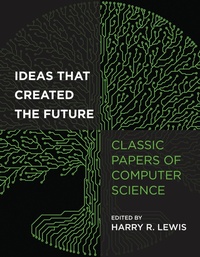
Ideas That Created the Future
Classic Papers of Computer Science
Published on 2. February 2021
Book
Paperback/Softback
520 pages
978-0-262-04530-8 (ISBN)
Description
Classic papers by thinkers ranging from from Aristotle and Leibniz to Norbert Wiener and Gordon Moore that chart the evolution of computer science.
Ideas That Created the Future collects forty-six classic papers in computer science that map the evolution of the field. It covers all aspects of computer science: theory and practice, architectures and algorithms, and logic and software systems, with an emphasis on the period of 1936-1980 but also including important early work. Offering papers by thinkers ranging from Aristotle and Leibniz to Alan Turing and Nobert Wiener, the book documents the discoveries and inventions that created today's digital world. Each paper is accompanied by a brief essay by Harry Lewis, the volume's editor, offering historical and intellectual context.
Ideas That Created the Future collects forty-six classic papers in computer science that map the evolution of the field. It covers all aspects of computer science: theory and practice, architectures and algorithms, and logic and software systems, with an emphasis on the period of 1936-1980 but also including important early work. Offering papers by thinkers ranging from Aristotle and Leibniz to Alan Turing and Nobert Wiener, the book documents the discoveries and inventions that created today's digital world. Each paper is accompanied by a brief essay by Harry Lewis, the volume's editor, offering historical and intellectual context.
More details
Language
English
Place of publication
Cambridge (Massachusetts)
United States
Publishing group
MIT Press Ltd
Illustrations
120
Dimensions
Height: 175 mm
Width: 228 mm
Thickness: 25 mm
Weight
810 gr
ISBN-13
978-0-262-04530-8 (9780262045308)
Copyright in bibliographic data and cover images is held by Nielsen Book Services Limited or by the publishers or by their respective licensors: all rights reserved.
Schweitzer Classification
Other editions
Additional editions
E-Book
02/2021
MIT Press
€58.99
Available for download
Person
Harry R. Lewis
Content
1 Prior Analytics (∼350 BCE) 1
2 The True Method (1677) 5
3 Sketch of the Analytical Engine (1843) 9
4 An Investigation of the Laws of Thought on Which Are Founded the Mathematical Theories of Logic and Probabilities (1854) 27
5 Mathematical Problems (1900) 45
6 On Computable Numbers, with an Application to the Entscheidungsproblem (1936) 51
7 A Proposed Automatic Calculating Machine (1937) 61
8 A Symbolic Analysis of Relay and Switching Circuits (1938) 71
9 A Logical Calculus of the Ideas Immanent in Nervous Activity (1943) 79
10 First Draft of a Report on the EDVAC (1945) 89
11 As We May Think (1945) 107
12 A Mathematical Theory of Communication (1948) 121
13 Error Detecting and Error Correcting Codes (1950) 135
14 Computing Machinery and Intelligence (1950) 147
15 The Best Way to Design an Automatic Calculating Machine (1951) 165
16 The Education of a Computer (1952) 169
17 On the Shortest Spanning Subtree of a Graph and the Traveling Salesman Problem (1956) 179
18 The Perceptron: A Probabilistic Model for Information Storage and Organization (1958) 183
19 Some Moral and Technical Consequences of Automation (1960) 191
20 Man–Computer Symbiosis (1960) 201
21 Recursive Functions of Symbolic Expressions and Their Computation by Machine (1960) 213
22 Augmenting Human Intellect: A Conceptual Framework (1962) 225
23 An Experimental Time-Sharing System (1962) 237
24 Sketchpad (1963) 251
25 Cramming More Components onto Integrated Circuits (1965) 261
26 Solution of a Problem in Concurrent Program Control (1965) 267
27 ELIZA—A Computer Program for the Study of Natural Language Communication between Man and Machine (1966) 271
28 The Structure of the “THE”-Multiprogramming System (1968) 279
29 Go To Statement Considered Harmful (1968) 289
30 Gaussian Elimination is Not Optimal (1969) 293
31 An Axiomatic Basis for Computer Programming (1969) 297
32 A Relational Model of Large Shared Data Banks (1970) 307
33 Managing the Development of Large Software Systems (1970) 321
34 The Complexity of Theorem-Proving Procedures (1971) 333
35 A Statistical Interpretation of Term Specificity and Its Application in Retrieval (1972) 339
36 Reducibility among Combinatorial Problems (1972) 349
37 The Unix Time-Sharing System (1974) 357
38 A Protocol for Packet Network Intercommunication (1974) 373
39 Programming with Abstract Data Types (1974) 387
40 The Mythical Man-Month (1975) 399
41 Ethernet: Distributed Packet Switching for Local Computer Networks (1976) 407
42 New Directions in Cryptography (1976) 421
43 Big Omicron and Big Omega and Big Theta (1976) 441
44 Social Processes and Proofs of Theorems and Programs (1977) 447
45 A Method for Obtaining Digital Signatures and Public-Key Cryptosystems (1978) 463
46 How to Share a Secret (1979) 475
Bibliography 479
Index 491
2 The True Method (1677) 5
3 Sketch of the Analytical Engine (1843) 9
4 An Investigation of the Laws of Thought on Which Are Founded the Mathematical Theories of Logic and Probabilities (1854) 27
5 Mathematical Problems (1900) 45
6 On Computable Numbers, with an Application to the Entscheidungsproblem (1936) 51
7 A Proposed Automatic Calculating Machine (1937) 61
8 A Symbolic Analysis of Relay and Switching Circuits (1938) 71
9 A Logical Calculus of the Ideas Immanent in Nervous Activity (1943) 79
10 First Draft of a Report on the EDVAC (1945) 89
11 As We May Think (1945) 107
12 A Mathematical Theory of Communication (1948) 121
13 Error Detecting and Error Correcting Codes (1950) 135
14 Computing Machinery and Intelligence (1950) 147
15 The Best Way to Design an Automatic Calculating Machine (1951) 165
16 The Education of a Computer (1952) 169
17 On the Shortest Spanning Subtree of a Graph and the Traveling Salesman Problem (1956) 179
18 The Perceptron: A Probabilistic Model for Information Storage and Organization (1958) 183
19 Some Moral and Technical Consequences of Automation (1960) 191
20 Man–Computer Symbiosis (1960) 201
21 Recursive Functions of Symbolic Expressions and Their Computation by Machine (1960) 213
22 Augmenting Human Intellect: A Conceptual Framework (1962) 225
23 An Experimental Time-Sharing System (1962) 237
24 Sketchpad (1963) 251
25 Cramming More Components onto Integrated Circuits (1965) 261
26 Solution of a Problem in Concurrent Program Control (1965) 267
27 ELIZA—A Computer Program for the Study of Natural Language Communication between Man and Machine (1966) 271
28 The Structure of the “THE”-Multiprogramming System (1968) 279
29 Go To Statement Considered Harmful (1968) 289
30 Gaussian Elimination is Not Optimal (1969) 293
31 An Axiomatic Basis for Computer Programming (1969) 297
32 A Relational Model of Large Shared Data Banks (1970) 307
33 Managing the Development of Large Software Systems (1970) 321
34 The Complexity of Theorem-Proving Procedures (1971) 333
35 A Statistical Interpretation of Term Specificity and Its Application in Retrieval (1972) 339
36 Reducibility among Combinatorial Problems (1972) 349
37 The Unix Time-Sharing System (1974) 357
38 A Protocol for Packet Network Intercommunication (1974) 373
39 Programming with Abstract Data Types (1974) 387
40 The Mythical Man-Month (1975) 399
41 Ethernet: Distributed Packet Switching for Local Computer Networks (1976) 407
42 New Directions in Cryptography (1976) 421
43 Big Omicron and Big Omega and Big Theta (1976) 441
44 Social Processes and Proofs of Theorems and Programs (1977) 447
45 A Method for Obtaining Digital Signatures and Public-Key Cryptosystems (1978) 463
46 How to Share a Secret (1979) 475
Bibliography 479
Index 491