

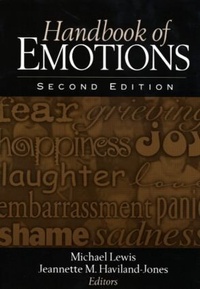
Handbook of Emotions, Second Edition
2nd Edition
Published on 20. May 2004
Book
Paperback/Softback
720 pages
978-1-59385-029-6 (ISBN)
Description
This comprehensive handbook provides a broad, balanced examination of what is currently known about emotion in human behavior. Leading experts first describe basic concepts and research models and explore the biology and neurophysiology of emotion. The following three sections address developmental pathways, issues related to social processes and personality, and the complex interface of affect and cognition. Next, innovative research on emotions and health is presented in a section that represents one of the field's most dynamic and fruitful areas of inquiry. Concluding chapters comprise in-depth reviews of a selection of widely studied emotions: fear, anger, sadness, shame, disgust, love, and happiness, among others.
Reviews / Votes
Emotion is a complex area, and one to which readers bring widely varying interests, biases, and levels of sophistication. This volume does very well in covering the basic and applied topics that are relevant to a broad audience. Presented by a distinguished group of experts who have much of import to say, the second edition of the Handbook is valuable as both a professional resource and a graduate-level text. - Richard S. Lazarus, University of California, BerkeleyThis is truly a handbook - in the classic sense of a standard reference source - and it is the only book in the field that is worthy of the designation. - Joseph J. Campos, University of California, Berkeley
This comprehensive, scholarly Handbook will further propel interest in the role of emotion. The first edition was named a Choice magazine Outstanding Academic Book of 1995. It is likely that the present second edition will garner similar accolades. It has my vote! Highly recommended for researchers and clinicians. - Donald Meichenbaum, University of Waterloo, Canada
This book served as the core reference for a graduate seminar I taught on emotion theory and research. All of the students found the assigned readings to be highly readable and comprehensive. I can't think of a better resource on the current status of emotion research for both graduate students and advanced undergraduates. - Alfred W. Kaszniak, University of Arizona
An excellent text for graduate-level courses on emotion and motivation....In addition, graduate students and faculty alike can use the Handbook as a springboard for developing their research ideas on various emotion-relevant topics. - Julie Hakim-Larson, University of Windsor, Canada This is truly a handbook - in the classic sense of a standard reference source - and it is the only book in the field that is worthy of the designation. - Joseph J. Campos, University of California, Berkeley, USA
More details
Edition
2nd edition
Language
English
Place of publication
New York
United States
Target group
College/higher education
Professional and scholarly
Dimensions
Height: 246 mm
Width: 174 mm
Weight
1260 gr
ISBN-13
978-1-59385-029-6 (9781593850296)
Copyright in bibliographic data and cover images is held by Nielsen Book Services Limited or by the publishers or by their respective licensors: all rights reserved.
Schweitzer Classification
Other editions
Additional editions
Michael Lewis | Lisa Feldman Barrett | Jeannette M. Haviland-Jones
Handbook of Emotions, Second Edition
Book
07/2000
2nd Edition
Guilford Publications
€98.11
Article exhausted; check different version
Persons
Michael Lewis, PhD, is University Distinguished Professor of Pediatrics and Psychiatry and Director of the Institute for the Study of Child Development at the UMDNJ-Robert Wood Johnson Medical School.
Jeannette M. Haviland-Jones, PhD, is Professor of Psychology at Rutgers University.
Jeannette M. Haviland-Jones, PhD, is Professor of Psychology at Rutgers University.
Content
Part 1: Interdisciplinary Foundations.Solomon, The Philosophy of Emotions. Stearns, History of Emotions: Issues of Change and Impact. White, Representing Emotional Meaning: Category, Metaphor, Schema, Discourse. Kemper, Social Models in the Explanation of Emotions. Frijda, The Psychologists' Point of View. Brown, Emotion and Clinical Depression: An Environmental View. Cosmides, Tooby, Evolutionary Psychology and the Emotions. Tan, Emotion, Art, and the Humanities. Part 2: Biological and Neurophysiological Approaches to Emotion.Panksepp, Emotions as Natural Kinds within the Mammalian Brain. LeDoux, Phelps, Emotional Networks in the Brain. Cacioppo, Berntson, Larsen, Poehlmann, Ito, The Psychophysiology of Emotion. Rende, Emotion and Behavior Genetics. Fox, Calkins, Multiple-Measure Approaches to the Study of Infant Emotion. Johnstone, Scherer, Vocal Communication of Emotion. Keltner, Ekman, Facial Expression of Emotion. Part 3: Developmental Changes. Izard, Ackerman, Motivational, Organizational, and Regulatory Functions of Discrete Emotions. Lewis, The Emergence of Human Emotions. Harris, Understanding Emotion. Haviland-Jones, Kahlbaugh, Emotion and Identity. Saarni, The Social Context of Emotional Development. Part 4: Social/Personality Issues. Diener, Lucas, Subjective Emotional Well-Being. Brody, Hall, Gender, Emotion, and Expression. Forgas, Vargas, The Effects of Mood on Social Judgment and Reasoning. Hess, Kirouac, Emotion Expression in Groups. Bates, Temperament as an Emotion Construct: Theoretical and Practical Issues. Shweder, Haidt, The Cultural Psychology of the Emotions: Ancient and New. Part 5: Cognitive Factors. Isen, Positive Affect and Decision Making. Stein, Trabasso, Liwag, A Goal Appraisal Theory of Emotional Understanding: Implications for Development and Learning. Johnson-Laird, Oatley, Cognitive and Social Construction in Emotions. Parrott, Spackman, Emotion and Memory. Russell, Lemay, Emotion Concepts. Salovey, Bedell, Detweiler, Mayer, Current Directions in Emotional Intelligence Research. Part 6: Health and Emotions. Leventhal, Patrick-Miller, Emotions and Physical Illness: Causes and Indicators of Vulnerability. Miller, Schnoll, When Seeing Is Feeling: A Cognitive Emotional Approach to Coping with Health Stress. Booth, Pennebaker, Emotions and Immunity. Part 7: Select Emotions.OEhman, Fear and Anxiety: Evolutionary, Cognitive, and Clinical Perspectives. Lemerise, Dodge, The Development of Anger and Hostile Interactions. Barr-Zisowitz, Sadness Is There Such a Thing?. Lewis, Self- Conscious Emotions: Embarrassment, Pride, Shame, and Guilt. Rozin, Haidt, McCauley, Disgust. Hatfield, Rapson, Love and Attachment Processes. Averill, More, Happiness. Eisenberg, Empathy and Sympathy