

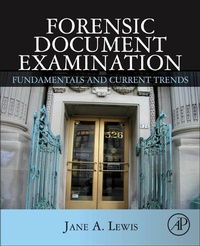
Forensic Document Examination
Fundamentals and Current Trends
Published on 2. April 2014
Book
Hardback
232 pages
978-0-12-416693-6 (ISBN)
Description
Forensic Document Examination enlightens forensic document examiners, forensic investigators, attorneys and others using the services of forensic document examiners with the basic principles and current trends in the area. Standards and methodologies apply now, which were non-existent 20 years ago. Instrumentation has moved beyond the microscope and the magnifying glass to digital cameras, digital microscopes, video spectral comparators, electrostatic detection devices for the development of indented writing on paper, scanners, and software programs like Write-On 2.0 and Photoshop.
Reviews / Votes
"The layout of the book is extremely well thought out and makes it very easy to read, due to the chapter division by colors, the font size, type and spacing....it contains excellent colored illustrations..." --InterfacesMore details
Language
English
Place of publication
San Diego
United States
Publishing group
Elsevier Science Publishing Co Inc
Target group
Professional and scholarly
Primary: Forensic document examiners and forensic investigators. Secondary: Attorneys and forensic science students.
Product notice
sewn/stitched
Cloth over boards
Dimensions
Height: 244 mm
Width: 195 mm
Thickness: 20 mm
Weight
782 gr
ISBN-13
978-0-12-416693-6 (9780124166936)
Copyright in bibliographic data and cover images is held by Nielsen Book Services Limited or by the publishers or by their respective licensors: all rights reserved.
Schweitzer Classification
Other editions
Additional editions
E-Book
01/2014
Academic Press
€75.95
Available for download
Person
1985 was a good year. Jane Lewis finished an internship in the Questioned Document section of the Secret Service Lab in Washington, DC. She graduated with a Master of Forensic Sciences degree from George Washington University and got a job as a document analyst with the FBI in the Hoover Building in Washington DC. She soon moved up the mall to the Secret Service Lab. But the lure of beer and bratwurst was too strong and Jane found herself back home at the Wisconsin State Crime Lab in Milwaukee. Twenty-three years later Jane retired from the Milwaukee Lab and moved on to greener pastures working in private practice in Milwaukee.She is certified by the American Board of Forensic Document Examiners. Jane is a member of the American Society of Questioned Document Examiners (ASQDE), Assistant Editor of the Journal of the American Society of Questioned Document Examiners, a Director representing the Questioned Document Section of the American Academy of Forensic Sciences (AAFS), a fellow in the Questioned Document Section of AAFS and a member of the Midwestern Association of Forensic Scientists (MAFS).Jane has testified more than 50 times as a forensic document examiner. She has presented her research at the annual scientific sessions of AAFS, ASQDE and MAFS. Her research has been published in the Journal of Forensic Sciences and the Journal of the American Society of Questioned Document Examiners. Jane along with three colleagues wrote a chapter on Forensic document examination in the book Forensic Science Current Issues, Future Directions, edited by Douglas H. Ubelaker, published in 2013.
Content
Chapter 1: A Brief History of Writing Chapter 2: The History of Forensic DocumentChapter 3: Forensic Document Examination DefinedChapter 4: Handwriting Individuality Chapter 5: Basic Methodology Chapter 6: Instrumentation Chapter 7: Case Examples Chapter 8: Standards for Forensic Document ExaminersChapter 9: Forensic Document Examination in the CourtsChapter 10: Court Preparation in Questioned Document CasesChapter 11: Court Charts Chapter 12: Questioned Document Research Present and Future