

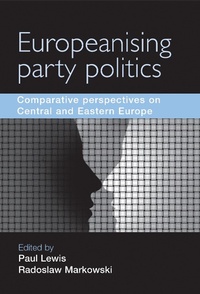
Europeanising Party Politics
Comparative Perspectives on Central and Eastern Europe
Published on 1. July 2011
Book
Hardback
272 pages
978-0-7190-8297-9 (ISBN)
Description
The book is a comparative, empirically based study of party politics in contemporary Central and Eastern Europe that seeks to define the impact of European Union membership in this area. The question of Europeanisation has been intensively debated over recent years, but no firm conclusion has been reached. This collection of rigorously comparative contributions directs attention to a number of key areas in the attempt to isolate cases where Europe has made a difference.
Successive chapters examine how new parties are managed by the state and the ways in which parties colonise the state itself, the role of transnational cooperation and the influence pan-European parties have on national organisations. The book goes on to consider patterns of party-oriented participation in the new democracies and dimensions of electoral turnout, dimensions of inter-party competition and identification of the specific features of post-communist party politics, examination of the key case of the extreme right and the conditions under which it tends to emerge, detailed analysis of the quality of political representation in the new democratic context, and discussion of how EU constraints are likely to undermine the prospects of stable party linkages. A conclusion seeks to establish how far Europe and EU policy has succeeded in influencing Central and East European developments. -- .
Successive chapters examine how new parties are managed by the state and the ways in which parties colonise the state itself, the role of transnational cooperation and the influence pan-European parties have on national organisations. The book goes on to consider patterns of party-oriented participation in the new democracies and dimensions of electoral turnout, dimensions of inter-party competition and identification of the specific features of post-communist party politics, examination of the key case of the extreme right and the conditions under which it tends to emerge, detailed analysis of the quality of political representation in the new democratic context, and discussion of how EU constraints are likely to undermine the prospects of stable party linkages. A conclusion seeks to establish how far Europe and EU policy has succeeded in influencing Central and East European developments. -- .
More details
Language
English
Place of publication
Manchester
United Kingdom
Target group
College/higher education
Product notice
Unsewn / adhesive bound
Cloth over boards
With dust jacket
Illustrations
Illustrations, black & white|Tables
Dimensions
Height: 236 mm
Width: 157 mm
Thickness: 28 mm
Weight
590 gr
ISBN-13
978-0-7190-8297-9 (9780719082979)
Copyright in bibliographic data and cover images is held by Nielsen Book Services Limited or by the publishers or by their respective licensors: all rights reserved.
Schweitzer Classification
Persons
Paul Lewis is Professor of European Politics at the Open University. Radoslaw Markowski is Director of the Polish National Election Study at the Institute of Political Studies, Polish Academy of Sciences. -- .
Content
1. Introduction: Europeanising party politics? Central and Eastern Europe
after EU enlargement, by Paul G. Lewis
2. Party management and state colonisation in post-communist Europe:
the European dimension, by Petr Kopecky and Maria Spirova
3. Political parties and their consolidation in post-communist new
democracies: indirect and direct impacts from EU enlargement, by
Geoffrey Pridham
4. Changing patterns of political participation, by Mitja Hafner-Fink,
Danica Fink-Hafner and Alenka Krasovec
5. Voter turnout and electoral success of pro-European parties in post
communist Europe, by Mikolaj Czesnik
6. Patterns of party competition, by Zsolt Enyedi and Fernando Casal
Bertoa
7. The radical right in post-communist Europe: comparative perspectives
on party competition, by Lenka Bustikova and Herbert Kitschelt
8. The quality of social, partisan and governmental representation, by
Radoslaw Markowski and Zsolt Enyedi
9. (Shallow) Europeanisation and party system instability in post
communist states: how changing constraints undermine the
development of stable partisan linkages, by Robert Ladrech
10. Conclusion, by Radoslaw Markowski -- .
after EU enlargement, by Paul G. Lewis
2. Party management and state colonisation in post-communist Europe:
the European dimension, by Petr Kopecky and Maria Spirova
3. Political parties and their consolidation in post-communist new
democracies: indirect and direct impacts from EU enlargement, by
Geoffrey Pridham
4. Changing patterns of political participation, by Mitja Hafner-Fink,
Danica Fink-Hafner and Alenka Krasovec
5. Voter turnout and electoral success of pro-European parties in post
communist Europe, by Mikolaj Czesnik
6. Patterns of party competition, by Zsolt Enyedi and Fernando Casal
Bertoa
7. The radical right in post-communist Europe: comparative perspectives
on party competition, by Lenka Bustikova and Herbert Kitschelt
8. The quality of social, partisan and governmental representation, by
Radoslaw Markowski and Zsolt Enyedi
9. (Shallow) Europeanisation and party system instability in post
communist states: how changing constraints undermine the
development of stable partisan linkages, by Robert Ladrech
10. Conclusion, by Radoslaw Markowski -- .