

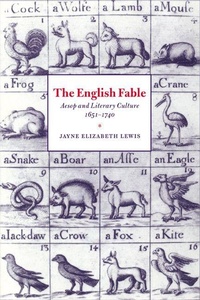
The English Fable
Aesop and Literary Culture, 1651-1740
Published on 30. March 2006
Book
Paperback/Softback
248 pages
978-0-521-02531-7 (ISBN)
Description
Between 1651 and 1740 hundreds of fables, fable collections, and biographies of the ancient Greek slave Aesop were published in England. In The English Fable, Jayne Elizabeth Lewis describes the national obsession with Aesop's fables during this period as both a figural response to sociopolitical crises, and an antidote to emerging anxieties about authorship. Lewis traces the role that fable collections, Augustan fable theory, and debates about the figure of Aesop played in the formation of a modern, literate, and self-consciously English culture, and shows how three Augustan writers - John Dryden, Anne Finch, and John Gay - experimented with the seemingly marginal symbolic form of fable to gain access to new centres of English culture. Often interpreted as a discourse of the dispossessed, the fable in fact offered Augustan writers access to a unique form of cultural authority.
More details
Series
Language
English
Place of publication
Cambridge
United Kingdom
Target group
Professional and scholarly
Product notice
Paperback (trade)
Illustrations
9 Halftones, unspecified
Dimensions
Height: 229 mm
Width: 152 mm
Thickness: 15 mm
Weight
408 gr
ISBN-13
978-0-521-02531-7 (9780521025317)
Copyright in bibliographic data and cover images is held by Nielsen Book Services Limited or by the publishers or by their respective licensors: all rights reserved.
Schweitzer Classification
Person
Content
Acknowledgments; Introduction: The English fable; 1. Aesopiean examples: the English fable collection and its authors, 1651-1740; 2. 'The first pieces of wit': Augustan fable theory and the birth of the book; 3. Common and uncommon characters: the lives of Aesop; 4. Brutal transactions, 'mysterious writ': Aesop's fables and Dryden's later poetry; 5. In her 'transparent Laberynth': obstructions of poetic justice in Anne Finch's fables; 6. Risking contradiction: John Gay's Fables and the matter of reading; 7. The moral; Notes; Bibliography; Index.