

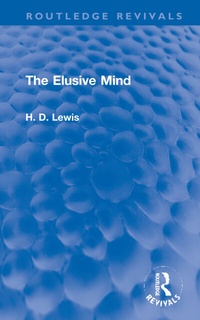
The Elusive Mind
1st Edition
Published on 30. October 2021
Book
Hardback
340 pages
978-1-032-10382-2 (ISBN)
Description
First published in 1969, The Elusive Mind argues that the mental processes are of a quite different nature from physical ones and belong to an entity which is elusive in the sense that it can only be known, in the first instance, by each person in his own case in the course of having any kind of experience. This 'elusive' self is much involved with the body in any conditions we know, but it could also survive the dissolution of the body. The views of thinkers like Ryle, Hampshire, Malcolm, Feigl, and Ayer are subjected to an exceptionally close and critical scrutiny. In presenting these views, the author offers us the substance of the first series of Gifford Lectures he delivered in the University of Edinburgh; and, in what he says on such topics as dreaming; mysticism; and the 'I-Thou' relation and on Christian Theology.
This book will be an essential read for scholars and researchers of philosophy, philosophy of mind, ethics, and religion.
This book will be an essential read for scholars and researchers of philosophy, philosophy of mind, ethics, and religion.
More details
Series
Language
English
Place of publication
London
United Kingdom
Publishing group
Taylor & Francis Ltd
Target group
College/higher education
Dimensions
Height: 216 mm
Width: 138 mm
Weight
800 gr
ISBN-13
978-1-032-10382-2 (9781032103822)
Copyright in bibliographic data and cover images is held by Nielsen Book Services Limited or by the publishers or by their respective licensors: all rights reserved.
Schweitzer Classification
Other editions
Additional editions
Person
H. D. Lewis
Content
Preface 1. Ryle and Descartes 2. 'Knowing How' and Voluntary Action 3. Some Further Themes of the Concept of Mind 4. The New Materialism 5. 'The Humpty Dumpty Argument' 6. Dreaming and Experience 7. Persons and the Structure of Language 8. Some Conventional Objections to Dualism 9. The Identity Thesis 10. Memory and Self- Identity 11. The Elusive Self 12. Self-Identity and Body Identity 13. The Elusive Self and the 'I-Thou Relation'. 14. Idealism 15. Mysticism and Monism 16. The Elusive Self in Morals and Religion Addendum: Private and Public Space Index