

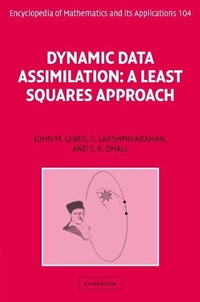
Dynamic Data Assimilation
A Least Squares Approach
Published on 3. August 2006
Book
Hardback
680 pages
978-0-521-85155-8 (ISBN)
Description
Dynamic data assimilation is the assessment, combination and synthesis of observational data, scientific laws and mathematical models to determine the state of a complex physical system, for instance as a preliminary step in making predictions about the system's behaviour. The topic has assumed increasing importance in fields such as numerical weather prediction where conscientious efforts are being made to extend the term of reliable weather forecasts beyond the few days that are presently feasible. This book is designed to be a basic one-stop reference for graduate students and researchers. It is based on graduate courses taught over a decade to mathematicians, scientists, and engineers, and its modular structure accommodates the various audience requirements. Thus Part I is a broad introduction to the history, development and philosophy of data assimilation, illustrated by examples; Part II considers the classical, static approaches, both linear and nonlinear; and Part III describes computational techniques. Parts IV to VII are concerned with how statistical and dynamic ideas can be incorporated into the classical framework. Key themes covered here include estimation theory, stochastic and dynamic models, and sequential filtering. The final part addresses the predictability of dynamical systems. Chapters end with a section that provides pointers to the literature, and a set of exercises with instructive hints.
Reviews / Votes
"I find a lot of detail that the readers will appreciate, and I like the way the book is structured -- from 'simple' estimation methods to the Kalman filter and variational methods."Professor Martin Ehrendorfer, University of Vienna "This book on data assimilation covers essentially all that we know about state estimation for dynamically evolving systems -- a grand effort on a much-needed textbook."
Professor Tomi Vukicevic, Colorado State University "I think the book will be very useful, giving derivations of key results at a level that my staff will find appropriate."
Dr. Andrew Lorenc, Head, Data Assimilation Section, British Meteorological Office "It was enjoyable to see so many ideas so nicely set out -- a treasure and wonderful resource for students."
Dr. James Purser, Research Meteorologist, National Center for Environmental Prediction, USA "... The book is pleasant to read... The book is of interest to meteorologists, geologists, and other geoscientists, but also to statisticians and applied mathematicians."
Stephan Morgenthaler, Mathematical Reviews "This book provides readers with a good mathematical framework for data assimilation, with all important proofs and deviations. I recommend this book for data assimilation system developers and colleagues who work with data assimilation research and applications." - Ziang-Yu Huang, Bulletin of the American Meteorological Society
More details
Series
Language
English
Place of publication
Cambridge
United Kingdom
Target group
Professional and scholarly
Illustrations
Worked examples or Exercises; 29 Tables, unspecified
Dimensions
Height: 235 mm
Width: 157 mm
Thickness: 44 mm
Weight
1238 gr
ISBN-13
978-0-521-85155-8 (9780521851558)
Copyright in bibliographic data and cover images is held by Nielsen Book Services Limited or by the publishers or by their respective licensors: all rights reserved.
Schweitzer Classification
Other editions
Additional editions
John M. Lewis | S. Lakshmivarahan | Sudarshan Dhall
Dynamic Data Assimilation
A Least Squares Approach
E-Book
01/2011
Cambridge University Press
€175.99
Available for download
Persons
John M. Lewis is a Research Scientist at the National Severe Storms Laboratory in Oklahoma, and the Desert Research Institute in Nevada. S. Lakshmivarahan is a George Lynn Cross Research Professor at the School of Computer Science, University of Oklahoma. Sudarshan K. Dhall is a Professor at the School of Computer Science, University of Oklahoma.
Content
1. Synopsis; 2. Pathways into data assimilation: illustrative examples; 3. Applications; 4. Brief history of data assimilation; 5. Linear least squares estimation: method of normal equations; 6. A geometric view: projection and invariance; 7. Nonlinear least squares estimation; 8. Recursive least squares estimation; 9. Matrix methods; 10. Optimisation: steepest descent method; 11. Conjugate direction/gradient methods; 12. Newton and quasi-Newton methods; 13. Principles of statistical estimation; 14. Statistical least squares estimation; 15. Maximum likelihood method; 16. Bayesian estimation method; 17. From Gauss to Kalman: sequential, linear minimum variance estimation; 18. Data assimilation-static models: concepts and formulation; 19. Classical algorithms for data assimilation; 20. 3DVAR - a Bayesian formulation; 21. Spatial digital filters; 22. Dynamical data assimilation: the straight line problem; 23. First-order adjoint method: linear dynamics; 24. First-order adjoint method: nonlinear dynamics; 25. Second-order adjoint method; 26. The ADVAR problem: a statistical and a recursive view; 27. Linear filtering - Part I: Kalman filter; 28. Linear filtering-part II; 29. Nonlinear filtering; 30. Reduced rank filters; 31. Predictability: a stochastic view; 32. Predictability: a deterministic view; Bibliography; Index.