

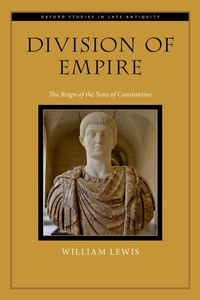
Division of Empire
The Reign of the Sons of Constantine
Published on 23. December 2024
Book
Hardback
240 pages
978-0-19-774514-4 (ISBN)
Description
Constantine the Great died on May 22nd in 337 AD, leaving behind three sons--Constantine II, Constantius II, and Constans--to face the challenge of how to rule the Roman Empire. Division of Empire follows the lives of these brothers, beginning with the death of their father, and traces how they first shared the empire as a triarchy, until one by one the heirs of Constantine fell to the sword. Constantine II was killed by his brother Constans in the civil war of 340, and Constans was murdered by a usurper in 350. Constantius was the last man standing of Constantine's sons, and he reunified the empire under the rule of a sole Augustus, like his father. However, the cracks were already starting to show, and his efforts at reunification would soon prove to be a failure.
It is well known that the Roman Empire came to be divided into eastern and western halves in 395, but what is less known is that this was the culmination of a series of smaller fractures, divisions, and then attempts at reunifications that stretched across the fourth century. Division was a process, rather than a singular event, and it is a process that has, until now, received little scholarly attention. William Lewis uses this story of family massacres, civil wars, assassinations, usurpations, and desperate armed struggles for power as a case study for division and an original reappraisal of politics in the mid-fourth century.
It is well known that the Roman Empire came to be divided into eastern and western halves in 395, but what is less known is that this was the culmination of a series of smaller fractures, divisions, and then attempts at reunifications that stretched across the fourth century. Division was a process, rather than a singular event, and it is a process that has, until now, received little scholarly attention. William Lewis uses this story of family massacres, civil wars, assassinations, usurpations, and desperate armed struggles for power as a case study for division and an original reappraisal of politics in the mid-fourth century.
Reviews / Votes
The book is superbly organized, with clear signposting in its introductions and cross-referencing in its body paragraphs. * Jeremy Swist, CJ-Online Review * Lewis's new narrative, interwoven with numismatics, panegyric, and prosopography, is compelling.... Recommended. * CHOICE *More details
Series
Language
English
Place of publication
New York
United States
Product notice
sewn/stitched
Cloth over boards
Dimensions
Height: 226 mm
Width: 152 mm
Thickness: 25 mm
Weight
454 gr
ISBN-13
978-0-19-774514-4 (9780197745144)
Copyright in bibliographic data and cover images is held by Nielsen Book Services Limited or by the publishers or by their respective licensors: all rights reserved.
Schweitzer Classification
Other editions
Additional editions
E-Book
09/2024
OUP eBook
€85.99
Available for download
E-Book
09/2024
OUP eBook
€85.99
Available for download
Person
William Lewis is a field archaeologist with Cotswold Archaeology. His research interests are focused on political structures and civil conflict in the fourth century.
Content
List of Abbreviations
Chapter 1: Introduction: Partes Regendae
Chapter 2: Constantius, Divider of Empires?
Chapter 3: The Constantinian Triarchy
Chapter 4: The Civil War of AD 340
Chapter 5: Ulpius Limenius and the West
Chapter 6: Fabius Titianus and the Urban Prefecture of Rome
Chapter 7: Constantius' Failure and the End of Unity
Chapter 8: Conclusion: Division of Empire
Bibliography
Chapter 1: Introduction: Partes Regendae
Chapter 2: Constantius, Divider of Empires?
Chapter 3: The Constantinian Triarchy
Chapter 4: The Civil War of AD 340
Chapter 5: Ulpius Limenius and the West
Chapter 6: Fabius Titianus and the Urban Prefecture of Rome
Chapter 7: Constantius' Failure and the End of Unity
Chapter 8: Conclusion: Division of Empire
Bibliography