

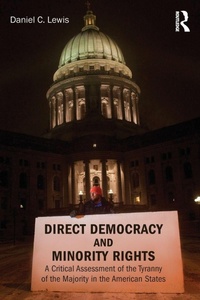
Direct Democracy and Minority Rights
A Critical Assessment of the Tyranny of the Majority in the American States
1st Edition
Published on 14. November 2012
Book
Paperback/Softback
117 pages
978-0-415-53744-5 (ISBN)
Description
This book conclusively demonstrates that direct democracy-institutions like the ballot initiative and the referendum-endangers the rights of minorities and perpetuates a tyranny of the majority. While advocates of direct democracy advocate that these institutions protect citizens from corrupt lawmakers beholden to special interests, Daniel Lewis's thorough investigation shows how such mass participation exposes minority groups to negative policy outcomes favored by only a slim majority of voters. Some would argue that greater democratic responsiveness is a positive outcome, but without the checks and balances of a representative, separated powers system that encourages deliberation and minority representation, minority rights are at increased risk under direct democracy institutions.
While research has been presented that supports both sides of the debate, the existing literature has yet to produce consistent and compelling evidence in favor of one side or the other. This book undertakes a comprehensive examination of the "tyranny of the majority" critique of direct democracy by examining a host of contemporary American state policies that affect the rights of a variety of minority groups. By assessing the impact of direct democracy on both ballot measures and traditional legislation, the book provides a more complete picture of how citizen legislative institutions can affect minority rights, covering a myriad of contemporary (and sometimes controversial) minority rights issues, including same-sex marriage, affirmative action, official English, hate crimes laws, racial profiling, and anti-discrimination laws.
The book is unique in its approach and scope, making it compelling for scholars interested in direct democracy, state politics, minority politics and electoral institutions, as well as American politics generally.
While research has been presented that supports both sides of the debate, the existing literature has yet to produce consistent and compelling evidence in favor of one side or the other. This book undertakes a comprehensive examination of the "tyranny of the majority" critique of direct democracy by examining a host of contemporary American state policies that affect the rights of a variety of minority groups. By assessing the impact of direct democracy on both ballot measures and traditional legislation, the book provides a more complete picture of how citizen legislative institutions can affect minority rights, covering a myriad of contemporary (and sometimes controversial) minority rights issues, including same-sex marriage, affirmative action, official English, hate crimes laws, racial profiling, and anti-discrimination laws.
The book is unique in its approach and scope, making it compelling for scholars interested in direct democracy, state politics, minority politics and electoral institutions, as well as American politics generally.
Reviews / Votes
"Examining a range of controversial public policies in the American states, Daniel Lewis' exceptionally accessible book takes on the thorny question of whether ballot measures undermine the rights of minorities. His empirical findings, which should be of interest scholars and practitioners alike, suggest that when rights are contingent on majority preferences, minorities are indeed at risk."-Daniel A. Smith, University of Florida
"This study makes a careful and multi-faceted empirical investigation into the important question of whether direct democracy threatens the rights of political minorities. Focusing on some of the most significant minority-rights issues of the day, Lewis uncovers a complex dynamic in which political institutions and public opinion interact to shape how states choose to protect (and not protect) their political minorities. This study provides the most nuanced understanding to date of this timely political issue."
-Elisabeth Gerber, University of Michigan
"Lewis' analysis is careful, nuanced, and compelling. He presents the strongest evidence to date that the citizen initiative undermines representative democracy and endangers the rights of political minorities."
-Justin Phillips, Columbia University
More details
Series
Language
English
Place of publication
London
United Kingdom
Publishing group
Taylor & Francis Ltd
Target group
College/higher education
Product notice
Paperback (trade)
Unsewn / adhesive bound
Illustrations
23 s/w Tabellen
23 Tables, black and white
Dimensions
Height: 229 mm
Width: 152 mm
Thickness: 7 mm
Weight
191 gr
ISBN-13
978-0-415-53744-5 (9780415537445)
Copyright in bibliographic data and cover images is held by Nielsen Book Services Limited or by the publishers or by their respective licensors: all rights reserved.
Schweitzer Classification
Other editions
Additional editions
Daniel Lewis
Direct Democracy and Minority Rights
A Critical Assessment of the Tyranny of the Majority in the American States
E-Book
01/2013
1st Edition
Routledge
€64.49
Available for download
Daniel Lewis
Direct Democracy and Minority Rights
A Critical Assessment of the Tyranny of the Majority in the American States
E-Book
01/2013
1st Edition
Routledge
€64.49
Available for download
Daniel Lewis
Direct Democracy and Minority Rights
A Critical Assessment of the Tyranny of the Majority in the American States
Book
11/2012
1st Edition
Routledge
€193.50
Shipment within 15-20 days
Person
Daniel C. Lewis is an Assistant Professor of Political Science at Siena College. His research examines state political institutions and public policy. His work on direct democracy, legislative term limits, policy diffusion, LGBT politics and federalism has been published in a number of leading political science journals.
Content
1. Direct Democracy Institutions & the Threat of Tyranny 2. Direct Democracy & the Diffusion of Anti-Minority Policies 3. A Representational Filter? The Passage of Anti-Minority Policy Proposals 4. The Flip Side; Direct Democracy & Pro-Minority Policies 5. Conclusion