

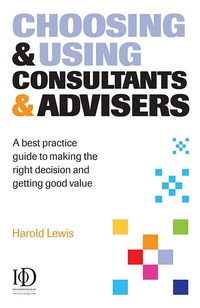
Choosing and Using Consultants & Advisers
Description
This book is perfect for anyone who needs to use contractors, consultants or other professional advisers, whatever their business. Acknowledged expert Harold Lewis uses his experience on both sides of the business relationship and explains the whole process. The first book to deal with this subject so comprehensively, Using and Choosing Consultants & Advisers....
gives best practice advie that can immediately be put into effect;
doesn't take sides on client-consultancy issues but offers a balanced view;
helps clients get into the mind of consultants, showing them how consultancy works from the inside;
is addressed to businesses/non-commercial groups as well as individuals.
The valuable advice it contains will be useful not just for new businesses, but also for established firms seeking to strengthen and extend their contracting skills. Written in a crisp, accessible and businesslike style, the book contains numerous examples and checklists as well as case studies of good and bad practice. This book will help you avoid mistakes and pitfalls, save time, money and effort, and make the process of working with consultants really worthwhile.
Reviews / Votes
"Owner managers and business advisers should read this." - Business Adviser "User-friendly... would recommend it to anyone involved with commissioning consultants." - Supply Management "Worry no more, help is at hand... a wealth of information and advice not generally available." - Liverpool Daily Post"More details
Other editions
Previous edition
Person
Content
<b>1 Why would I want to use consultants? 1</b>
This is what clients say 1; Consultants and employees 5;
What are the alternatives to an external consultant? 7;
Starting the relationship 10; When not to use consultants 11;
Bringing people onside 12; Making a business case 13
<b>2 How do consultants operate? 15</b>
Profile of the consultancy sector 15; Professional credentials:
what's in a name? 20; Quality accreditation: what's it
worth? 21; Professional indemnity insurance 23; Consultants
and relationship management: what you need to know 24
<b>3 What do consultants charge? 27</b>
Basis of charges: a range of options 27; Fee levels 31; How
fees are calculated 33; How time is charged 36; How expenses
are dealt with 37; Will I have to pay money up front? 38; The
hidden costs of consultancy 39; Counting the benefits 40
<b>4 How should I specify the job to be done? 43</b>
Preparing a work specification 44; Defining your
objectives 46; Drawing up the scope and content 46; Gauging
the practical demands of the work 49; Setting a timetable
50; Identifying the right form of engagement 51; Confirming
your budget 51; Determining your inputs 53; Deciding
what is really important 54; Assessing and controlling
risks 55; Putting the work specification on paper 60; Moving
ahead to selection 66
<b>5 How do I select the right people? 69</b>
Taking up references 72; Follow-up meeting 74; Seeking
more information 77; Going out to tender 82; Inviting
proposals 84; Reaching a decision 102
<b>6 What should I know about engaging consultants? 125</b>
Agreements and contracts 125; Types of contract 130;
Drawing up a contract 138; Guidelines to steer you clear of
problems 144
<b>7 How do I keep track of the work? 161</b>
Before the work starts 161; Once the work is under
way 162; Monitoring performance and progress 165; Why do
things go wrong? 171; What can you do to put matters
right? 174; Handling contract variations 178; When the
assignment is completed 183
<b>8 How does the public sector go about procurement? 187</b>
Procurement rules and regulations 188; The procurement
process 190; Best value and partnering 201
<b>9 How can I get the best value from consultants? 203</b>
Securing added value 204; Creating a collaborative
business relationship 206