

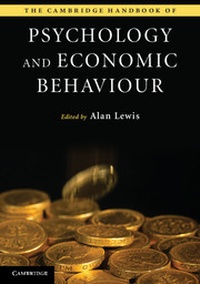
The Cambridge Handbook of Psychology and Economic Behaviour
Published on 12. April 2012
Book
Paperback/Softback
586 pages
978-1-107-65415-0 (ISBN)
Description
Psychologists have been observing and interpreting economic behaviour for at least fifty years, and the last decade, in particular, has seen an escalated interest in the interface between psychology and economics. The Cambridge Handbook of Psychology and Economic Behaviour is a valuable reference resource dedicated to improving our understanding of the economic mind and economic behaviour. Employing empirical methods - including laboratory experiments, field experiments, observations, questionnaires and interviews - the Handbook covers aspects of theory and method, financial and consumer behaviour, the environment and biological perspectives. With contributions from distinguished scholars from a variety of countries and backgrounds, the Handbook is an important step forward in the improvement of communications between the disciplines of psychology and economics. It will appeal to academic researchers and graduates in economic psychology and behavioural economics.
Reviews / Votes
Review of the hardback: 'The Cambridge Handbook of Psychology and Economic Behaviour is an important step towards breaking down the last barriers between economics and psychology. Lewis has compiled an interesting and easy to read overview of the field. ... I can recommend it to anyone who is interested in the science of economic behavior.' Journal of Social EconomicsMore details
Series
Language
English
Place of publication
Cambridge
United Kingdom
Target group
Professional and scholarly
College/higher education
Product notice
Paperback (trade)
Illustrations
18 Tables, black and white; 2 Halftones, unspecified; 13 Halftones, color; 17 Line drawings, unspecified
Dimensions
Height: 247 mm
Width: 170 mm
Thickness: 29 mm
Weight
1160 gr
ISBN-13
978-1-107-65415-0 (9781107654150)
Copyright in bibliographic data and cover images is held by Nielsen Book Services Limited or by the publishers or by their respective licensors: all rights reserved.
Schweitzer Classification
Other editions
New editions
Book
02/2018
2nd Edition
Cambridge University Press
€76.00
Article not available at the moment
Person
Alan Lewis is Professor of Economic Psychology in the Department of Psychology at the University of Bath. He is a former editor of the Journal of Economic Psychology and his books include Morals, Markets and Money: Ethical, Green and Socially Responsible Investing (2002) and The New Economic Mind: The Social Psychology of Economic Behaviour (with Paul Webley and Adrian Furnham, 1995).
Content
Part I. Introduction, Theory and Method: 1. Introduction Alan Lewis; 2. Theory and method in economics and psychology Denis Hilton; Part II. Finance: 3. The economic psychology of the stock market Karl-Erik Waerneryd; 4. Stock prices: insights from behavioural finance Werner F. M. De Bondt; 5. Inter-temporal choice and self-control: saving and borrowing Paul Webley and Ellen K. Nyhus; 6. Financial decisions in the household Carole Burgoyne and Erich Kirchler; 7. Corporate social responsibility: the case of long term and responsible investment Danyelle Guyatt; Part III. Consumer Behaviour in the Private Sector: 8. Consumption and identity Russell Belk; 9. Wealth, consumption and happiness Aaron Ahuvia; 10. Comparing models of consumer behaviour Gerrit Antonides; Part IV. Consumer Behaviour in the Public Sector: 11. Lay perceptions of government economic activity Simon Kemp; 12. How big should government be? John G. Cullis and Philip R. Jones; 13. Integrating explanations of tax evasion and avoidance Valerie Braithwaite and Michael Wenzel; Part V. Environment: 14. Sustainable consumption and lifestyle change Tim Jackson; 15. Environmentally significant behaviour in the home Paul C. Stern; 16. Economic and psychological determinants of car ownership and use Tommy Gaerling and Peter Loukopoulos; 17. Environmental morale and motivation Bruno S. Frey and Alois Stutzer; 18. Contingent valuation as a research method: environmental values and human behaviour Clive L. Spash; Part VI. Biological Perspectives: 19. Neuroeconomics: what neuroscience can learn from economics Terry Lohrenz and P. Read Montague; 20. Evolutionary economics and psychology Ulrich Witt; 21. Evolutionary psychology and economic psychology Stephen E. G. Lea.